Calendrier et rythme d'alternance

Dans le cadre des formations d'ingénieurs par alternance en 3 ans : systèmes embarqués et conception mécanique (options architecture navale et systèmes pyrotechniques), les séquences professionnelles et séquences académiques s'étendent sur plusieurs semaines. Ces séquences longues, vous permettent en entreprise d'être affecté sur des affaires importantes et, à l'école, de pouvoir vous concentrer sur l'apprentissage de nouvelles compétences.

Les séquences académiques servent à l’acquisition et au perfectionnement des connaissances fondamentales : apprentissage des sciences et techniques de l’ingénieur (concepts, principes et méthodes), pour les domaines purement techniques et pour ceux relatifs à l’intégration dans l’entreprise et à l’exercice des responsabilités.

Les séquences professionnelles sont l'occasion de mises en situation de résolution de problèmes opérationnels réels. Elles permettent la validation des concepts, principes et méthodes enseignées en séquences académiques et favorisent l'analyse critique de ceux-ci.

Le fait d'être la moitié du temps en entreprise, d'alterner théorie et pratique, nous apporte beaucoup. Nous sommes  plus rapidement opérationnels, cela représente un atout pour l'entreprise qui nous recrutera. 

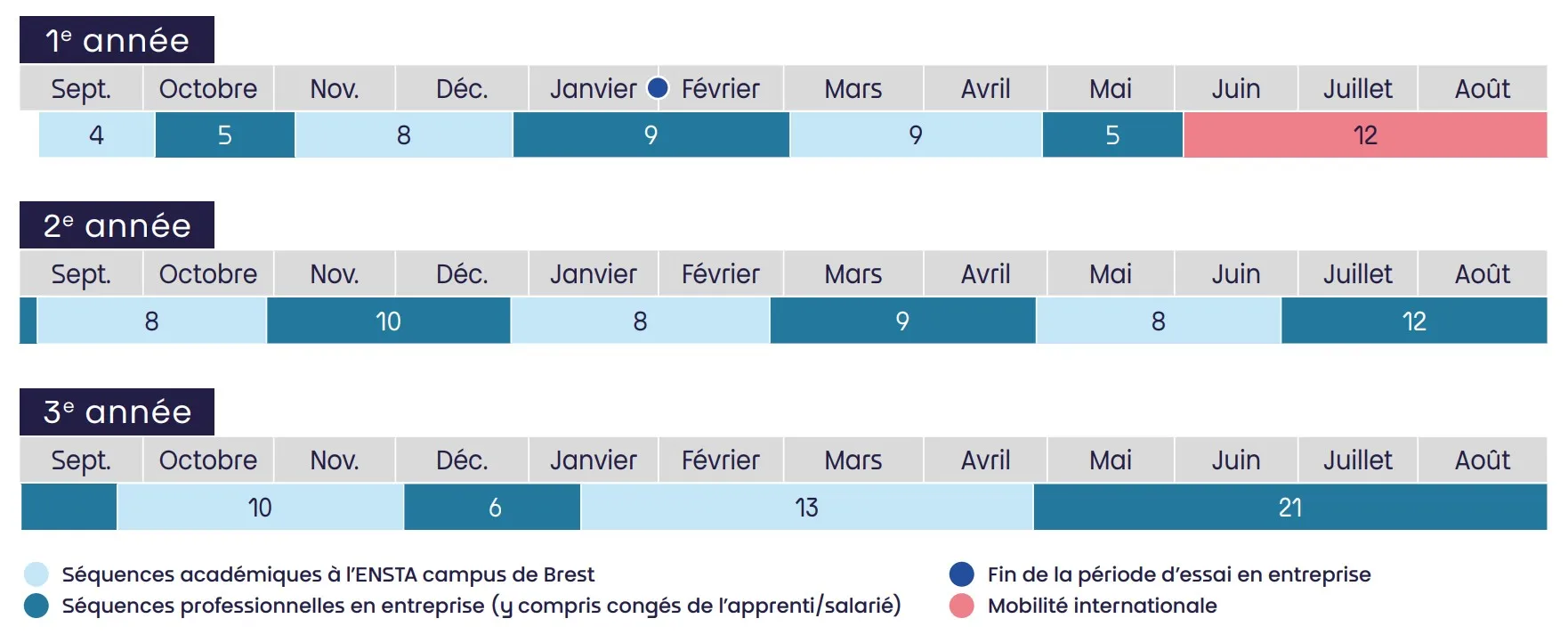
Calendrier d'alternance sur 3 ans

Les séquences en entreprise et à l'école sont d'environ 2 mois sauf la dernière année d'études ou les deux dernières séquences sont de 4 mois environ.

Our latest news

Alumni | Training | Research
A thesis on characterizing the strength of a submerged textile structure

Noise pollution generated during the installation of offshore wind turbines is attracting increasing attention. An engineer trained at ENSTA in the specialty of “mechanical modeling of materials and structures,” Jeanne Cavoit wrote her thesis on the...

A thesis on characterizing the strength of a submerged textile structure

Noise pollution generated during the installation of offshore wind turbines is attracting increasing attention. An engineer trained at ENSTA in the specialty of “mechanical modeling of materials and structures,” Jeanne Cavoit wrote her thesis on the...

Alumni | Innovation
DeepFoil: Two ENSTA Graduates Are Reinventing Underwater Exploration

Graduates in architecture and naval hydrodynamics, Emillia Perdigon and Paul François have designed the DeepFoil, a flying underwater wing that allows for effortless movement underwater. Fueled by public enthusiasm and investor support, their project is...

DeepFoil: Two ENSTA Graduates Are Reinventing Underwater Exploration

Graduates in architecture and naval hydrodynamics, Emillia Perdigon and Paul François have designed the DeepFoil, a flying underwater wing that allows for effortless movement underwater. Fueled by public enthusiasm and investor support, their project is...

Innovation | Research
Gabriel Betton: Exploring the karst networks

Beneath our feet, in the darkness of the underground, a natural network spanning more than a third of France’s territory supplies drinking water to nearly 30 million people. But the quality of this vast freshwater reservoir is threatened by climate change...

Gabriel Betton: Exploring the karst networks

Beneath our feet, in the darkness of the underground, a natural network spanning more than a third of France’s territory supplies drinking water to nearly 30 million people. But the quality of this vast freshwater reservoir is threatened by climate change...