Understanding our Education System

Since the 18th century, French "Grandes Écoles" have been training the leaders and senior executives of France's leading industrial companies. These institutions, which include ENSTA, are highly selective in their admissions. Small to medium in size, "Grandes Écoles" provide high-quality education and maintain close ties with the business world.

Graduates of France's “Grandes Écoles” enjoy a status similar to that of Oxbridge in the UK and Ivy League schools in the US. Naturally, they are highly sought after by many large companies around the world. There are around 250 different engineering schools in France. The most prestigious of these, such as ENSTA, are certified by the Commission des Titres d'Ingénieur (CTI). This body is responsible for accrediting French higher education institutions in the field of engineering.

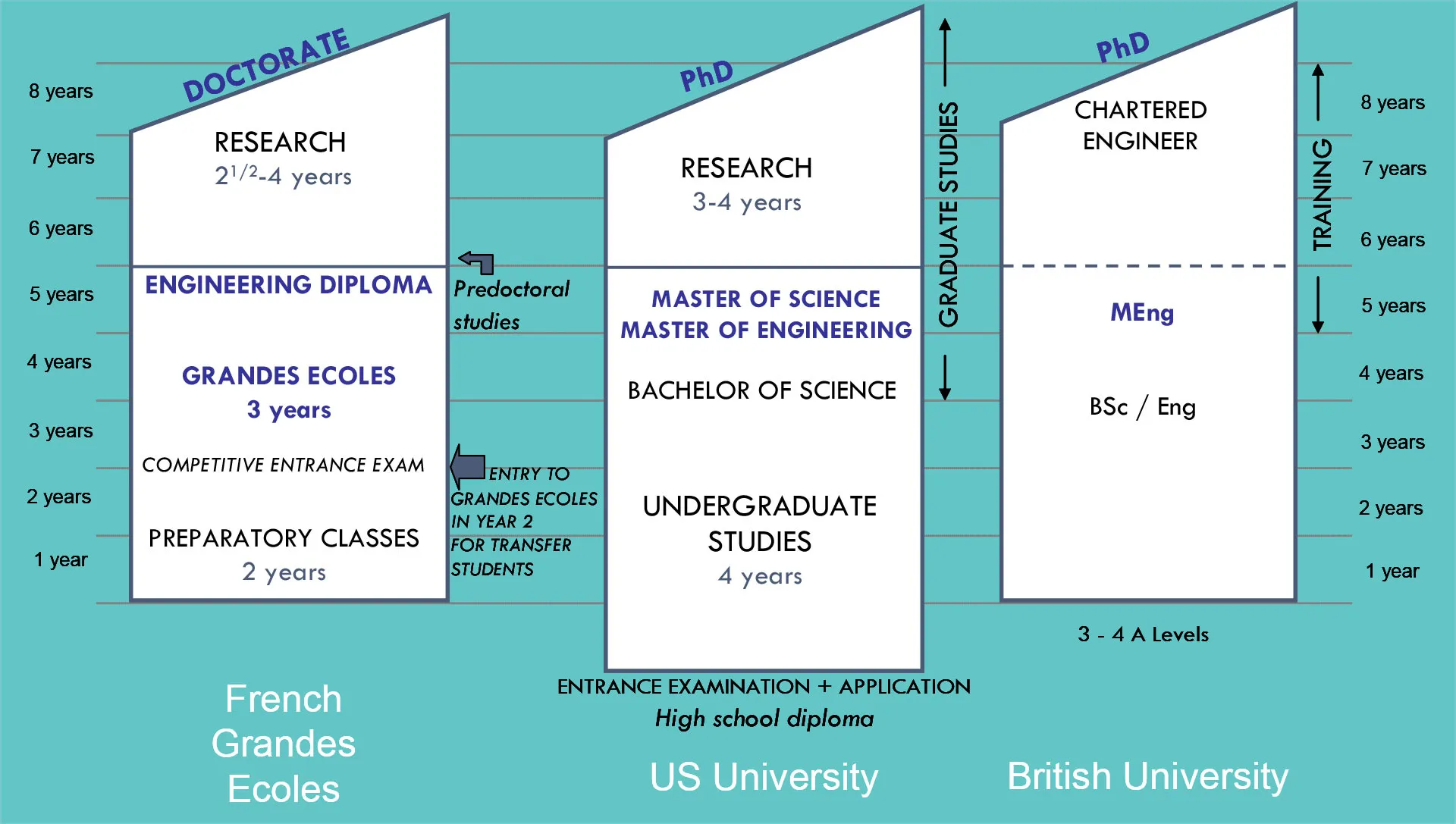
Equivalency table to understand the French education system of grandes écoles:

Illustration des différentes formations accessibles dans les grandes écoles, en les comparant à celles des États-Unis et de l'Angleterre.

Grading system

The French grading system is based on a scale of 20. Grades are awarded from 0 to 20, with “0” being the lowest grade.

Traditionally, grades above 16 are rarely awarded. The passing grade for a subject is generally 10/20, although grades of 8 or 9 may indicate satisfactory performance. The grading system in France is particularly demanding and can vary from one institution to another and from one course to another.

French grading systemLetter equivalentGrade GPA
16-20A+4,3
14-15,9A4
12-13,9A-3,7
11-11,9B+3,3
10-10,9B3
8-8,9C2
6-7,9D1
0-5,9F0

ECTS distribution system

The table below shows how ECTS credits are distributed on average at ENSTA, taking into account the positive results awarded in each field of study.

ECTS% of students who passedDefinition 
A20%Exceptional 
B30%Very goodAbove-average results, no significant errors
C30%GoodOverall satisfactory work, contains errors
D15%SatisfactoryAdequate: passable results, some shortcomings
E5%SufficientThe work meets basic requirements
FX FailAdditional work required before credit can be awarded
F ÉchecConsiderable work is required; implies repeating the course

Our latest news

Alumni | Innovation
DeepFoil: Two ENSTA Graduates Are Reinventing Underwater Exploration

Graduates in architecture and naval hydrodynamics, Emillia Perdigon and Paul François have designed the DeepFoil, a flying underwater wing that allows for effortless movement underwater. Fueled by public enthusiasm and investor support, their project is...

DeepFoil: Two ENSTA Graduates Are Reinventing Underwater Exploration

Graduates in architecture and naval hydrodynamics, Emillia Perdigon and Paul François have designed the DeepFoil, a flying underwater wing that allows for effortless movement underwater. Fueled by public enthusiasm and investor support, their project is...

Innovation | Research
Gabriel Betton: Exploring the karst networks

Beneath our feet, in the darkness of the underground, a natural network spanning more than a third of France’s territory supplies drinking water to nearly 30 million people. But the quality of this vast freshwater reservoir is threatened by climate change...

Gabriel Betton: Exploring the karst networks

Beneath our feet, in the darkness of the underground, a natural network spanning more than a third of France’s territory supplies drinking water to nearly 30 million people. But the quality of this vast freshwater reservoir is threatened by climate change...

Training | Innovation | Student Life
An ENSTA team wins the Energy4Climate 2026 Challenge

How can we best promote renewable energy production in France? That was the question posed by the 6th edition of the Energy4Climate – Agorize Challenge, to which a team of ENSTA students provided an answer that was both innovative and well-reasoned.

An ENSTA team wins the Energy4Climate 2026 Challenge

How can we best promote renewable energy production in France? That was the question posed by the 6th edition of the Energy4Climate – Agorize Challenge, to which a team of ENSTA students provided an answer that was both innovative and well-reasoned.