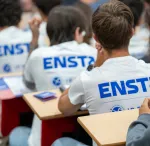
Each year, ENSTA welcomes several hundred doctoral students to its two campuses, enabling them to pursue their research at the highest scientific level in a variety of exciting and innovative fields of innovation.

Why pursue a thesis at ENSTA?

Internationally recognized as a mark of excellence and a sign of a very high level of expertise, a Ph.D. opens the door to highly skilled positions in both the public and private sectors. In addition to providing access to the academic world, it opens up major long-term career opportunities based on the specific skills acquired during the doctoral program, which are widely recognized in the socio-economic sphere for highly skilled positions.

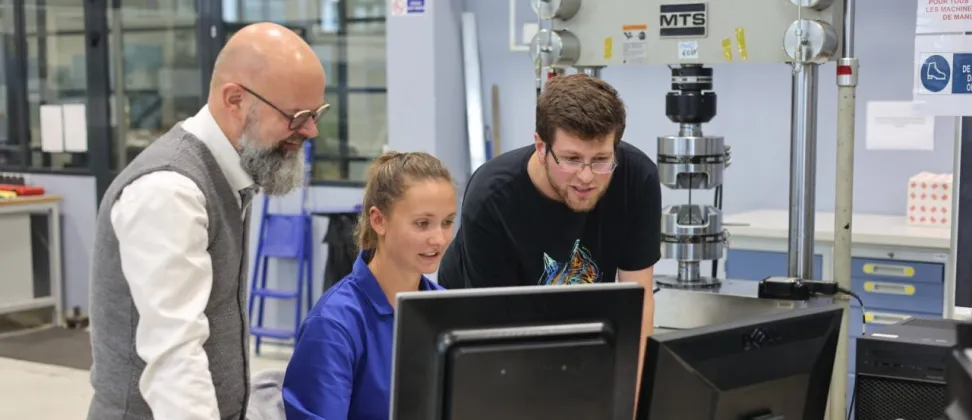
Within the ENSTA laboratories, doctoral students work in a cutting-edge research and innovation ecosystem. With close ties to industry (many CIFRE theses), they become part of a large, internationally recognized research community.

Key figures

300
PhD students
11
academic laboratories
27
industrial chairs and joint laboratories
Over 200
lecturers and research professors

What is a doctoral dissertation?

Available to those who have earned an MSc in Engineering, a master’s degree, or an equivalent qualification, the doctorate is a national degree awarded by an accredited institution of higher education in recognition of the research conducted by a doctoral student as part of a dissertation.

This research is generally conducted in a research laboratory at the institution (or partially in a company under CIFRE agreements), is supervised by one or more thesis advisors, and typically lasts three years. Doctoral students enroll in doctoral schools that support them throughout their research-based training. The doctorate is an internationally recognized degree.

Doctoral Schools

The doctoral schools affiliated with ENSTA are:

In the field of Humanities and Social Sciences, ENSTA doctoral students, in association with the FoAP laboratory, are affiliated with the Abbé Grégoire Doctoral School at CNAM Paris.

Read more

Our latest news

Alumni | Innovation
DeepFoil: Two ENSTA Graduates Are Reinventing Underwater Exploration

Graduates in architecture and naval hydrodynamics, Emillia Perdigon and Paul François have designed the DeepFoil, a flying underwater wing that allows for effortless movement underwater. Fueled by public enthusiasm and investor support, their project is...

DeepFoil: Two ENSTA Graduates Are Reinventing Underwater Exploration

Graduates in architecture and naval hydrodynamics, Emillia Perdigon and Paul François have designed the DeepFoil, a flying underwater wing that allows for effortless movement underwater. Fueled by public enthusiasm and investor support, their project is...

Innovation | Research
Gabriel Betton: Exploring the karst networks

Beneath our feet, in the darkness of the underground, a natural network spanning more than a third of France’s territory supplies drinking water to nearly 30 million people. But the quality of this vast freshwater reservoir is threatened by climate change...

Gabriel Betton: Exploring the karst networks

Beneath our feet, in the darkness of the underground, a natural network spanning more than a third of France’s territory supplies drinking water to nearly 30 million people. But the quality of this vast freshwater reservoir is threatened by climate change...

Training | Innovation | Student Life
An ENSTA team wins the Energy4Climate 2026 Challenge

How can we best promote renewable energy production in France? That was the question posed by the 6th edition of the Energy4Climate – Agorize Challenge, to which a team of ENSTA students provided an answer that was both innovative and well-reasoned.

An ENSTA team wins the Energy4Climate 2026 Challenge

How can we best promote renewable energy production in France? That was the question posed by the 6th edition of the Energy4Climate – Agorize Challenge, to which a team of ENSTA students provided an answer that was both innovative and well-reasoned.