The ENSTA/ISAE-Supaero Defense & Security engineering program offers you the opportunity to join a unique world where cutting-edge technology, disruptive innovation, and strategic challenges come together. This multidisciplinary, high-level program trains students in the engineering of large systems in the cyber, AI, naval, land, aeronautics, and space domains. Engineers who qualify will work in the defense industry and for the DGA (French Defense Procurement Agency), whether civilians or military personnel (from the IETA corps), and be capable of designing, developing, and managing the most complex and innovative systems.
A unique program in France combining engineering, sovereignty, and innovation
Since their creation, ENSTA and ISAE-SUPAERO have been dedicated to training high-level civilian and military engineers capable of meeting both the strategic needs of the armed forces and the major technological challenges of civil society.
Key points
A multidisciplinary and demanding program offering a “systems” approach
The degree is awarded jointly by ENSTA and ISAE-SUPAERO, two renowned engineering schools, on their three campuses (Brest, Paris-Saclay, and Toulouse)
All students come together in Brest for the first year of training, and the choice of campus is then made according to the option chosen
Three specialization options are offered, covering a wide range of fields of application: cyber & AI, naval & land, aeronautics & space.
There are two statuses and different career paths to choose from: military engineering student IETA (armament studies and techniques engineer - only for students of French nationality) or student (civilian).
Access to the vast network of graduates from both schools (> 45,000 engineers)
A stimulating living and learning environment on three different campuses
The possibility of completing the third year of the program on a work-study basis under an apprenticeship contract for civilian students
Beyond training as an engineer in defense and security engineering, the ENSTA/ISAE-SUPAERO engineering degree is a real gateway to a wide range of technical fields. It opens the doors to a demanding and innovative world, directly linked to the major French and European players in engineering, innovation, and research.
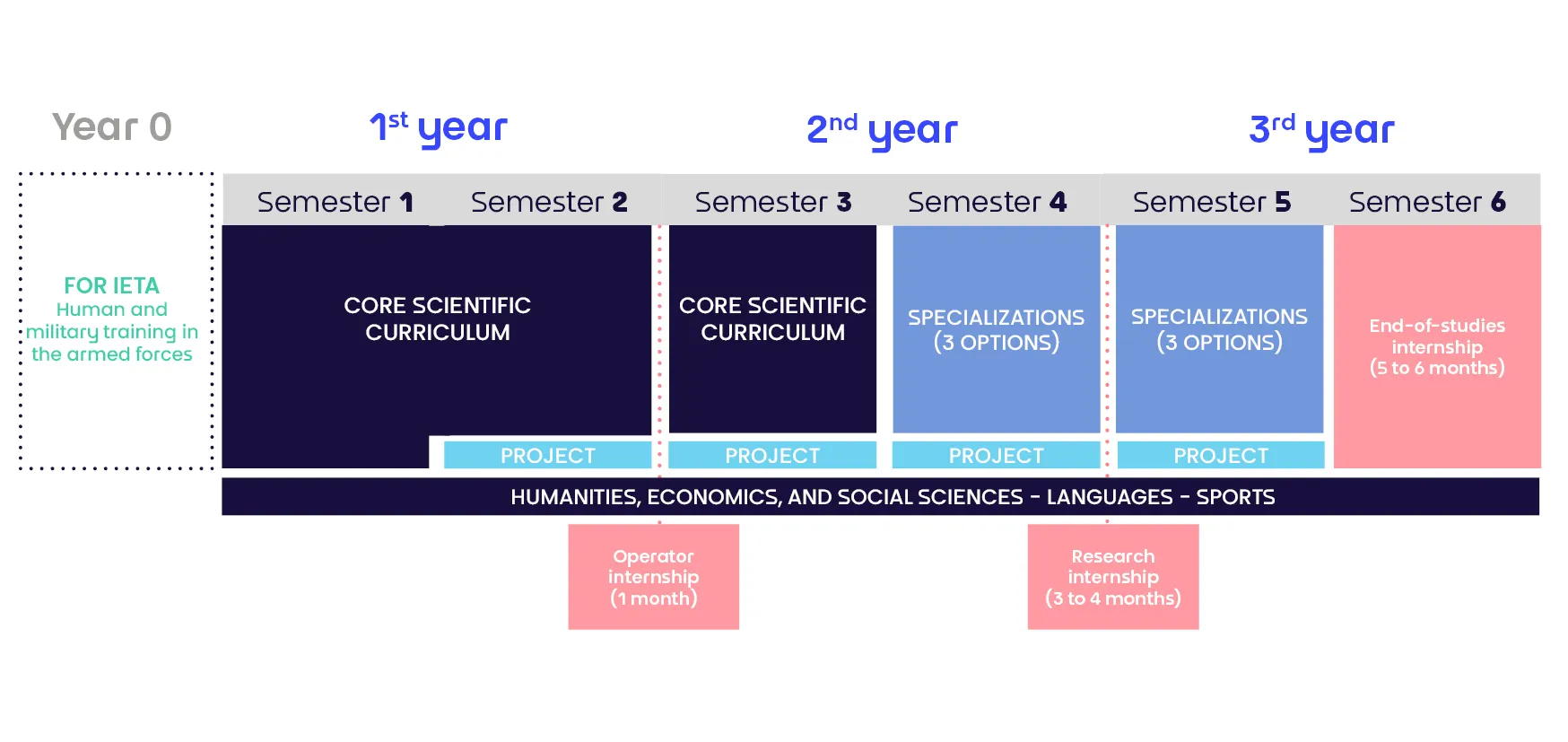
A comprehensive program spanning six semesters across three campuses
The first year of training takes place on the Brest campus. The aim is to train versatile engineers with solid scientific, technical, and managerial skills across a broad spectrum: mathematics, mechanics, digital technology, project management, communication, modern languages, and industrial challenges, particularly in the field of defense.
From the second year onwards, students join the campus specializing in their chosen option: naval/land systems in Brest, cyber and AI in Paris-Saclay, aeronautics and space in Toulouse.
Teaching formats are varied to facilitate learning, including numerous application projects.
Three internships punctuate the program, amounting to more than nine months in a professional environment, to gain skills and autonomy. The highlight is the final project in the sixth semester, culminating in a written thesis and a viva voce defense, evaluated on the campus where you completed your specialization.
A choice of three options
At the beginning of the second year, students join the campus that covers their chosen specialization. After a third semester of core courses, which are the same for all students across all curricula, semesters 4 and 5 are largely dedicated to specialization. Here again, the courses are multidisciplinary in order to cover the overall design of systems and all their components, both mechanical and digital. The courses are taught by the teaching and research teams of both schools, with contributions from industry experts and the DGA.
Students must complete a minimum of 16 weeks of international mobility through internships, a semester abroad, or even a dual degree program (for civilian students).
Engineers who graduate from this program are valued for their ability to design, develop, and operate the most complex systems.
Career opportunities for IETA and civil engineers are extensive and include:
the Ministry of the Armed Forces: Military (IETA) and civil engineers constitute the expertise and innovation force spread across the many centers that form the DGA (Directorate General of Armament), including the AID (Defense Innovation Agency), the SHOM (Naval Hydrographic and Oceanographic Service), support services, and more.
the 4,000 defense companies (200,000 jobs) that form a strategic group known as the BITD (Defense Industrial and Technological Base). The BITD brings together cutting-edge companies of all sizes, large companies, SMEs, and mid-sized companies, with military or dual (civilian and military) activities, including nine major European groups that are partners in training: Airbus, ArianeGroup, Arquus, Dassault, MBDA, Naval Group, KNDS (which comprises Nexter and KMW), Safran, and Thales.
and all industrial sectors of civil society that design and manufacture critical, high-performance systems, in which ENSTA and ISAE-SUPAERO alumni are well represented: from cybersecurity to aerospace, transport and mobility, maritime, energy, digital, robotics and health engineering.
Target sectors of activity
Defense
Automotive industry
Shipbuilding industry
Aeronautics and space
Robotics
Information systems
Engineering and consulting firms
Types of jobs
Design engineer
Development engineer
Test engineer, calculation
Expertise manager
Program or batch (subprogram) engineer
IT security engineer
Quality engineer
Project manager
Find career prospects on the pages dedicated to the three options
Admission for High-Level Athletes or Artists (SAHN)
A specific admission process is open to candidates who qualify as High-Level Athletes or Artists (SAHN). It aims to offer an admission process tailored to specific academic and personal profiles, with a view to promoting equal opportunities and diversity.
proof of SAHN status (according to the indicative list provided),
a letter of support or recommendation from a representative of the activity,
a cover letter,
transcripts from high school and post-high school studies, serving as proof of enrollment in CPGE, university degree, or equivalent.
Any incomplete applications or those submitted after the deadline will not be considered. Candidates will be pre-selected on the basis of their academic record and after validation of their sporting and artistic record.
Tuition rates for European Union Citizens:Tuition rates for non-European Union nationals:
Tuition: 2,936 €/year
Exemption for CROUS scholarship recipients
Exemption for IETA students (military status)
Tuition rates for non-European Union Citizens:
Registration and tuition fees: 5,034 €/year
* The amount of tuition is set by decree (to be published shortly)
Course of study available under civilian or IETA status (military: only for candidates of French nationality)
The curricula are designed to train defense and industry engineers, both civilian and military. The choice between these two statuses and career paths is offered to you at the start of the training, when you submit your training preferences on the competition website:
student status. These (civilian) engineers work in all innovative sectors of industry and public bodies, in particular the DGA.
IETA status: armament design and technical engineer. This is a dual commitment: engineer and military. Within the DGA, these engineers serve their country's defense apparatus and the armed forces by designing and implementing the most innovative programs. From the start of their training, IETA students are under contract and paid by the DGA. The engineering training is preceded by a year (“0”) of immersion in the armed forces.
Nous avons développé ce site internet dans le cadre d’une démarche forte
d’écoconception.
Si vous aussi, vous souhaitez diminuer drastiquement les besoins
énergétiques nécessaires à votre navigation, vous pouvez le parcourir
dans son Mode Eco. Celui-ci sollicitera très peu nos serveurs et vous
deviendrez ainsi un acteur majeur de l’écoconception.