Metal recycling: towards greener and more efficient methods

Research Marine Engineering

With nearly 7% of global CO₂ emissions linked to the metallurgy industry, metal recycling is clearly essential to reducing the sector's footprint. But how can metal waste be transformed into high-performance materials capable of meeting the needs of the most demanding industries? The THERMOS project, initiated by a professor and researcher at ENSTA, is exploring innovative ways to meet this challenge.

The challenges of metal recycling: quality and decarbonization

Metal recycling today is mainly based on remelting, a process that involves melting different types of waste (car bodies, packaging, household appliances, etc.) together at high temperatures. While this method can handle large volumes of waste, it has one major limitation: the alloys are mixed with impurities that cannot be completely removed. This leads to a deterioration in the properties of the recycled materials, particularly their formability and mechanical performance in service.

As a result, the use of these materials is currently limited to non-structural applications, which limits the economic value of recycling and its potential to reduce the extraction of primary resources and greenhouse gas emissions, even as demand for steel and aluminum continues to grow.

THERMOS: innovative strategies for solid-state recycling

Led by Bruno Levieil, professor and researcher at ENSTA / Institut de Recherche Dupuy de Lôme, the THERMOS project is part of this dynamic.

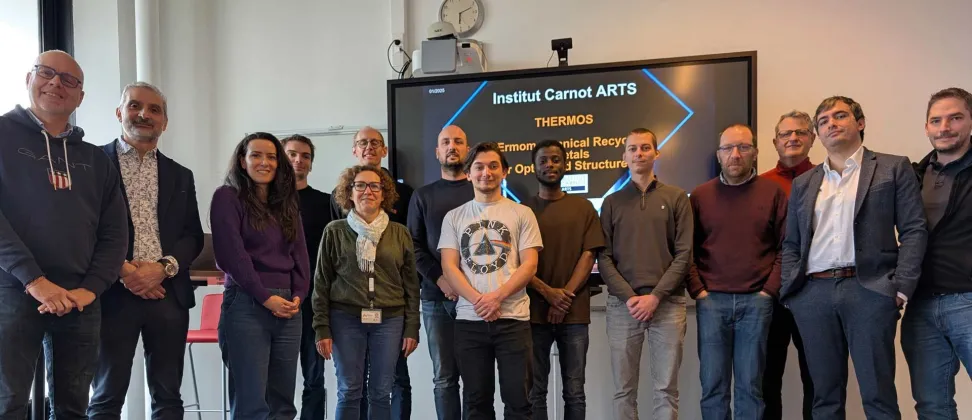
Funded largely by the ARTS Carnot Institute, it brings together five French laboratories around a common goal: to improve the quality of recycled metals to make them suitable for structural uses, while limiting the environmental impact of the transformation processes.

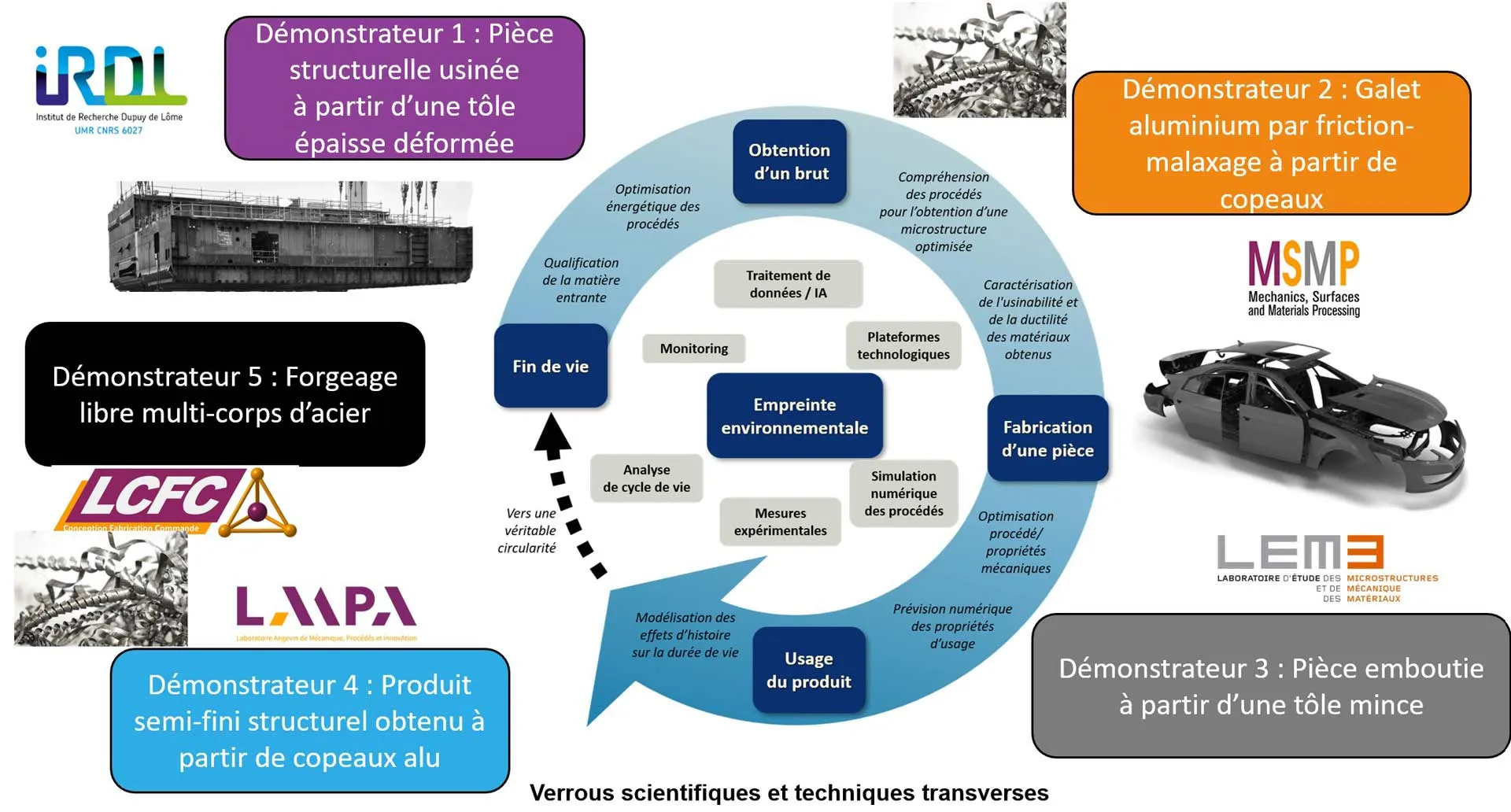
Unlike remelting, the methods explored favor the transformation of metals by “solid” means, carried out at lower temperatures—and therefore less energy-intensive—while limiting the introduction of impurities. Five avenues are currently being explored to produce new raw materials (sheets or profiles):

  • The manufacture of high yield strength raw materials from thick deformed sheets (IRDL laboratory);
  • The production of aluminum rollers by friction-kneading from chips (MSMP laboratory);
  • The creation of stamped parts from thin sheets (LEM3 laboratory);
  • The development of semi-finished structural products from aluminum chips (LAMPA laboratory);
  • The open-die forging of profiles from multi-body scrap (LCFC laboratory).

Today, metals are often mixed during recycling, which limits their reuse. We are seeking to develop more targeted recovery processes that can be adapted to smaller volumes and operate in short circuits, in order to reduce the environmental footprint and improve the economic value of recycled materials.

Bruno Levieil Research Professorat ENSTA / IRDL

Focus on recycling submarine hulls

At ENSTA, within the Dupuy de Lôme Research Institute, researchers are focusing on the recycling of thick, high-strength steel sheets. This work is being carried out in collaboration with the DGA and Naval Group through the Gustave Zédé joint laboratory, which focuses on the integrity of materials and structures in the naval military sector.

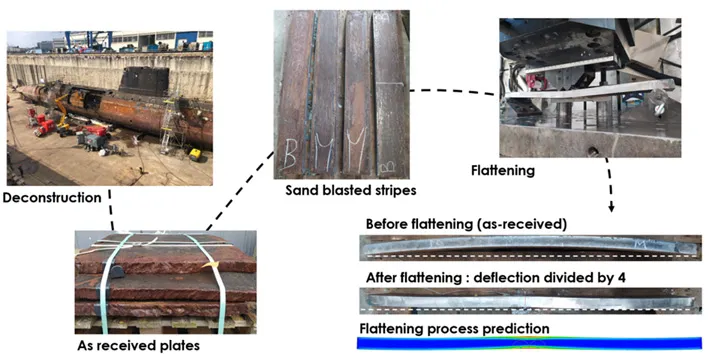
We obtained parts of hulls from old decommissioned submarines from our partners: curved, oxidized plates that were sandblasted and then flattened.
The results show that it is possible to recover mechanical properties similar to those of the original material, and above all, significantly superior to those obtained from conventional recycling processes. This recovery of recycled thick sheet metal is a significant challenge with submarine classes reaching the end of their service life and due to be decommissioned in the coming decades. 
Naval Group and the DGA will monitor the progress of the work, both on the technical aspect of characterizing thick sheet metal and on the life cycle assessment (LCA) associated with the new recycling process.

Fahan Mohammed Togba recently began his thesis at the ENSTA campus in Brest to implement a methodology for predicting mechanical behavior after straightening that can be generalized to new configurations of shapes, thicknesses, and steel grades.

The THERMOS project will run until 2029. The five processes will also be evaluated for their environmental impact. The results will provide manufacturers with avenues for more sustainable production.

Key information about the project
  • Name: THERMOS, THErmomecanical Recycling of Metals for Optimized Structures
  • Launch: December 2025
  • Research laboratories involved: IRDL, LEM3, LAMPA, LCFC, MSMP
  • Funding: Institut Carnots Arts
  • Total budget: €1,200,000

Our latest news

Alumni | Training | Research
A thesis on characterizing the strength of a submerged textile structure

Noise pollution generated during the installation of offshore wind turbines is attracting increasing attention. An engineer trained at ENSTA in the specialty of “mechanical modeling of materials and structures,” Jeanne Cavoit wrote her thesis on the...

A thesis on characterizing the strength of a submerged textile structure

Noise pollution generated during the installation of offshore wind turbines is attracting increasing attention. An engineer trained at ENSTA in the specialty of “mechanical modeling of materials and structures,” Jeanne Cavoit wrote her thesis on the...

Alumni | Innovation
DeepFoil: Two ENSTA Graduates Are Reinventing Underwater Exploration

Graduates in architecture and naval hydrodynamics, Emillia Perdigon and Paul François have designed the DeepFoil, a flying underwater wing that allows for effortless movement underwater. Fueled by public enthusiasm and investor support, their project is...

DeepFoil: Two ENSTA Graduates Are Reinventing Underwater Exploration

Graduates in architecture and naval hydrodynamics, Emillia Perdigon and Paul François have designed the DeepFoil, a flying underwater wing that allows for effortless movement underwater. Fueled by public enthusiasm and investor support, their project is...

Innovation | Research
Gabriel Betton: Exploring the karst networks

Beneath our feet, in the darkness of the underground, a natural network spanning more than a third of France’s territory supplies drinking water to nearly 30 million people. But the quality of this vast freshwater reservoir is threatened by climate change...

Gabriel Betton: Exploring the karst networks

Beneath our feet, in the darkness of the underground, a natural network spanning more than a third of France’s territory supplies drinking water to nearly 30 million people. But the quality of this vast freshwater reservoir is threatened by climate change...