ENSTA's new training programs on video

Institute, Training, Student Life Defense and Security, Sustainable Energy, Engineering for health, Marine Engineering, Digital Science & Engineering, Transport and mobility

ENSTA invites you to discover two of its new training programs for the 2026 academic year on video: MSc in Engineering and MSc in Eng. in Defense and Security

MSc in Engineering

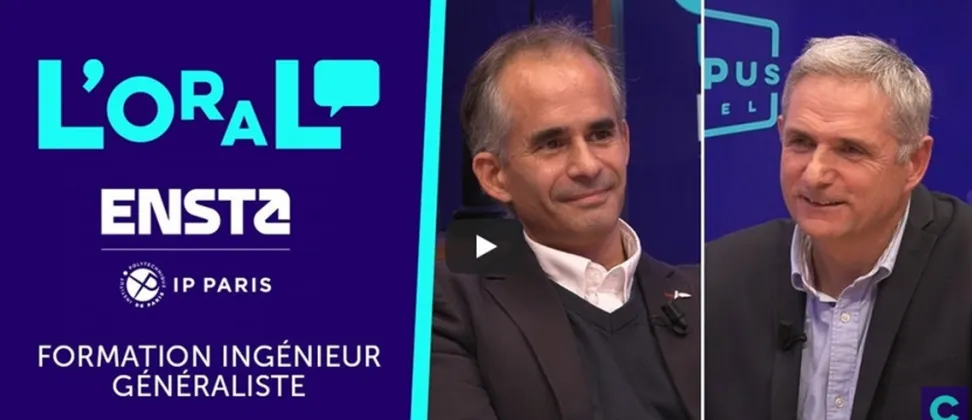
This comprehensive and multidisciplinary program is still unknown to many students in preparatory classes. This video answers most of the questions that they and their parents may have.

First of all, what is the real advantage of this new ENSTA? A tremendous range of opportunities drawn from the best of both campuses, each in a unique environment where students can flourish according to the specialization they choose in their third year. But also a solid first-year scientific core curriculum taught on both campuses, which allows 30% of each class to complete their training with a doctoral thesis.

Why have two campuses? And which one should you choose? Given that this multidisciplinary program is taught on both campuses and that the degree awarded is the same at the end, it's a legitimate question. Rémy Thibaud, Director of Education, and Pierre-Jean Cottalorda, Director of Generalist Engineering Education, answer this question in detail based on their own experience.

In this video, they also discuss the many opportunities for double degrees and exchange semesters with prestigious academic partners in Europe (including KTM, DTH, and Politecnico di Milano), Asia (National University of Singapore), North America (Polytechnique Montréal), and France, including HEC, École des Ponts or ISAE-SUPAERO.

MSc in Eng. in Defense and Security

The main feature of this program, which is unique in France in combining engineering, sovereignty, and innovation, is that it offers a new structure bringing together two schools under the supervision of the French Ministry of the Armed Forces, ENSTA and ISAE-SUPAERO, each a leader in its traditional field of expertise: naval, land, and cyber on the one hand, and aeronautics and space on the other.

The degree is jointly awarded by both schools, and each graduate has equal access to both alumni networks, which is a considerable asset in terms of career development opportunities, with much broader possibilities than the “Defense and Security” specialization might suggest: in practice, many of the companies involved in this program and natural outlets for its graduates have dual civilian and military activities.

How does training on three campuses work? What are the criteria for admission to the program? Civilian or military status?

Caroline Bérard, director of the defense and security engineering program, and Rémy Thibaud, director of training at ENSTA, answer all these questions in this video.

Our latest news

Alumni | Training | Research
A thesis on characterizing the strength of a submerged textile structure

Noise pollution generated during the installation of offshore wind turbines is attracting increasing attention. An engineer trained at ENSTA in the specialty of “mechanical modeling of materials and structures,” Jeanne Cavoit wrote her thesis on the...

A thesis on characterizing the strength of a submerged textile structure

Noise pollution generated during the installation of offshore wind turbines is attracting increasing attention. An engineer trained at ENSTA in the specialty of “mechanical modeling of materials and structures,” Jeanne Cavoit wrote her thesis on the...

Alumni | Innovation
DeepFoil: Two ENSTA Graduates Are Reinventing Underwater Exploration

Graduates in architecture and naval hydrodynamics, Emillia Perdigon and Paul François have designed the DeepFoil, a flying underwater wing that allows for effortless movement underwater. Fueled by public enthusiasm and investor support, their project is...

DeepFoil: Two ENSTA Graduates Are Reinventing Underwater Exploration

Graduates in architecture and naval hydrodynamics, Emillia Perdigon and Paul François have designed the DeepFoil, a flying underwater wing that allows for effortless movement underwater. Fueled by public enthusiasm and investor support, their project is...

Innovation | Research
Gabriel Betton: Exploring the karst networks

Beneath our feet, in the darkness of the underground, a natural network spanning more than a third of France’s territory supplies drinking water to nearly 30 million people. But the quality of this vast freshwater reservoir is threatened by climate change...

Gabriel Betton: Exploring the karst networks

Beneath our feet, in the darkness of the underground, a natural network spanning more than a third of France’s territory supplies drinking water to nearly 30 million people. But the quality of this vast freshwater reservoir is threatened by climate change...