
DyNNamo, AI for the benefit of people with disabilities

Innovation, Research Engineering for health, Digital Science & Engineering, Transport and mobility

While artificial intelligence is gradually being deployed in all areas of mobility, the field of disability presents particular challenges in terms of robustness, reliability, and adaptation to a wide variety of situations.

With funding from the French National Research Agency, the ANR DyNNamo project aims to design AI capable of dynamically adapting to these situations. This ambitious goal can only be achieved by exploring the best compromises between software and hardware using a development method that does not prejudge solutions, but matures them by taking into account all the system's specifications.

With its sometimes confusing traffic lanes, its more or less disciplined cyclists, and its impatient motorists, crossing a major city street is already a challenge in itself for a pedestrian in full possession of their faculties.

But now imagine that you have major physical and sensory disabilities, and that your mobility depends largely on the intelligence built into your electric wheelchair. Would you blindly trust it to make the decision to cross?

“Equipping an electric wheelchair with reliable AI is one of the most demanding use cases” 

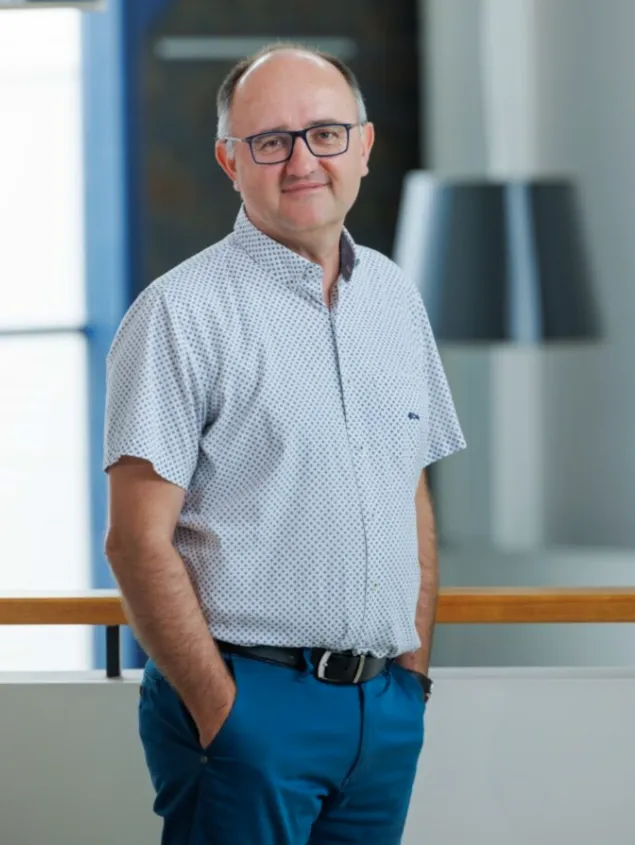
confirms Jean-Christophe Le Lann, professor and researcher in embedded systems at LabSTicc, on the Brest campus of ENSTA.

ANR DyNNamo

“On the industrial side, the spontaneous tendency would be to multiply the number of AIs dedicated to each problem: one for vision, one for motor management, another for navigation or traversability, etc. But that would require far too much energy and computing power for a platform as constrained as a wheelchair,” continues the researcher. " The solution is to create an AI that is economical in terms of resources and capable of adapting to each context. And my job is to design the architecture of this embedded system.

To do this, Jean-Christophe Le Lann is working within the framework of a paradigm called ”Dataflow," in which the embedded system is modeled as a huge flow of information at the computer chip level.

“The goal is to model the system at a certain level of abstraction and gradually descend to the hardware platform through progressive architectural refinements.”

During this process, several choices are possible, in terms of hardware or software, and it is necessary to explore them virtually to assess all the implications.

“Moving directly from system modeling to a fixed hardware platform would be like taking a dangerous leap of faith, where we would be taking a lot of risks by misunderstanding the implications of these choices, which could jeopardize the entire project!”

As part of the DyNNamo project, the work will be divided into two theses conducted jointly by ENSTA and the IETR branches in Nantes (Sébastien Le Nours) and Rennes: one thesis on the modeling of the embedded system, and another on the methodology for verifying this system.

“Not only must this system be designed, but it must also be verified, using a specific approach focused on verifying the system's chances of functioning,” continues the researcher. "As a methodologist involved in tool design, I seek to shape best modeling practices, which I see as levers: the right lever can lift the heaviest stones and the most complex projects. "

Jean-Christophe Le Lann, professor in embedded systems at LabSTicc, on the Brest campus of ENSTA

This metaphor is perfectly applicable to the field of assistance for people with disabilities, where the goal is to smooth out difficulties in order to guarantee the safest possible mobility for all.

Our latest news

Alumni | Training | Research
A thesis on characterizing the strength of a submerged textile structure

Noise pollution generated during the installation of offshore wind turbines is attracting increasing attention. An engineer trained at ENSTA in the specialty of “mechanical modeling of materials and structures,” Jeanne Cavoit wrote her thesis on the...

A thesis on characterizing the strength of a submerged textile structure

Noise pollution generated during the installation of offshore wind turbines is attracting increasing attention. An engineer trained at ENSTA in the specialty of “mechanical modeling of materials and structures,” Jeanne Cavoit wrote her thesis on the...

Alumni | Innovation
DeepFoil: Two ENSTA Graduates Are Reinventing Underwater Exploration

Graduates in architecture and naval hydrodynamics, Emillia Perdigon and Paul François have designed the DeepFoil, a flying underwater wing that allows for effortless movement underwater. Fueled by public enthusiasm and investor support, their project is...

DeepFoil: Two ENSTA Graduates Are Reinventing Underwater Exploration

Graduates in architecture and naval hydrodynamics, Emillia Perdigon and Paul François have designed the DeepFoil, a flying underwater wing that allows for effortless movement underwater. Fueled by public enthusiasm and investor support, their project is...

Innovation | Research
Gabriel Betton: Exploring the karst networks

Beneath our feet, in the darkness of the underground, a natural network spanning more than a third of France’s territory supplies drinking water to nearly 30 million people. But the quality of this vast freshwater reservoir is threatened by climate change...

Gabriel Betton: Exploring the karst networks

Beneath our feet, in the darkness of the underground, a natural network spanning more than a third of France’s territory supplies drinking water to nearly 30 million people. But the quality of this vast freshwater reservoir is threatened by climate change...