UTAC automobile challenge: ENSTA students take up the challenge

Company, Training Transport and mobility

The first European student competition dedicated to autonomous vehicles, the UTAC challenge brings together numerous French and European students every year. For the 2025 edition, engineering students from ENSTA's two campuses have been working for several weeks to meet the challenges of the competition. On May 22, a team will be present at the Linas-Monthléry site to test their vehicle during the track trials.

Supplement of 05/23/2025

ENSTA students win the highway challenge! A first-place finish that recognizes the team's commitment throughout the project and during the challenge. Congratulations to them!


Organized by the Société des Ingénieurs de l'Automobile, the competition features 4 events: a free test and 3 track tests (urban course, motorway course, parking).

On the Brest campus, 6 students worked together on their 2nd year industrial project. Samuel, in his 2nd year of general engineering training, specializing in autonomous robotics:

Understanding how the algorithms that may transport us tomorrow work, and trying to reproduce them, is a very rewarding experience.

After getting to grips with the vehicle and the work carried out last year for the challenge, the students concentrated on developing detection and control algorithms, assembling the various codes and finally carrying out tests and final adjustments in order to take part in the “freeway” and “parking” events. With just a few days to go before the challenge, the team is proud to have validated the first tests:

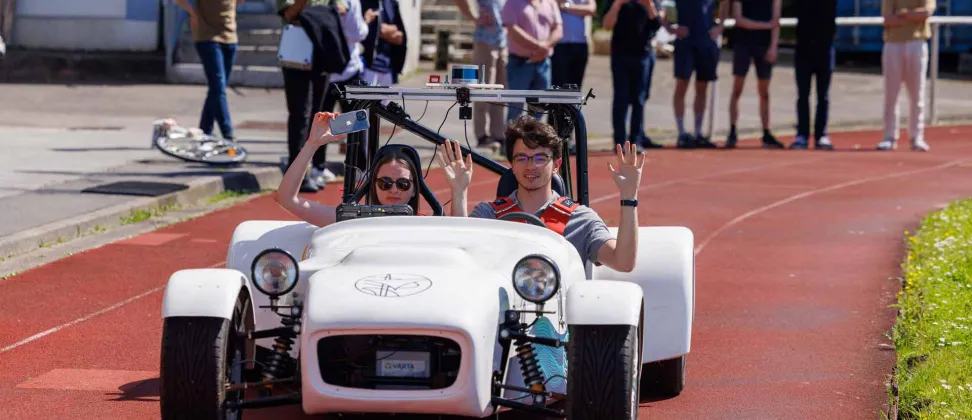
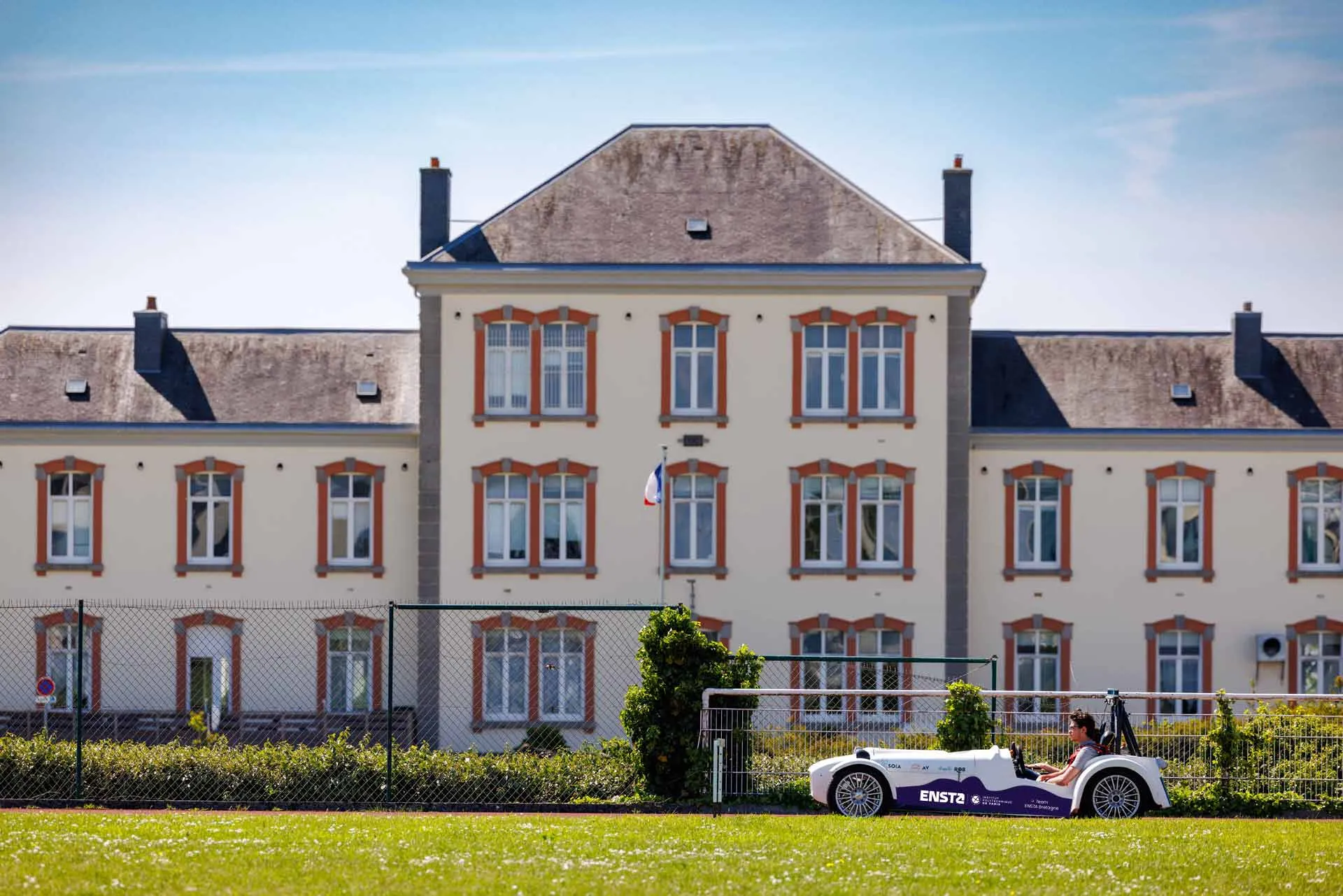
We managed to drive the car completely autonomously around the school's athletics track. The car stopped in front of a pedestrian at a speed of 15km/h!

On the Paris Saclay campus, 13 engineering students took part in this project as part of the engineering team project (PIE). Ryan, a general engineering student:

The challenge offered an opportunity to discover more about the workings of the automobile of the future, at a time when vehicles are already moving around without the intervention of a driver.

At the end of the project, the team produced a simulation to determine the trajectory the vehicle would take in the parking lot to reach its predefined parking space. Work was also carried out on the detection of people, vehicles and objects.

On May 22, two students from Brest, a teacher and the autonomous vehicle will be present on the circuit:

We're looking forward to the challenge with both excitement and apprehension. It's a chance to present our results to industry professionals, but we're also aware that there's a risk that not everything will work out as we planned. We hope to be as successful as possible in meeting the challenge, and to give the students who will be taking up our work next year a clean, clear basis on which to work, so that the vehicle can be optimized as far as possible.

Our latest news

Alumni | Training | Research
A thesis on characterizing the strength of a submerged textile structure

Noise pollution generated during the installation of offshore wind turbines is attracting increasing attention. An engineer trained at ENSTA in the specialty of “mechanical modeling of materials and structures,” Jeanne Cavoit wrote her thesis on the...

A thesis on characterizing the strength of a submerged textile structure

Noise pollution generated during the installation of offshore wind turbines is attracting increasing attention. An engineer trained at ENSTA in the specialty of “mechanical modeling of materials and structures,” Jeanne Cavoit wrote her thesis on the...

Alumni | Innovation
DeepFoil: Two ENSTA Graduates Are Reinventing Underwater Exploration

Graduates in architecture and naval hydrodynamics, Emillia Perdigon and Paul François have designed the DeepFoil, a flying underwater wing that allows for effortless movement underwater. Fueled by public enthusiasm and investor support, their project is...

DeepFoil: Two ENSTA Graduates Are Reinventing Underwater Exploration

Graduates in architecture and naval hydrodynamics, Emillia Perdigon and Paul François have designed the DeepFoil, a flying underwater wing that allows for effortless movement underwater. Fueled by public enthusiasm and investor support, their project is...

Innovation | Research
Gabriel Betton: Exploring the karst networks

Beneath our feet, in the darkness of the underground, a natural network spanning more than a third of France’s territory supplies drinking water to nearly 30 million people. But the quality of this vast freshwater reservoir is threatened by climate change...

Gabriel Betton: Exploring the karst networks

Beneath our feet, in the darkness of the underground, a natural network spanning more than a third of France’s territory supplies drinking water to nearly 30 million people. But the quality of this vast freshwater reservoir is threatened by climate change...