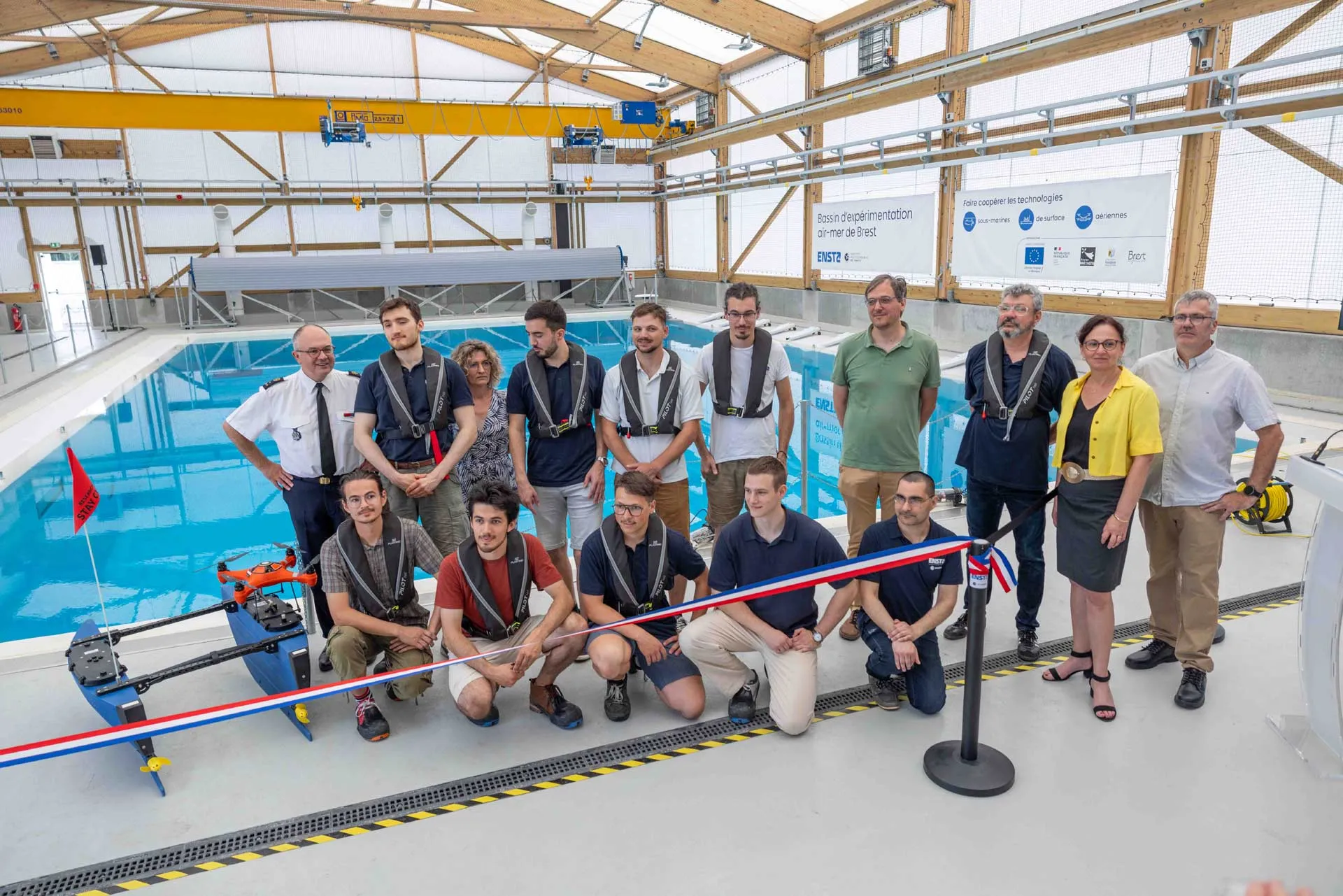
Inauguration of the air-sea experimental basin, the only one of its kind in Europe

Press release, Institute, Innovation, Research Brest Marine Engineering
Download the press release

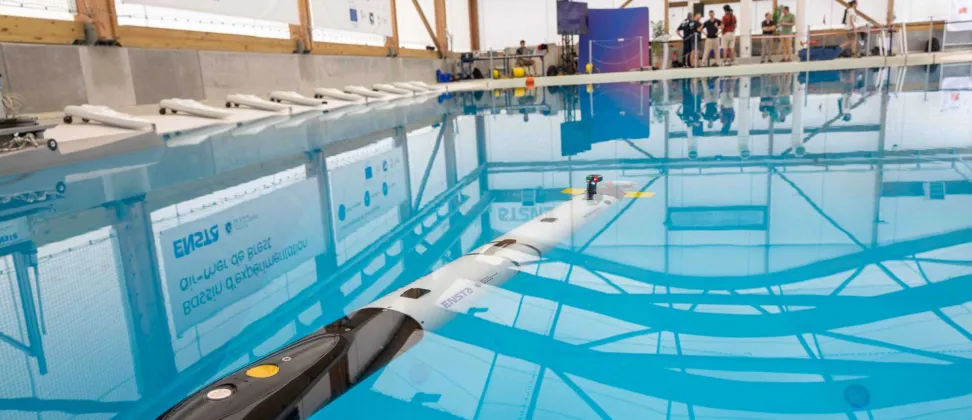
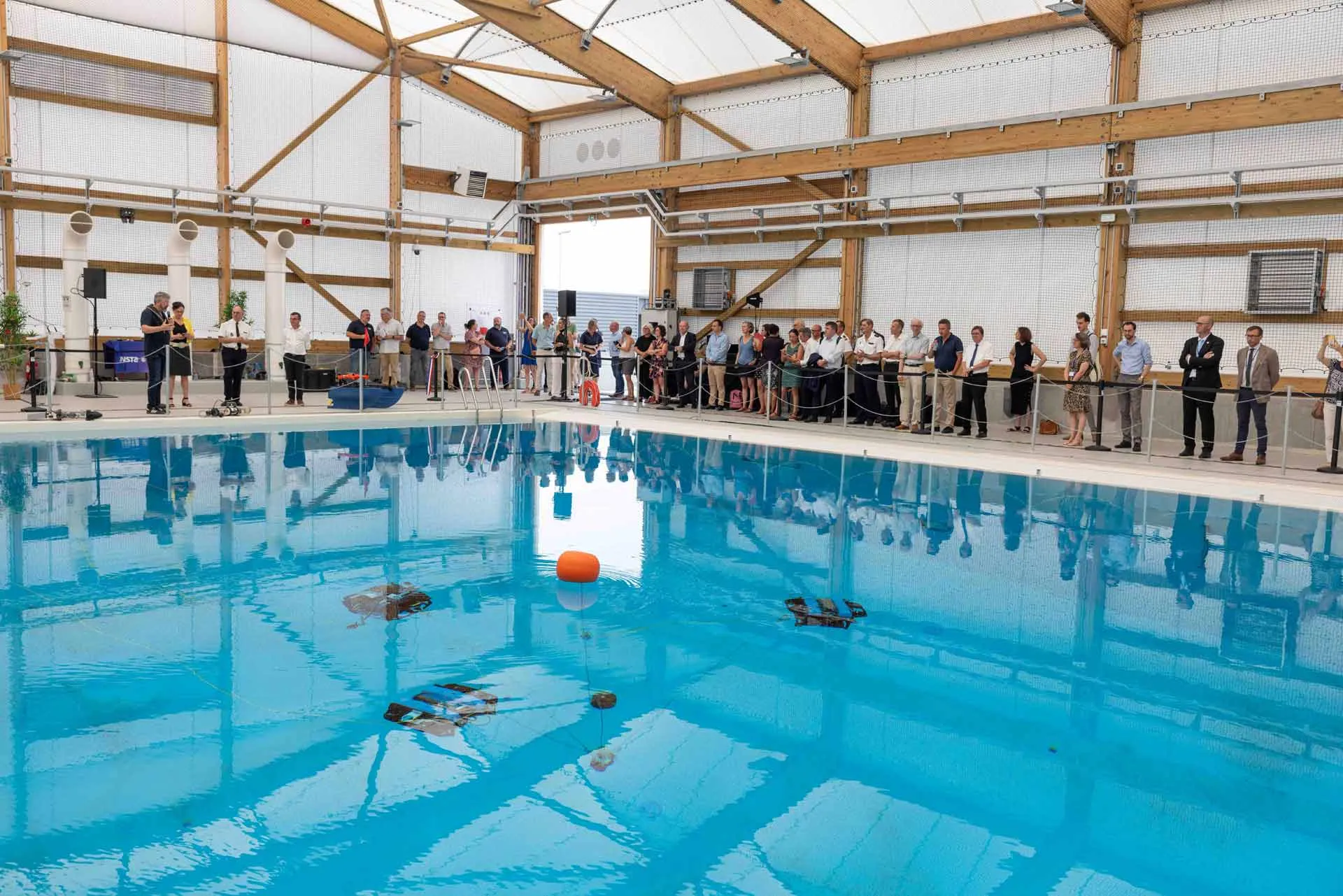
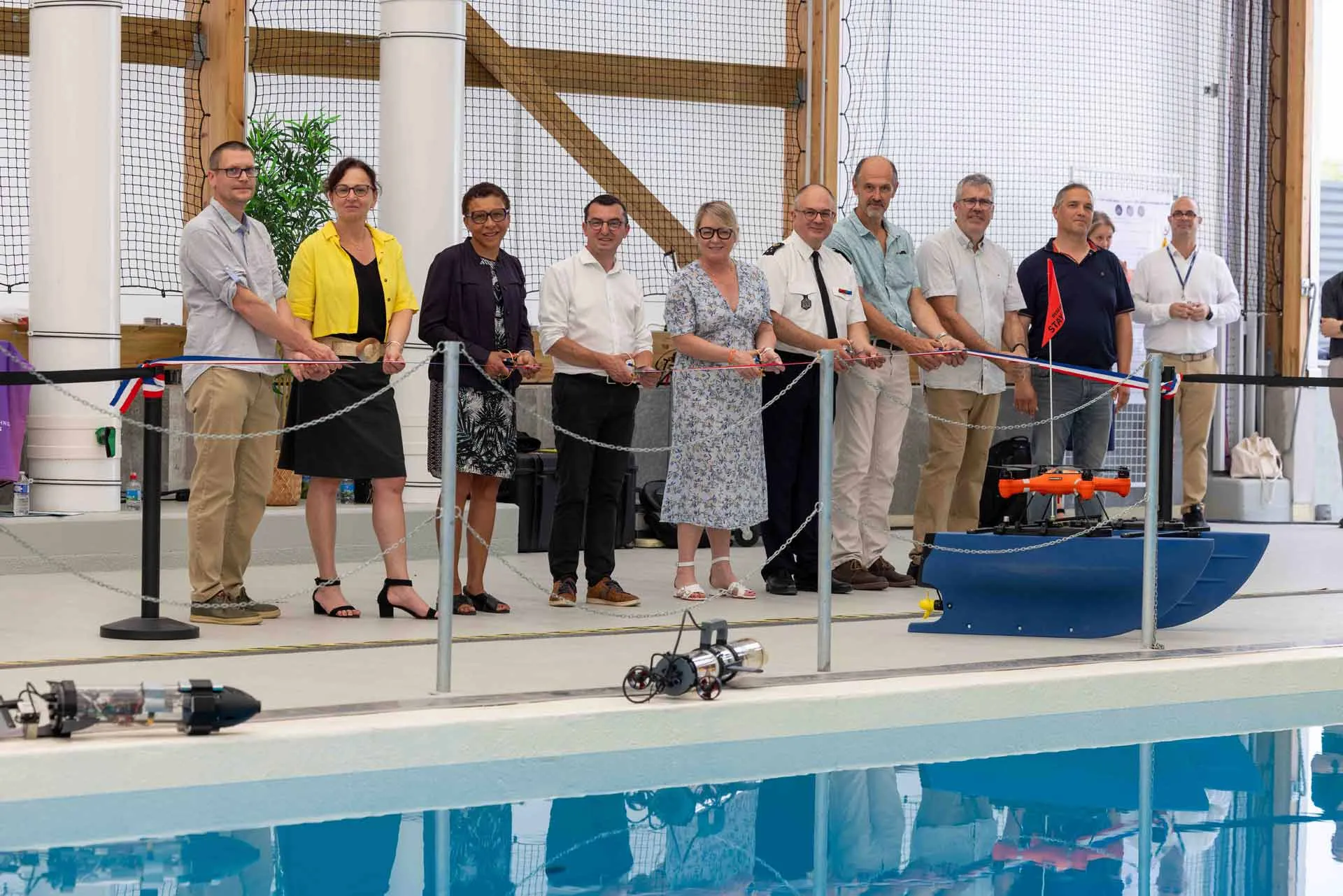
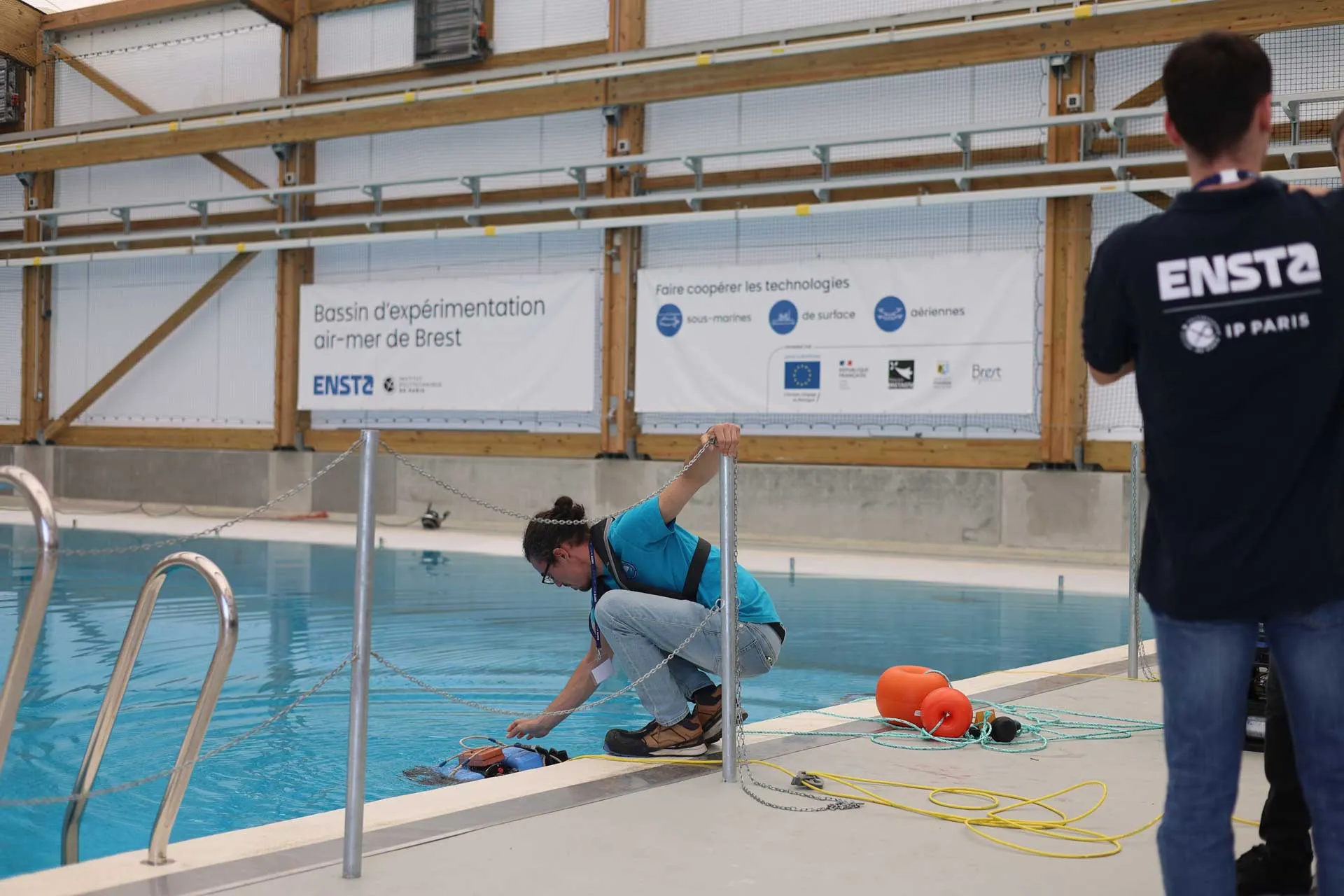
On June 24, 2026, ENSTA inaugurated a new air-sea experimental basin on its Brest campus: an exceptional facility for ocean research that combines a test basin with a drone flight enclosure. Its vast dimensions and permeability to satellite waves make it possible to simulate real-world at-sea testing conditions in a laboratory setting. It strengthens national and European capabilities for understanding and monitoring the ocean.

A catalyst for maritime innovation

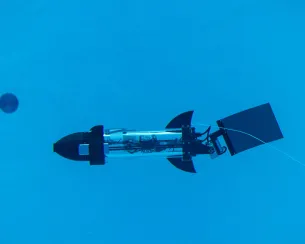
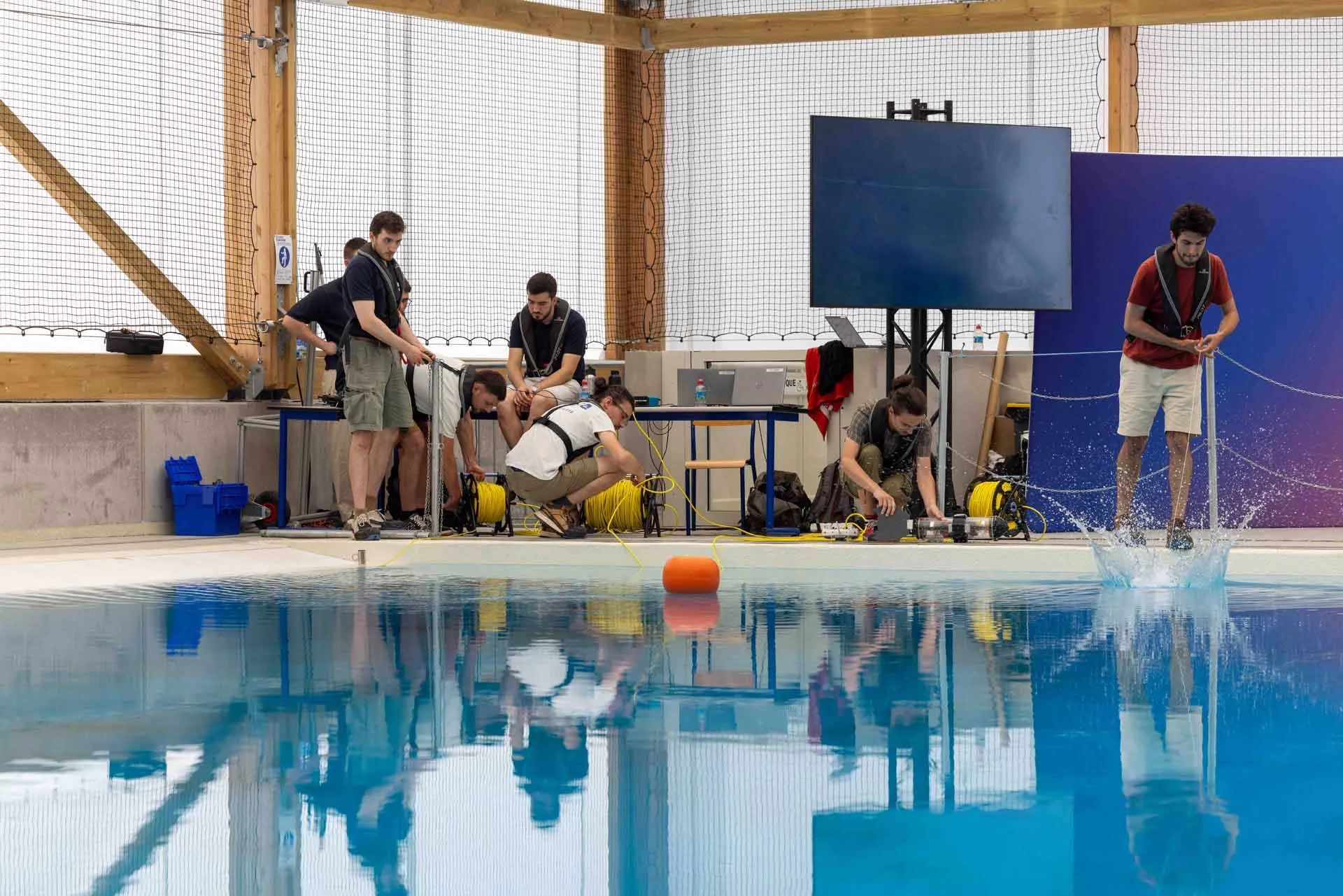
This state-of-the-art facility provides ideal conditions for testing large-scale prototypes, swarms of robots, and combinations of aerial, surface, and underwater observation systems necessary for characterizing the ocean environment.

This accelerator of maritime innovation in autonomous robotics, acoustic systems, and new mobile observation technologies strengthens national and European capabilities for understanding and monitoring the ocean, a strategic domain of sovereignty.

The new test basin enables the analysis of the performance of new observation methods and technologies that combine multi-environment autonomous robotics, acoustic systems, sensors, aerial and underwater communications, artificial intelligence, and data processing. This broad spectrum of scientific expertise is brought together at a high level on the ENSTA campuses and is further developed for marine applications at the Brest campus, where scientific teams now benefit from complementary experimental resources at sea and in the tank to meet the needs of ocean knowledge and modeling.

A strong indicator of the school’s dynamism in marine research and science, this infrastructure stands out as a unifying hub for innovation, dedicated to research and innovation at the highest level of excellence. It will also serve as an exceptional learning environment for the school’s doctoral students and engineering students across various disciplines, while further enhancing the research capabilities of the Institut Polytechnique de Paris. The institution’s influence now extends from Paris-Saclay to Brest, reaffirming Brittany’s status as a key center of excellence in autonomous robotics in Europe.

Estelle Iacona Director General of ENSTA
Technical Specifications
  • Building with 900 m² of technical space
  • Freshwater tank measuring 20 x 12 meters and 6 meters deep
  • Topped by an aviary (5 meters high)
  • Cover made of fabric permeable to satellite and radio waves
  • Adjustable removable bottom
  • Multiple measurement systems

State-of-the-art equipment funded by the CPER 2021–2027

The project arose from a key observation: understanding the ocean, exploring the deep sea, and conducting maritime surveillance require a comprehensive range of aerial, marine, and underwater technologies. Industrial innovation faces increasingly complex challenges and requires smarter, more autonomous robots capable of communicating with one another and carrying out long-duration missions while operating in various environments (underwater, on the surface, and in the air).

The project was launched in response to academic and industrial needs—both civilian and defense-related—driven by ENSTA, the Lab-STICC laboratory (a CNRS joint research unit), the Pôle Mer Bretagne Atlantique, and its many companies and public sector partners. It immediately received strong support from the Ministry of the Armed Forces, as well as from the European Union and local authorities, which designated it as a strategic project under the 2021–2027 CPER. It represents an investment of 3.54 million euros for its construction (real estate component) and equipment (components of the SpaceTechDroneTech project), two-thirds of which is funded by the State through the Ministry of the Armed Forces (DGA) and one-third by local authorities (Brittany Region, Finistère Department, Brest Métropole) and the European Union (ERDF).

Wide-ranging applications

As soon as it becomes operational, the facility will host large-scale projects:

  • RACAM: A fleet of marine robots dedicated to studying the cybersecurity of drone “swarms” (CPER 2021–2027).
  • ID-GF (Deep-Sea Distributed Imager, France 2030 project): A program involving several autonomous floats equipped with new hybrid underwater communication methods for deep-sea exploration. A key component of the project—in which ENSTA plays a leading role—involves arranging the floats to form a discrete underwater array. A system that includes, in particular, an underwater laser is being developed and will enable short-range communication between the floats. Tests on the laser’s range have begun in the test tank.
  • EMOI (Integrated Offshore Wind Observation, an interdisciplinary project coordinated by Ifremer): A new technology for acoustically positioned underwater profilers is being designed and developed by ENSTA teams at Lab-STICC to measure the effects of turbulence created by offshore wind turbine towers on pelagic marine ecosystems. The project is led by Ifremer, in collaboration with ENSTA and the Open-C Foundation (which oversees the five French offshore floating wind test sites).
  • Underwater Refueling Robot (AUVr): An autonomous docking system enabling underwater drones to connect for data transfer or recharging (in collaboration with AID: the Defense Innovation Agency).
  • MOSTS (Underwater Object Manipulation by a Fleet of Robots via an Over-constrained Tensegrity Structure): The manipulation of heavy objects underwater is currently carried out from the surface, but remains difficult to control and is sometimes impossible in complex or deep environments. The project proposes using a fleet of coordinated robots, connected by cables in a tensegrity structure, to move these objects with greater precision, stability, and flexibility.

Photo credit: ©Julien Creff / ENSTA

See also

Our latest news

Alumni | Training | Research
Maïmouna Bocoum: The Art of Exploring Across Disciplines

A recent recipient of the Irène Joliot-Curie Prize, Maïmouna Bocoum began her distinguished academic career at ENSTA. While she has come a long way since then, she still occasionally consults her class notes when she needs to familiarize herself with a...

Maïmouna Bocoum: The Art of Exploring Across Disciplines

A recent recipient of the Irène Joliot-Curie Prize, Maïmouna Bocoum began her distinguished academic career at ENSTA. While she has come a long way since then, she still occasionally consults her class notes when she needs to familiarize herself with a...

Alumni
Lords of the Ocean, an adventure that challenges preconceptions about sharks

For over five years, the Lords of the Ocean team—founded by two ENSTA graduates—has been crisscrossing the seas in search of large sharks. They dive to help us understand them better, combat our preconceptions, and protect them more effectively. In 2026...

Lords of the Ocean, an adventure that challenges preconceptions about sharks

For over five years, the Lords of the Ocean team—founded by two ENSTA graduates—has been crisscrossing the seas in search of large sharks. They dive to help us understand them better, combat our preconceptions, and protect them more effectively. In 2026...

Company | Innovation | Research
ENSTA Welcomes You to VIVATECH 2026

From June 17 to 20, Paris Expo Porte de Versailles will host the 2026 edition of Viva Technology, Europe’s largest innovation and technology trade show. ENSTA will be represented there by four startups from its ecosystem, with the head of the ENSTARTUPS...

ENSTA Welcomes You to VIVATECH 2026

From June 17 to 20, Paris Expo Porte de Versailles will host the 2026 edition of Viva Technology, Europe’s largest innovation and technology trade show. ENSTA will be represented there by four startups from its ecosystem, with the head of the ENSTARTUPS...