
Chaos in Caracas : the role of sediments

Research Defense and Security, Digital Science & Engineering
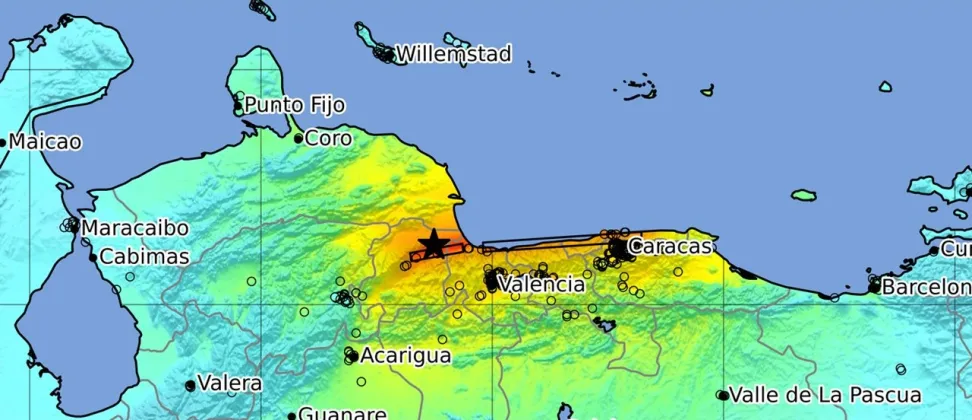
Caracas, located more than 150 km east of the epicenter (black star on the left), was severely affected by seismic wave amplification. Credit: United States Geological Survey

During the double earthquake that struck Venezuela on June 24, 2026, damage extended as far as Caracas, the capital, more than 150 km from the epicenter. How can such extensive damage be explained at such a great distance? Jean-François Semblat, a professor at ENSTA, has scientific data to explain it.

The key factors determining the damage an earthquake is likely to cause are, of course, its magnitude—that is, the energy released at the source—and its depth. In the case of June 24, two earthquakes—with magnitudes of 7.2 and 7.5—occurred 39 seconds apart, with the second occurring at a depth of less than 20 kilometers. Nothing comparable had occurred in the region for more than 125 years. But that alone does not explain the extent of the damage and the number of casualties, particularly in Caracas, more than 150 kilometers from the epicenter.

The sedimentary basin on which Caracas was built is well known to Jean-François Semblat, a professor at ENSTA and deputy director of the Mechanics Training and Research Unit. In a scientific article published in the early 2000s in *Computers and Geotechnics*, based on data collected during a previous earthquake in 1967, he had already described the risks of seismic wave amplification that could reach a factor of 25. The cause, according to the researcher, is what he calls the “jelly bowl” effect .”

Jean-François Semblat, ENSTA professor and deputy director of the Mechanics Unit

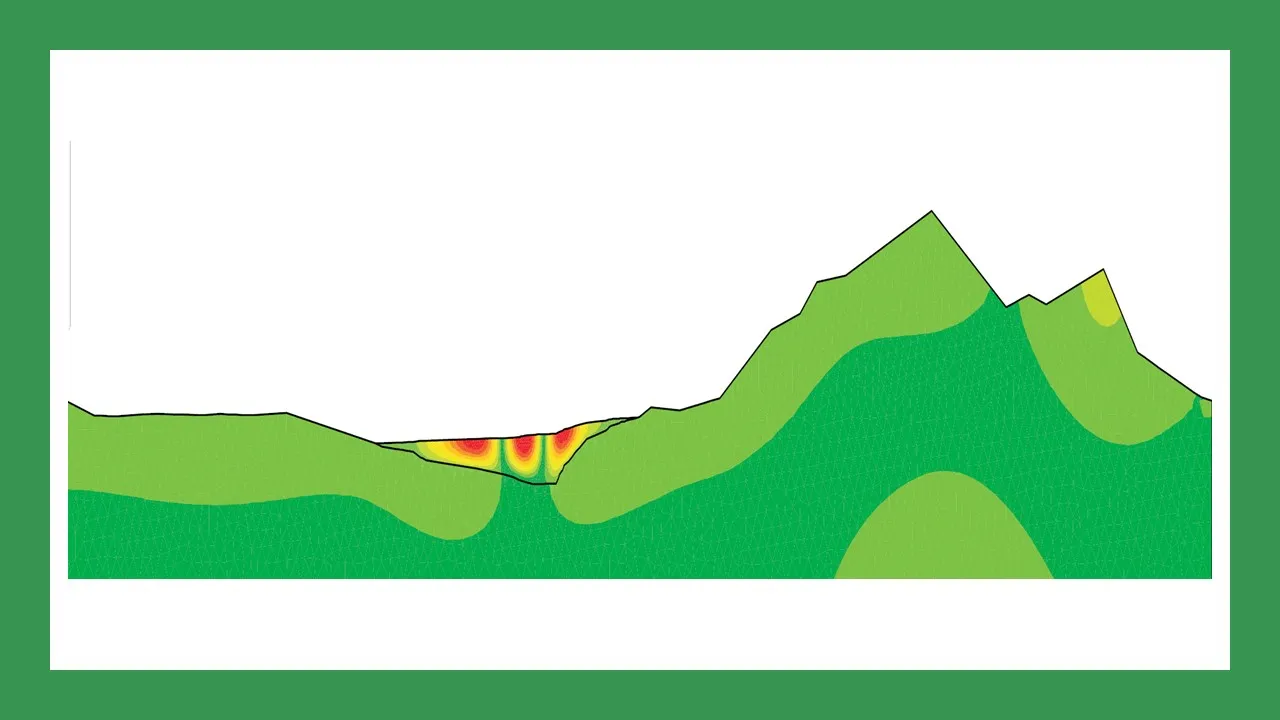
“The jelly bowl effect is simply a matter of contrasting properties between the rock that surrounds the sedimentary basin (the bowl in the analogy), which is very rigid, and the sediments themselves (the jelly), which consist of sand or clay. If we calculate the wave transmission coefficient as the wave passes from a rock layer to a sedimentary layer, it can be significantly greater than 1. And the more sedimentary layers the wave must pass through, the more the phenomenon amplifies, so that at the surface we can observe a very strong amplification of seismic waves. »

This phenomenon is linked to the resonance of these sedimentary layers at certain frequencies; if these frequencies coincide with the natural frequency of buildings, it can lead to damage or even their complete collapse.

Amplification of seismic waves in the Caracas sedimentary basin: areas of high amplification are shown in red, and areas of low amplification are shown in green. Reference: Semblat J.F., Duval A.M., Dangla P. (2002). Seismic Site Effects in a Deep Alluvial Basin: Numerical Analysis by the Boundary Element Method, Computers and Geotechnics, 29(7): 573-585.

“During the 1967 earthquake in Caracas, a clear correlation had already been identified between the depth of the sedimentary basin and the height of the most severely damaged buildings. In the Los Palos Grandes neighborhood, which lies above the deepest sedimentary layers, it was the high-rise buildings (10 to 12 stories) that sustained the most damage,” the researcher continues.

What lessons can be drawn from this in terms of earthquake-resistant engineering?

“In 2025, we published an article in the Bulletin of the Seismological Society of America (BSSA) with Kim Pham of ENSTA, Agnès Maurel of the Langevin Institute, and Simon Félix of the Le Mans Acoustics Laboratory. This article examines the various urban configurations that lead to a reduction in building vibrations during an earthquake. This approach, which we have termed ‘site-city interaction,’ has been under development—particularly in France—for several years.”

Jean-François Semblat Professor at ENSTA, Deputy Director of the Mechanics Unit

Unfortunately, the advantages of alluvial plains in terms of soil fertility and flatness are such that cities have largely developed nearby, contributing to the amplification of earthquakes in urban areas. Scientists and urban planners are therefore forced to work with the existing situation.

“Given the existing situation, it is very difficult to modify urban configurations in the short term. There is still the possibility of analyzing the different soil layers and determining the risks of amplification based on different building heights. We can also assess buildings that are potentially more vulnerable and reinforce them. And there’s no need to wait for earthquakes to do this; it can be done very easily by recording ambient vibrations in the ground, such as those created by human activities. This “seismic background noise” makes it possible to directly determine the vibrational characteristics of buildings in the absence of an earthquake.”

While predicting earthquakes still seems like an unattainable goal today, the work conducted by Jean-François Semblat and his colleagues at ENSTA offers a glimpse into seismic engineering methods capable of preventing their most severe effects.

Parole d'expert : Jean-François Semblat sur la liquéfaction des sols pendant les séismes

Our latest news

Institute | Training
IETA military engineering students training at ENSTA marched in the July 14 parade

About 40 IETA military students marched on July 14, 2026, on the Champs-Élysées on behalf of ENSTA and the DGA. For the past three weeks, they had been preparing together for this major event for the French armed forces, whose theme was “Europe’s...

IETA military engineering students training at ENSTA marched in the July 14 parade

About 40 IETA military students marched on July 14, 2026, on the Champs-Élysées on behalf of ENSTA and the DGA. For the past three weeks, they had been preparing together for this major event for the French armed forces, whose theme was “Europe’s...

Research
APRO : Teaching Drones to Go Unnoticed

Whether used for urgent deliveries or autonomous flying taxi services, drones could help solve many of the problems plaguing our congested city centers—provided, that is, that their main nuisance is reduced: that annoying, giant-mosquito-like buzz caused...

APRO : Teaching Drones to Go Unnoticed

Whether used for urgent deliveries or autonomous flying taxi services, drones could help solve many of the problems plaguing our congested city centers—provided, that is, that their main nuisance is reduced: that annoying, giant-mosquito-like buzz caused...

Institute | Training | Student Life
Gaspard, a top-level windsurfer and engineering student

Having always been passionate about sailing and the maritime world, Gaspard Carfantan has built his professional and personal life around this passion. At 23, he divides his time between competitive sailing and his engineering studies at ENSTA.

Gaspard, a top-level windsurfer and engineering student

Having always been passionate about sailing and the maritime world, Gaspard Carfantan has built his professional and personal life around this passion. At 23, he divides his time between competitive sailing and his engineering studies at ENSTA.