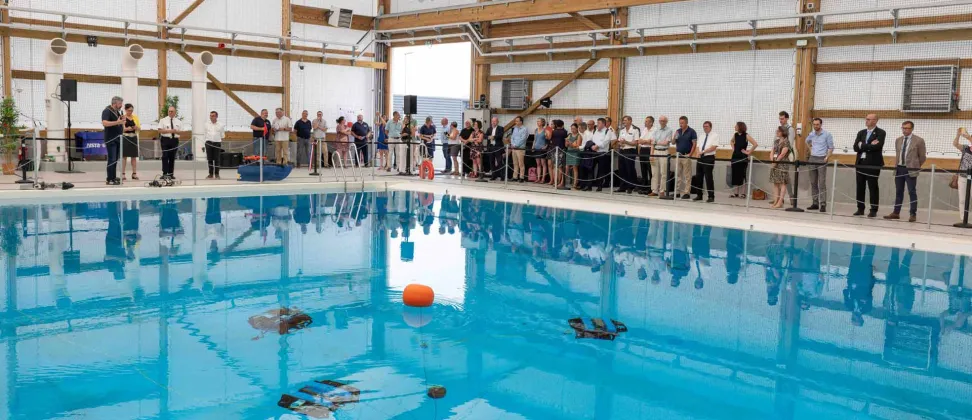
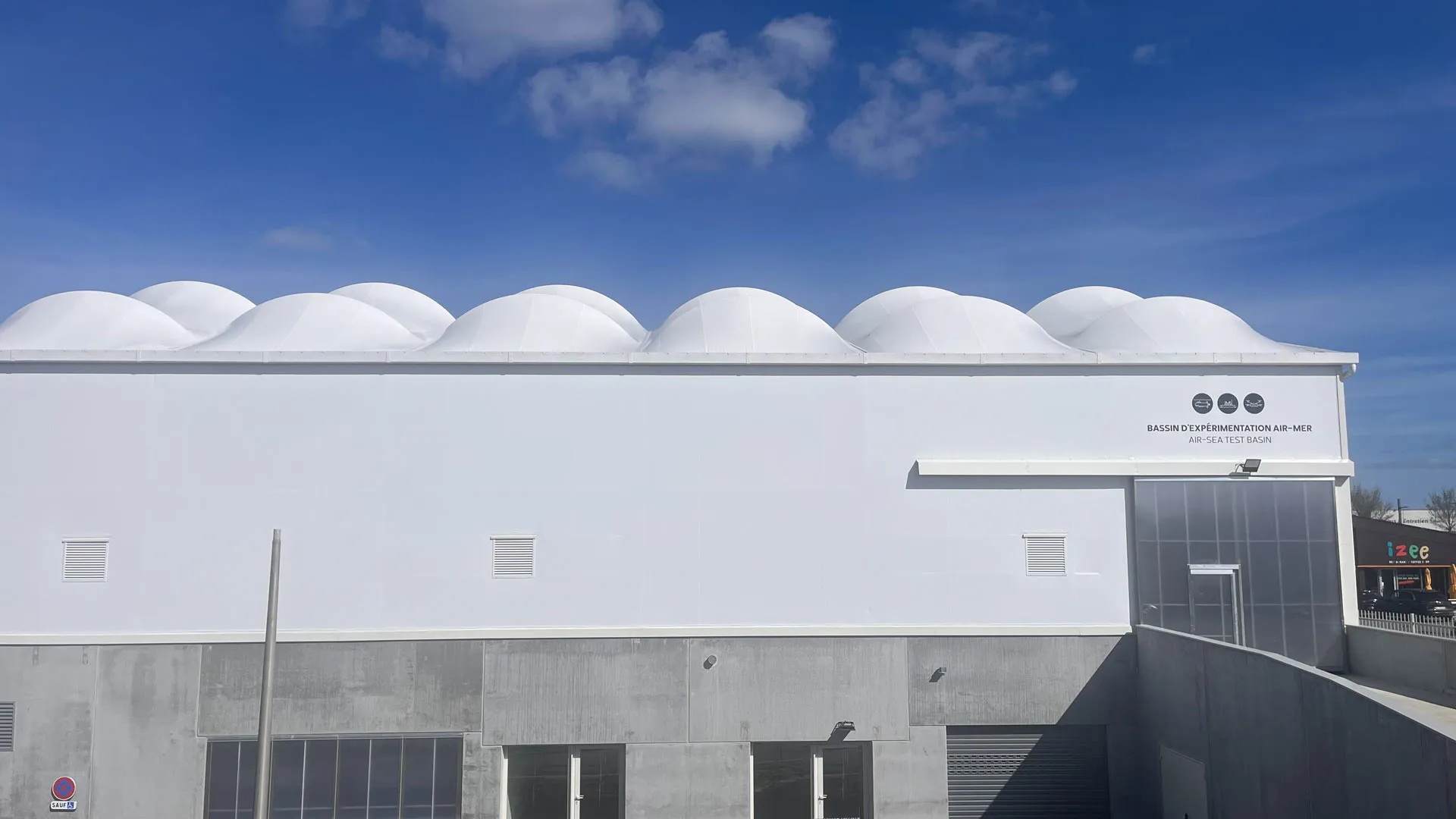
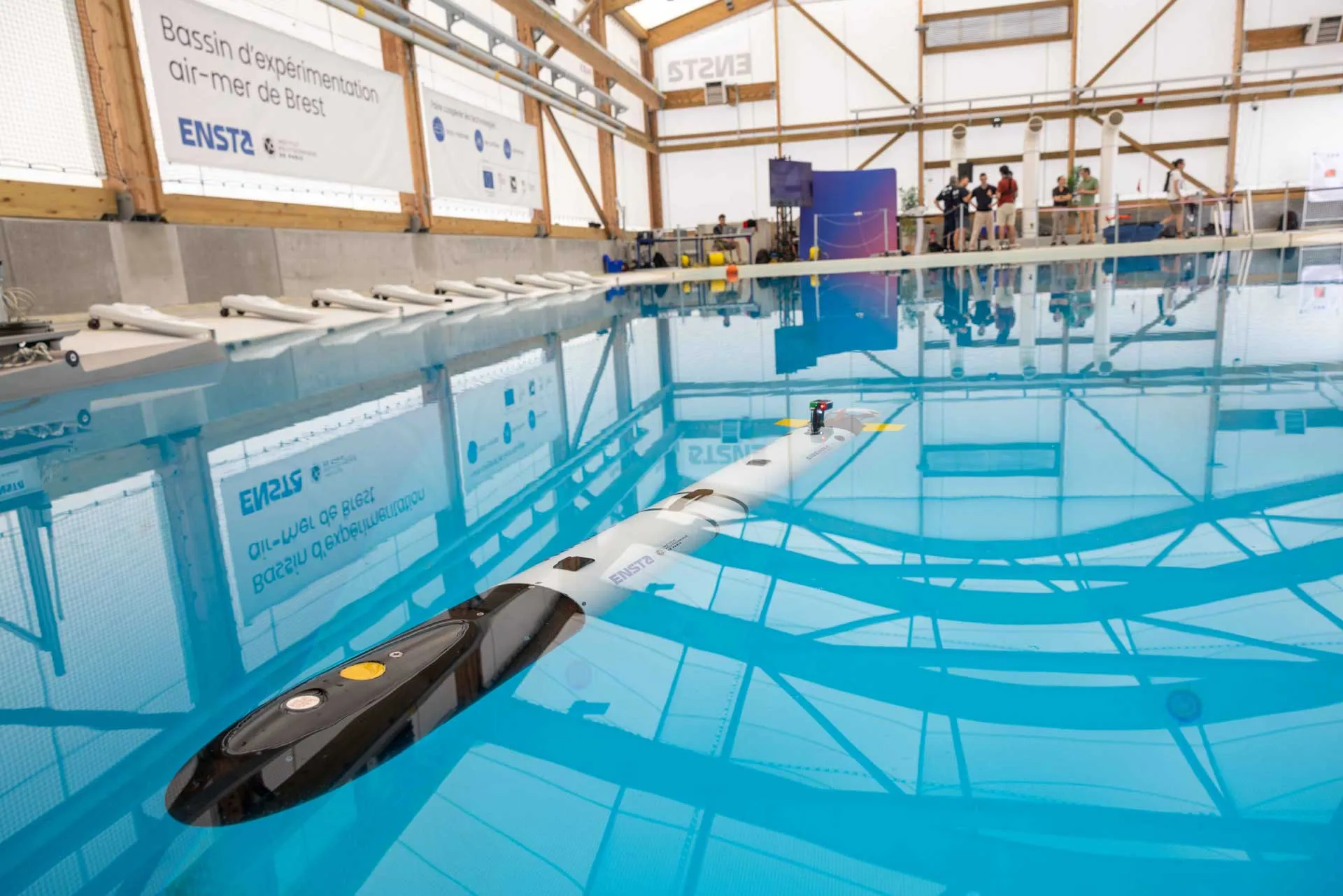
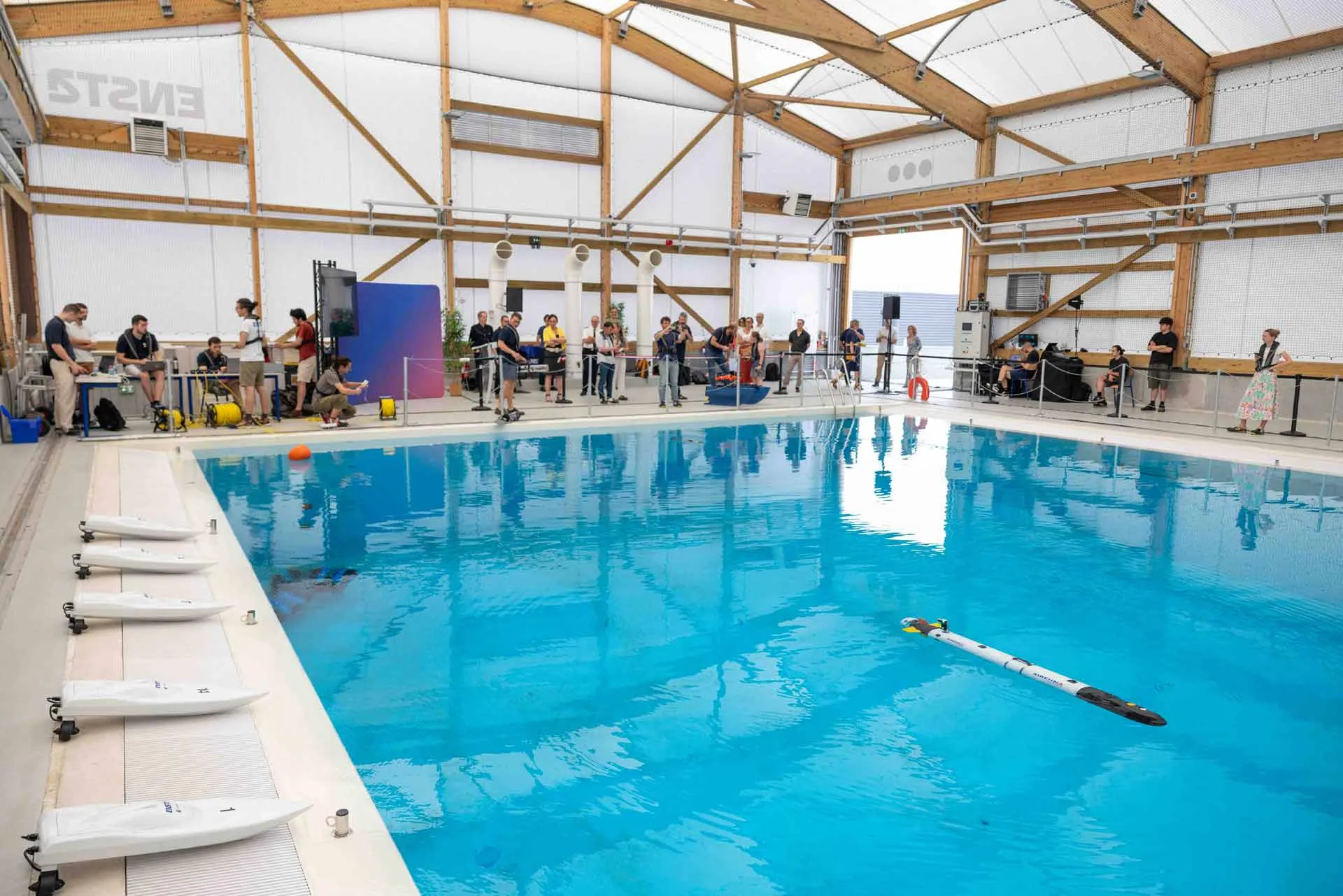
A facility unique in France and Europe, the air-sea experimental tank is located at ENSTA’s Brest campus. It consists of a large basin and a covered aviary, equipped with comprehensive satellite coverage, to test—under controlled, real-world conditions—the cooperation between tomorrow’s autonomous drones and mobile observation systems by combining aerial, surface, and underwater technologies.

An exceptional scientific facility to accelerate maritime innovation

Inaugurated on June 24, 2026, ENSTA’s large air-sea test basin​ is unique in France and Europe.​

  • ​A wide and deep basin ​20 m long x 12 m wide​ x 6 m deep​
  • topped by a 5-meter-high drone aviary​
  • under a shelter, and equipped with full GPS coverage, to conduct tests under controlled, real-world conditions​
  • in the immediate vicinity of the research laboratories, at the heart of a scientific and industrial environment of excellence in marine engineering.

Equipment:

  • a removable bottom covering one-quarter of the basin to reduce its depth
  • an overhead crane for launching heavy loads (large prototypes)
  • a mobile access walkway providing access to all points of the basin
  • a motorized roller shutter that covers the basin and allows tests to be conducted exclusively in aviary mode.

This scientific facility strengthens national and European capabilities for observing and understanding the ocean.

The basin enables testing, in a controlled experimental environment, of the coordination between drones and marine observation systems, combining aerial, surface, and underwater technologies. It offers opportunities for testing prior to at-sea deployments under real-world conditions, thereby serving as a major driver for accelerating innovation for industry and all maritime stakeholders.

Areas of Application

  • Marine energy
  • Maritime transport
  • Seabed modeling and monitoring
  • Deep-sea exploration
  • Maritime defense and security
  • Drones
  • Environmental monitoring and impact assessment
  • Coastal surveillance
  • Marine mammal observation

Key Scientific Themes

  • Multi-environment drone cooperation
  • Underwater acoustics
  • Autonomous mobile robotics
  • Drone fleets
  • Hydrography
  • Oceanography
  • Ocean modeling
  • Sensors
  • Underwater communications
  • Artificial Intelligence

Our latest news

Student Life
A sports challenge in wingfoiling to support medical research

Max Duez is a master’s student at ENSTA and the University of Brest (UBO). This summer, he decided to take on a sporting challenge with his friend Pol: to cover 500 kilometers by wingfoil along the coast of Brittany. It’s a human and charitable adventure...

A sports challenge in wingfoiling to support medical research

Max Duez is a master’s student at ENSTA and the University of Brest (UBO). This summer, he decided to take on a sporting challenge with his friend Pol: to cover 500 kilometers by wingfoil along the coast of Brittany. It’s a human and charitable adventure...

Institute | Training
IETA military engineering students training at ENSTA marched in the July 14 parade

About 40 IETA military students marched on July 14, 2026, on the Champs-Élysées on behalf of ENSTA and the DGA. For the past three weeks, they had been preparing together for this major event for the French armed forces, whose theme was “Europe’s...

IETA military engineering students training at ENSTA marched in the July 14 parade

About 40 IETA military students marched on July 14, 2026, on the Champs-Élysées on behalf of ENSTA and the DGA. For the past three weeks, they had been preparing together for this major event for the French armed forces, whose theme was “Europe’s...

Research
Chaos in Caracas : the role of sediments

During the double earthquake that struck Venezuela on June 24, 2026, damage extended as far as Caracas, the capital, more than 150 km from the epicenter. How can such extensive damage be explained at such a great distance? Jean-François Semblat, a...

Chaos in Caracas : the role of sediments

During the double earthquake that struck Venezuela on June 24, 2026, damage extended as far as Caracas, the capital, more than 150 km from the epicenter. How can such extensive damage be explained at such a great distance? Jean-François Semblat, a...