
Computer Science & System Engineering

The research conducted by Lab-STICC and U2IS is multidisciplinary and meets the needs of industry, government, and society to master critical technologies, protect sensitive data and infrastructure, and monitor the environment.

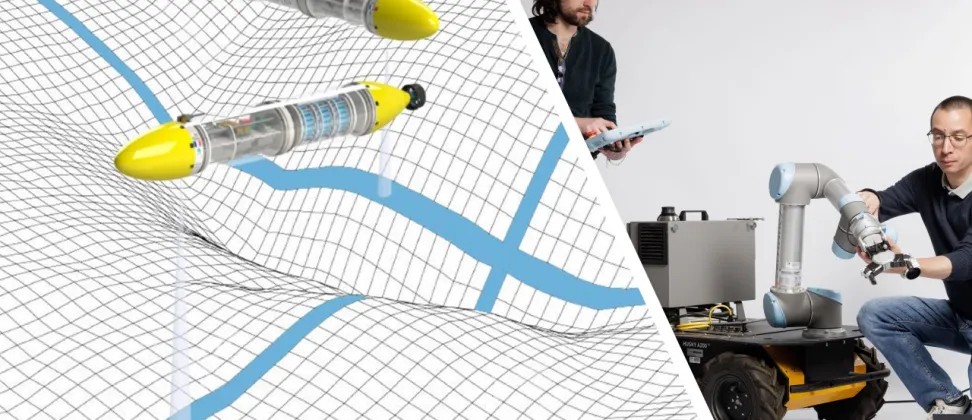
Advanced detection systems and autonomous robotics are essential for surveillance and operations in hostile environments. Embedded AI enables real-time decision-making, and operational safety guarantees system reliability.

At the Interdisciplinary Center for Seas and Oceans (CIMO) at the Institut Polytechnique de Paris, the information sciences focus is on new types of underwater sensors and robots for collecting accurate oceanographic and hydrographic data and modeling ocean-atmosphere interactions in order to enhance environmental monitoring and safety in the marine environment.

On land, increasingly autonomous vehicles that use AI, sensors, and onboard communication are helping to reduce the carbon footprint by ensuring connected and secure mobility.

Digital transformation and industrial innovation are supported by this work, which advances AI, multi-sensor data fusion, and software architectures for embedded systems.

Sectors of application
  • Defense and security
  • Smart and sustainable mobility
  • Environment, oceanography, and climate
  • Digital transformation and innovation

Research themes

AI, EMBEDDED, SAFETY, SENSORS, RADAR, ARCHITECTURES, HARDWARE/SOFTWARE, INFORMATION PROCESSING, ROBOTICS, SONAR, HYDROGRAPHY, OCEANOGRAPHY, OCEAN MODELING

Examples of maritime research projects

ID-GF: Distributed Imager – Deep Sea

France 2030 Project: “Deep Sea”

Today more than ever, the deep seabed is at the heart of strategic national and international issues. With an average depth of 4,500 meters and subject to extremely high pressures, a large portion of the deep seabed remains unexplored. The ID-GF project is a program involving autonomous floats equipped with new hybrid underwater communication systems for deep-sea exploration. A key component of the project—in which ENSTA plays a leading role—involves arranging the floats to form a discreet underwater array. A system incorporating an underwater laser is being developed to enable short-range communication between the floats. Tests on the laser’s range have begun in the test tank.

  • More information


EMOI: Effects of Offshore Wind Energy on Pelagic Ecosystems: Toward Integrated Observation

Project led by IFREMER, ENSTA, and the OPEN-C Foundation (which oversees the five French offshore floating wind test sites).

What are the effects of wind farms on marine ecosystems? As France plans to bring 40 GW of offshore wind power online by 2050, this question requires scientifically indisputable answers. This is precisely the focus of the EMOI project component to which ENSTA is contributing through the use of freely drifting underwater profilers that measure the turbulence induced in the wake of wind turbine towers by ocean currents.

Our latest news

Institute | Training | Innovation | Research
The education and the research at ENSTA at the core of the development of IP Paris

The Institut Polytechnique de Paris’s back-to-term press conference took place on Tuesday 29 September. In particular, it provided an opportunity to highlight ENSTA’s specific contributions and new developments in education that benefit the Institute.
The education and the research at ENSTA at the core of the development of IP Paris

The Institut Polytechnique de Paris’s back-to-term press conference took place on Tuesday 29 September. In particular, it provided an opportunity to highlight ENSTA’s specific contributions and new developments in education that benefit the Institute.

Innovation | Research
SEARENITY, the magnetic hull-cleaning robot designed to decarbonise maritime transport

ENSTA is one of the partners in the SEARENITY project, which was selected under the ‘CORIMER Low-Carbon Ships’ call for proposals (funded by Ademe, France 2030). The project aims to develop an autonomous robot capable of continuously cleaning ship hulls...

SEARENITY, the magnetic hull-cleaning robot designed to decarbonise maritime transport

ENSTA is one of the partners in the SEARENITY project, which was selected under the ‘CORIMER Low-Carbon Ships’ call for proposals (funded by Ademe, France 2030). The project aims to develop an autonomous robot capable of continuously cleaning ship hulls...

Institute | Training
Training a generation of committed engineers

One afternoon in September, in the lecture theatres at ENSTA, groups of around ten students are discussing ideas whilst gathered around large sheets of white paper. Together, with the help of a facilitator, they are placing cards relating to climate...

Training a generation of committed engineers

One afternoon in September, in the lecture theatres at ENSTA, groups of around ten students are discussing ideas whilst gathered around large sheets of white paper. Together, with the help of a facilitator, they are placing cards relating to climate...