
SEARENITY, the magnetic hull-cleaning robot designed to decarbonise maritime transport

Innovation, Research Marine Engineering

ENSTA is one of the partners in the SEARENITY project, which was selected under the ‘CORIMER Low-Carbon Ships’ call for proposals (funded by Ademe, France 2030). The project aims to develop an autonomous robot capable of continuously cleaning ship hulls and limiting the growth of algae and barnacles, with the aim of reducing energy consumption and CO₂ emissions.

Decarbonisation of the maritime sector is well under way

Accounting for nearly 3 per cent of greenhouse gas emissions, the maritime sector is equivalent to the world’s sixth-largest emitter. In 2023, the International Maritime Organisation set a target of carbon neutrality by 2050 for global maritime transport and a reduction of at least 40 per cent by 2030. To achieve these targets, France has drawn up a roadmap and a comprehensive action plan.

Reducing the hydrodynamic drag of ships (resistance to forward motion) is one of the possible measures. This leads to improved energy efficiency, thereby reducing ships’ fuel consumption and associated emissions.

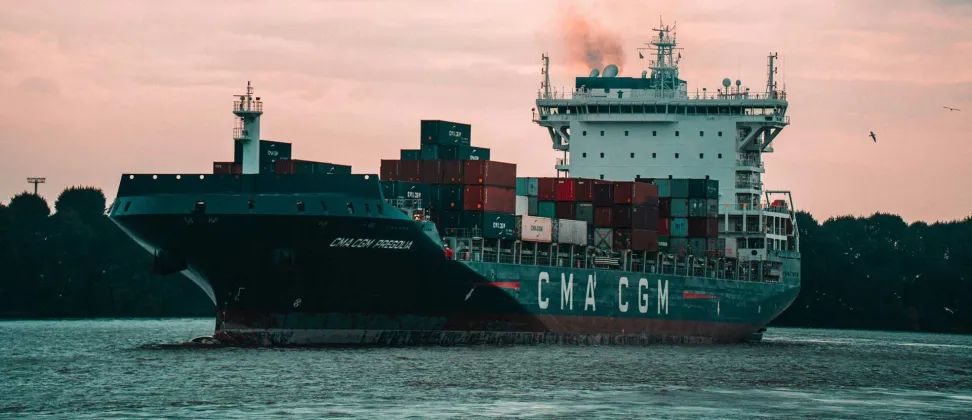
With SEARENITY, the project partners propose to address this issue, not through changes to ship design, but by tackling biofouling, also known as biological fouling. Naturally, within a few hours, micro-organisms settle on the hull of ships and form a thin, oily layer known as a ‘conditioning film’. This biofilm thickens day by day and gradually becomes home to larger organisms such as mussels, clams and barnacles… leading to up to a 25 per cent increase in fuel consumption.

A project with multiple scientific challenges

The SEARENITY project aims to develop an autonomous underwater drone that attaches to the ship’s hull via magnetic attraction. It is designed to operate continuously whilst the ship is underway to remove the biofilm and thus maintain the ship’s hydrodynamic efficiency.

ENSTA is involved in two aspects of the project, both of which present numerous and highly specialised technical challenges:

  • the magnetic attachment system: definition, simulation and testing.
  • the robot’s hydrodynamic aspects: modeling and simulation.

With regard to the magnetic attraction aspect, which I am working on, we must take into account the shape of the ship’s hull, which is not smooth but curved in places, creating complex attraction issues. The thrust of the water on the robot must also be taken into account, as it will have a significant impact on the robot’s stability. Finally, the required magnetic force must be fine-tuned to ensure it does not damage the hull’s paintwork.

Yannick Argouarc’h Associate professor at ENSTA, IRDL laboratory

In the field of naval hydrodynamics, the work of ENSTA researchers focuses on optimising the robot’s geometry using numerical simulation, in order to minimise the forces it is subjected to. The models developed will also undergo validation tests in ENSTA’s new wind tunnel.

We will be examining the forces encountered by the robot underwater under nominal operating conditions, as well as the impact forces experienced when the robot breaks the surface. Indeed, depending on sea state, traversing the wave field can prove to be a particularly critical factor in determining the robot’s stability on the hull.

Pierre-Michel Guilcher Associate professor at ENSTA, IRDL laboratory

In addition to the involvement of two researchers, two engineers will be recruited on fixed-term contracts for this project.

Led by Subsea Tech in partnership with Naval Group, CMA CGM, the University of South Brittany (LBCM laboratory) and ENSTA (IRDL laboratory), the project will run for 42 months and has a total budget of 5.96 million euros, of which 3.95 million euros is funded by the State under the France 2030 programme, administered by ADEME.

Our latest news

Institute | Training
Training a generation of committed engineers

One afternoon in September, in the lecture theatres at ENSTA, groups of around ten students are discussing ideas whilst gathered around large sheets of white paper. Together, with the help of a facilitator, they are placing cards relating to climate...

Training a generation of committed engineers

One afternoon in September, in the lecture theatres at ENSTA, groups of around ten students are discussing ideas whilst gathered around large sheets of white paper. Together, with the help of a facilitator, they are placing cards relating to climate...

Institute | Innovation
MEKA Solutions: A Robot to Make Harvesting Traditional Breton Vegetables Easier

An engineer and the son of a farmer, Corentin Le Méhauté founded MEKA Solutions to provide practical solutions to the challenges facing the agricultural sector. His startup, incubated at ENSTARTUPS, offers a robot designed to assist with vegetable...

MEKA Solutions: A Robot to Make Harvesting Traditional Breton Vegetables Easier

An engineer and the son of a farmer, Corentin Le Méhauté founded MEKA Solutions to provide practical solutions to the challenges facing the agricultural sector. His startup, incubated at ENSTARTUPS, offers a robot designed to assist with vegetable...

Institute | Training | Student Life
First Joint Start of the School Year at ENSTA’s Two Campuses

Marking the completion of the merger that officially began on January 1, 2025, ENSTA’s 2026 academic year was the first to take place simultaneously and via a dual-campus format between the Paris-Saclay and Brest campuses. August 31 was a doubly historic...

First Joint Start of the School Year at ENSTA’s Two Campuses

Marking the completion of the merger that officially began on January 1, 2025, ENSTA’s 2026 academic year was the first to take place simultaneously and via a dual-campus format between the Paris-Saclay and Brest campuses. August 31 was a doubly historic...