
Training a generation of committed engineers

Institute, Training Paris-Saclay & Brest

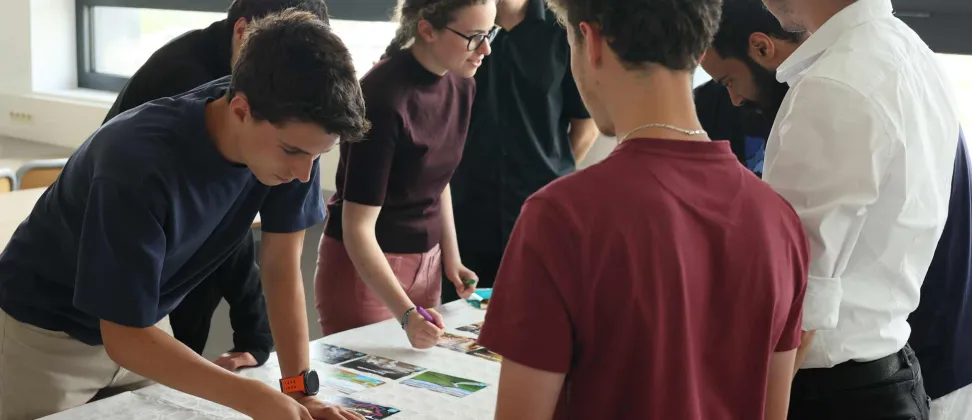
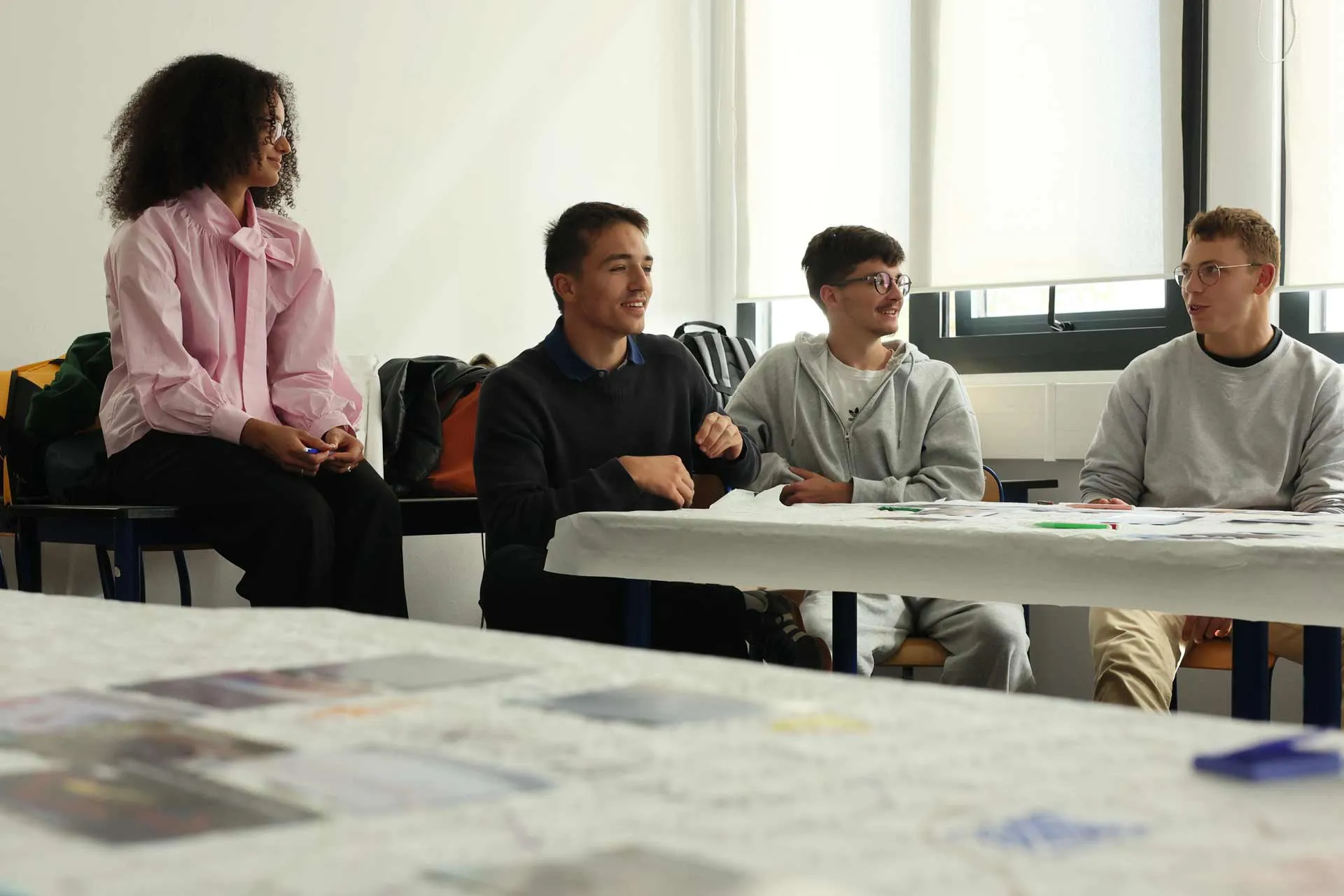
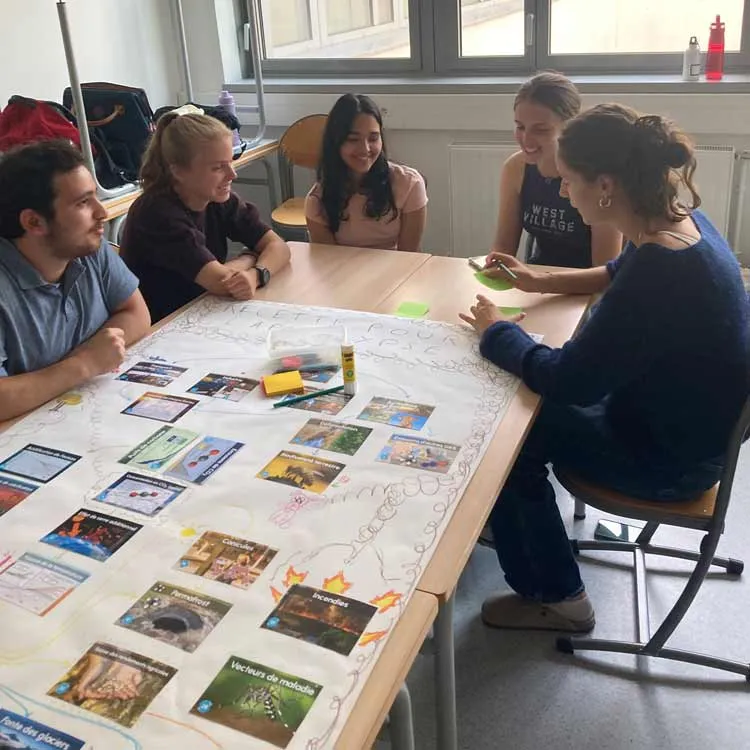
One afternoon in September, in the lecture theatres at ENSTA, groups of around ten students are discussing ideas whilst gathered around large sheets of white paper. Together, with the help of a facilitator, they are placing cards relating to climate change on the sheets and connecting them to piece together the Climate Mural. This marks the starting point for the course dedicated to the socio-ecological transition.

 A l’ENSTA, toutes les formations d’ingénieur intègrent des modules d’enseignement dédiés à la transition socio-écologique. L’approche se veut systémique en début de cursus pour permettre à chaque élève-ingénieur de mesurer les enjeux du développement durable et d’identifier les principaux leviers d’actions. Puis, progressivement, les enseignements deviennent plus spécifiques en lien avec la spécialité choisie offrant ainsi à chaque élève une boite à outils facilement mobilisable.

The systemic approach we have sought to implement enables us to go beyond the issue of carbon and climate change by addressing other challenges such as planetary boundaries. It also provides an opportunity to move beyond the engineer’s traditional role by taking societal impacts into account, hence the inclusion of economics modules, modules relating to social justice, and the use of systems modelling.

Bruno Levieil Associate professor in mechanical engineering, co-head of teaching in the TSE programme

A systemic approach to socio-ecological transition (SET) at the start of the degree programme

In their first year, all ENSTA engineering students take part in the ‘Fresque du Climat’ during the first month of their studies. This three-hour workshop aims to collaboratively illustrate the links between human activities, climate change and its consequences.

Other modules complement this approach. Students are thus taught about planetary boundaries, energy, equality and social justice, and systems modelling… with the aim of sharing a common understanding and the key orders of magnitude essential to grasping the issues at stake.

Students on the MSc in Eng. in Defense and Security also see this curriculum reinforced by a focus on the defense and sovereignty aspects of SET.

A focus on eco-design and life-cycle analysis

The second part of the programme aims to develop proficiency in life cycle assessment (LCA) methodology, drawing on concrete data and critical analysis. Students are encouraged to propose eco-design solutions to minimise the environmental footprint of their product.

The LCA approach requires consideration not only of the product’s manufacturing phase but also of the extraction of raw materials, the transport of the product to distribution centres, the impact of its use, and its recycling or disposal at the end of its life. In addition to this step-by-step analysis, LCA is also a multi-criteria assessment, as it enables an examination of environmental impacts beyond carbon, such as water use or land use, for example.

Further courses to explore the subject in greater depth

In addition to this core body of knowledge shared by all engineering students, elective modules are offered as part of the general engineering programme relating to transitions, particularly regarding low-tech solutions.

In their final year, as part of their Specializations, students are made aware of the specific challenges facing their future professional field: materials, transport, energy, etc. These modules are complemented by a humanities course dedicated to the responsibility of stakeholders.

Bruno Levieil concludes:

“This programme is the result of discussions and an educational tradition that has existed for several years across ENSTA’s two campuses. It brings together numerous lecturers and external contributors to enable our engineering students to gain a holistic understanding of the subject. Finally, it has been made possible by the trainer development initiatives launched by Catherine Adam, a lecturer and researcher at ENSTA, through the Holi-D Blue and Blue Training Horizons projects. Trainer development is a key element that we will continue to pursue in the coming years in order to mainstream and ensure the long-term sustainability of the TSE curriculum.”

Our latest news

Institute | Innovation
MEKA Solutions: A Robot to Make Harvesting Traditional Breton Vegetables Easier

An engineer and the son of a farmer, Corentin Le Méhauté founded MEKA Solutions to provide practical solutions to the challenges facing the agricultural sector. His startup, incubated at ENSTARTUPS, offers a robot designed to assist with vegetable...
MEKA Solutions: A Robot to Make Harvesting Traditional Breton Vegetables Easier

An engineer and the son of a farmer, Corentin Le Méhauté founded MEKA Solutions to provide practical solutions to the challenges facing the agricultural sector. His startup, incubated at ENSTARTUPS, offers a robot designed to assist with vegetable...

Institute | Training | Student Life
First Joint Start of the School Year at ENSTA’s Two Campuses

Marking the completion of the merger that officially began on January 1, 2025, ENSTA’s 2026 academic year was the first to take place simultaneously and via a dual-campus format between the Paris-Saclay and Brest campuses. August 31 was a doubly historic...

First Joint Start of the School Year at ENSTA’s Two Campuses

Marking the completion of the merger that officially began on January 1, 2025, ENSTA’s 2026 academic year was the first to take place simultaneously and via a dual-campus format between the Paris-Saclay and Brest campuses. August 31 was a doubly historic...

Alumni | Innovation
We.Deploy(Science): The Startup Optimizing Vessel Performance

Founded in late 2024, the startup We.Deploy(Science) was created by Nedeleg Bigi and Hugo Kerhascoët, two childhood friends with a passion for sailing and engineering. Thanks to their complementary skills, they specialize in the control and optimization...

We.Deploy(Science): The Startup Optimizing Vessel Performance

Founded in late 2024, the startup We.Deploy(Science) was created by Nedeleg Bigi and Hugo Kerhascoët, two childhood friends with a passion for sailing and engineering. Thanks to their complementary skills, they specialize in the control and optimization...