
Franck Ruffier, a researcher in bio-inspired robotics

Research Digital Science & Engineering
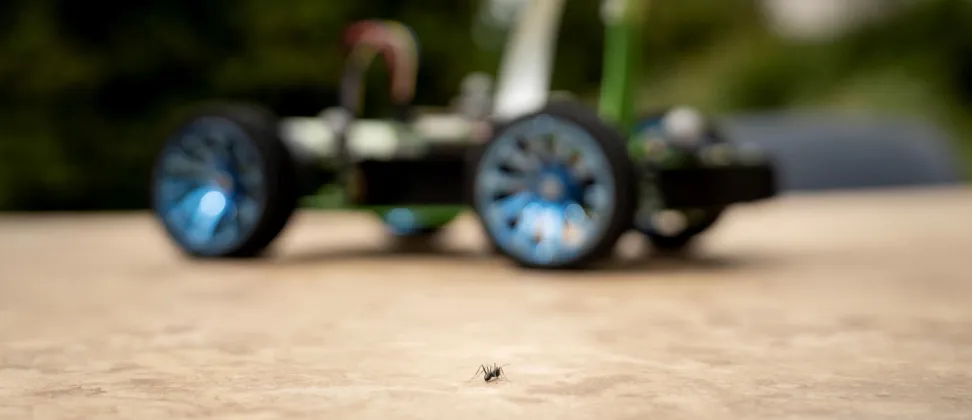
Projet Antcar ©Tifenn Ripoll - VOST Collectif / Institut Carnot STAR

Recently appointed to the ENSTA campus in Brest, Franck Ruffier is a CNRS research director in robotics in the ROBEX team at Lab-STICC. His research projects are inspired by living organisms. At the crossroads of biology and robotics, he explores animal vision to create frugal bio-inspired robots.

In this era of big data and rapid growth in data centers around the world, Franck Ruffier's research goes against the grain. His credo: to develop frugal robots using biomimetic perception.

Nature does a lot with very little. By drawing on visible phenomena in nature, such as the behavior of butterflies and ants, and especially their neuroanatomy, we can accurately model the visuomotor behavior of these animals and transfer it to small robots. To do this, we use images with a very low number of pixels, which generate a small amount of information and consume very little energy.

Franck Ruffier CNRS Research Director

Among Franck Ruffier's recent projects is “Flocking by eyes,” which focuses on the collective behavior identified in schools of fish or flocks of starlings. The swarm of robots developed is based on four identified rules: attraction (the desire to stay together); alignment (the desire to move in the same direction as one's neighbors); avoidance (of collisions); and anchoring (limiting the area of movement).

Another original project, “Antcar,” is inspired by Andalusian ants, whose vision relies on the massive visual contrasts present in their environment, such as those created by the horizon, trees, or buildings. This project requires much less complex and energy-intensive information than a high-resolution image for the robot to move.

The project, which received the Biomim'Expo 2025 award in the research category, is explained in more detail by Franck Ruffier in France Culture's « Avec sciences » podcast.

His arrival in Brittany has enabled Franck Ruffier to initiate new research activities focused on the maritime field (surface and underwater robots).

Franck Ruffier ©Germain Verhille

There are many similarities between insects and crustaceans in terms of their compound eyes and neural structure. This gives me many ideas for research projects to explore this new universe, always with frugality in mind.

To facilitate testing of future drones, a new experimental basin measuring 20 meters by 12 meters and 6 meters deep will soon be put into service on the ENSTA campus in Brest: an incredible playground, unique in France, which offers many opportunities for researchers.

Our latest news

Institute | Training
IETA military engineering students training at ENSTA marched in the July 14 parade

About 40 IETA military students marched on July 14, 2026, on the Champs-Élysées on behalf of ENSTA and the DGA. For the past three weeks, they had been preparing together for this major event for the French armed forces, whose theme was “Europe’s...

IETA military engineering students training at ENSTA marched in the July 14 parade

About 40 IETA military students marched on July 14, 2026, on the Champs-Élysées on behalf of ENSTA and the DGA. For the past three weeks, they had been preparing together for this major event for the French armed forces, whose theme was “Europe’s...

Research
Chaos in Caracas : the role of sediments

During the double earthquake that struck Venezuela on June 24, 2026, damage extended as far as Caracas, the capital, more than 150 km from the epicenter. How can such extensive damage be explained at such a great distance? Jean-François Semblat, a...

Chaos in Caracas : the role of sediments

During the double earthquake that struck Venezuela on June 24, 2026, damage extended as far as Caracas, the capital, more than 150 km from the epicenter. How can such extensive damage be explained at such a great distance? Jean-François Semblat, a...

Research
APRO : Teaching Drones to Go Unnoticed

Whether used for urgent deliveries or autonomous flying taxi services, drones could help solve many of the problems plaguing our congested city centers—provided, that is, that their main nuisance is reduced: that annoying, giant-mosquito-like buzz caused...

APRO : Teaching Drones to Go Unnoticed

Whether used for urgent deliveries or autonomous flying taxi services, drones could help solve many of the problems plaguing our congested city centers—provided, that is, that their main nuisance is reduced: that annoying, giant-mosquito-like buzz caused...