
Adnan Saood: a touch of feeling in robotics

Innovation, Research Engineering for health, Digital Science & Engineering
Adnan Saood

Robots can already see, hear, and even smell, but their sense of touch remains very rudimentary and is more akin to obstacle detection than any kind of dexterity. How can this be improved? This is the focus of the thesis work of Adnan Saood, a doctoral student at ENSTA who was recently awarded a prize by the Fédération Demeny Vaucanson.

As a child, when he was building robots from Lego's “Technic” range, Adnan Saood could never have imagined that one day he would be working on giving their distant descendants the most universal sense in the living world: touch.

"I have been passionate about robotics and engineering since I was very young, and I became interested in the issue of touch for robots following discussions with my professors. It is an exciting challenge that involves not only engineering and materials science, but also psychological aspects concerning interactions between robots and humans. And I love taking on this kind of complex challenge."

But does this challenge, which he is undertaking at ENSTA's U2IS under the supervision of Professor Adriana Tapus, have any practical use? Adnan's answer is immediate:

Adnan Saood

"It's an absolutely crucial aspect in improving interactions between humans and robots, and everything we call social robotics. Imagine a robot tasked with helping an elderly person get up after a fall or simply get out of their chair. If it doesn't have a very fine perception of the person's body, weight, and reactions, it can very quickly turn into a disaster. “

But the reverse is also true, especially when it comes to accepting simple interaction with a robot.

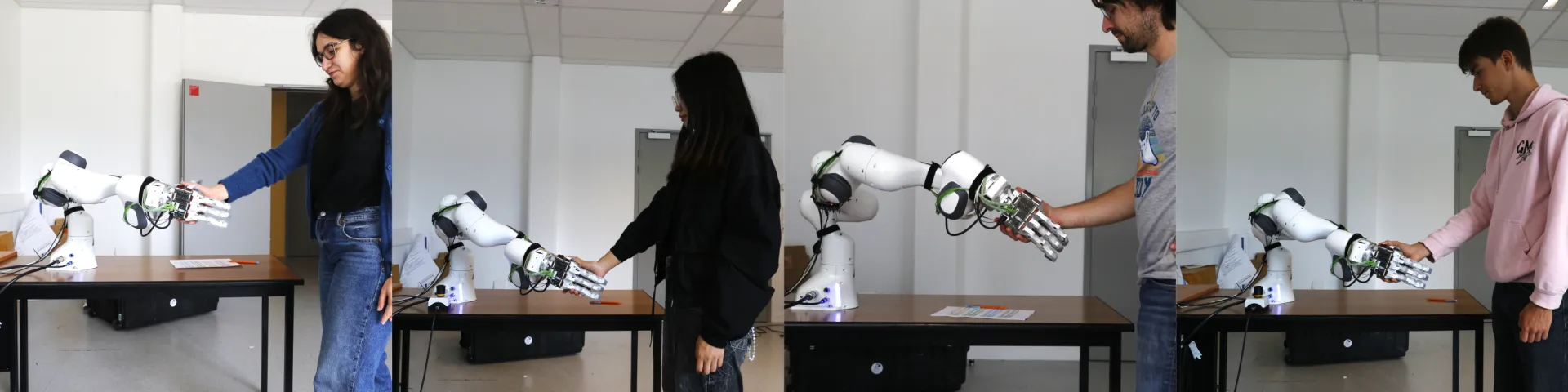
Are you ready to shake hands with a robot with confidence?

”Until now, humanoid robots have been considered computers hidden under a more or less human-shaped shell. My thesis aims to develop devices that allow robots to be perceived as companions, capable of sensing our presence through touch and adapting to it. The idea is that humans feel safe and comfortable when cared for by robots, just as they would with other people."

In other words, the idea is to develop a new interface that would be analogous to skin, capable of detecting, feeling, and reacting appropriately to human contact.

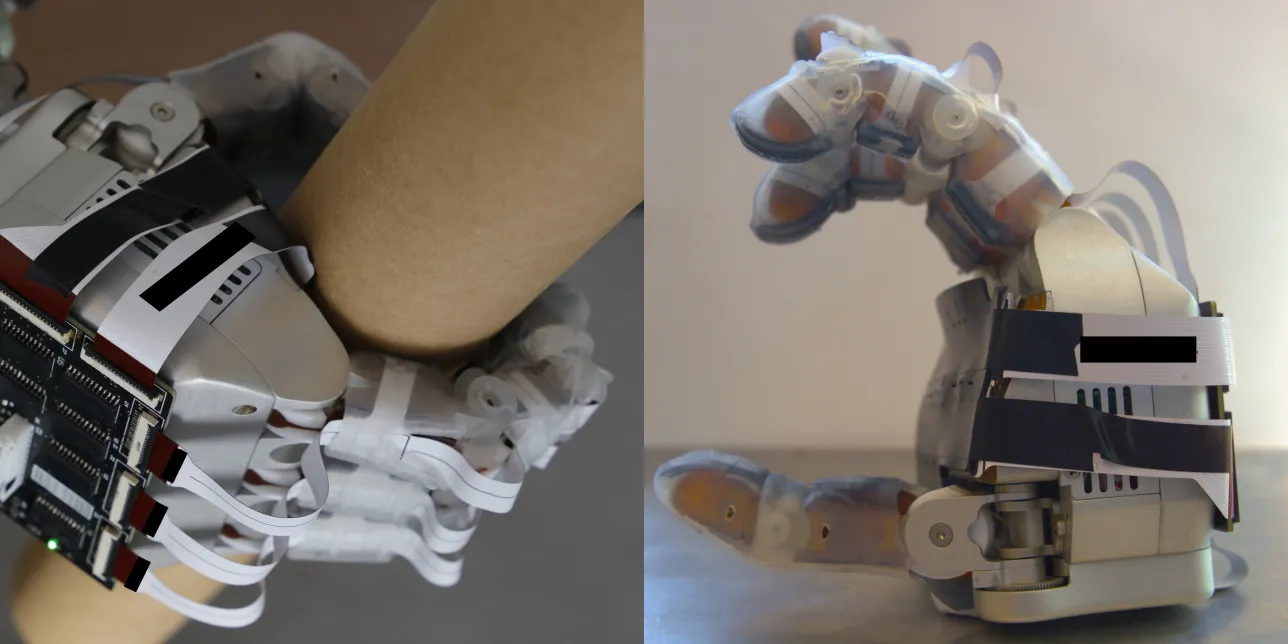
"We tested a lot of formulas to find the ideal synthetic skin, one that people would not be repelled from touching because it was too slimy or sticky, and one that was also sufficiently resistant. The best material we have developed is a special blend of silicone that we mold into different shapes. For example, for a hand, we mold the fingertips, phalanges, palm, etc."

Robotic hand coated with silicone

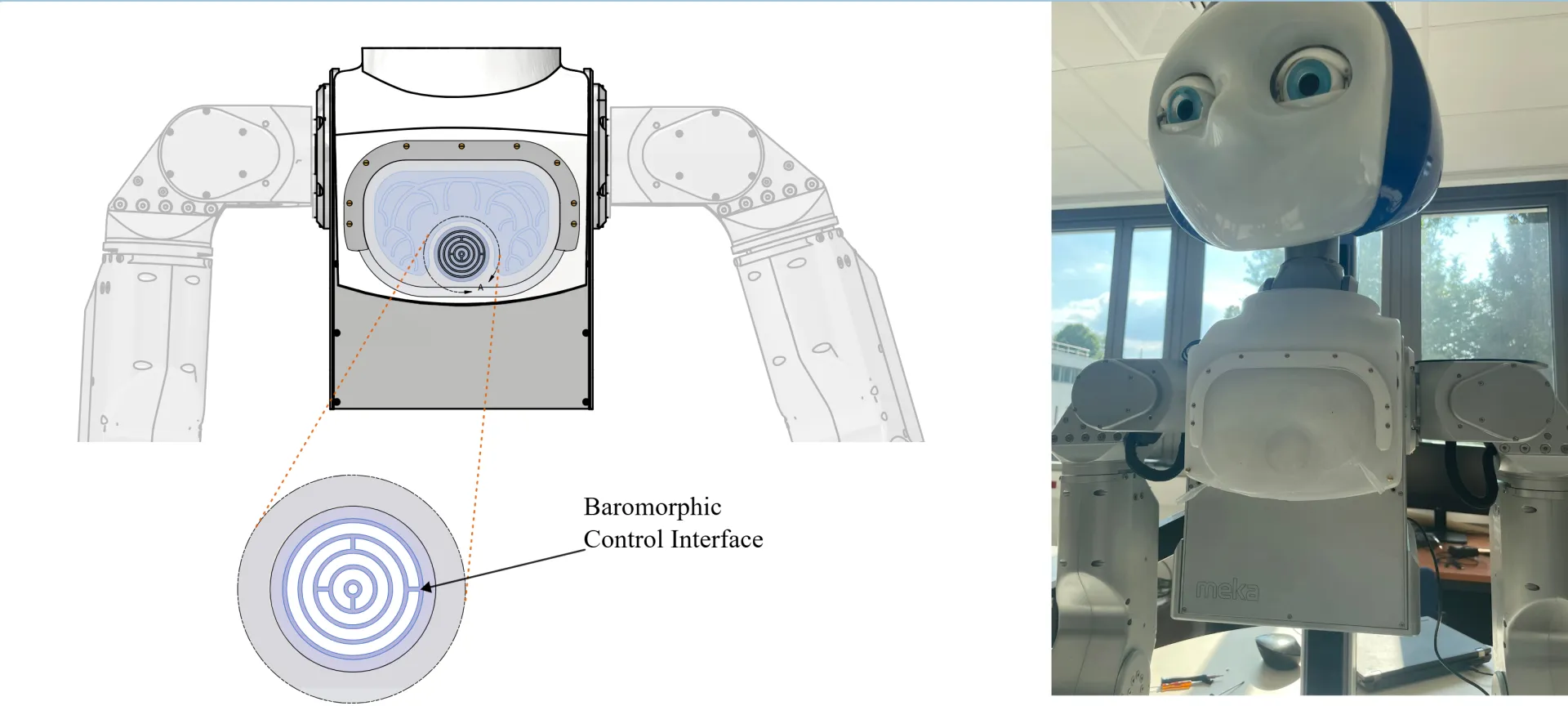
With his thesis supervisor Adriana Tapus, Adnan Saood set out to take mimicry even further, reproducing breathing and heartbeats using pneumatic systems, such as compressed air.

“During an experiment involving contact with our devices, one of the testers told us that she had the same feeling as when her cat came to snuggle up against her. That's when I realized we were on the right track.”

Device simulating breathing on a robot

Currently in the second year of his thesis, Adnan Saood still has a lot of work to do before we are ready to confidently surrender ourselves to the arms of his robots.

"I plan to tackle the issue of body temperature during my final year of my thesis, but in principle it shouldn't be too complicated. Since we're using compressed air, it's fairly simple to bring it to a temperature of 37°C. The best method will be the simplest and most reliable.

Although he does not yet know whether he will continue in research or industry after his doctorate, Adnan Saood wants to send a message to engineering students who are hesitating between pursuing a thesis or entering the business world directly once they have their degree:

Doing a thesis is a very formative experience that prepares you even better for entering the professional world. By definition, a thesis can only be completed in project mode: you are confronted with very concrete questions about the best way to approach and solve new problems. You learn a very fruitful way of reformulating problems and tackling difficulties, and it is very important for a future industry executive to acquire this skill, whatever the sector in question."

Our latest news

Institute | Training
IETA military engineering students training at ENSTA marched in the July 14 parade

About 40 IETA military students marched on July 14, 2026, on the Champs-Élysées on behalf of ENSTA and the DGA. For the past three weeks, they had been preparing together for this major event for the French armed forces, whose theme was “Europe’s...

IETA military engineering students training at ENSTA marched in the July 14 parade

About 40 IETA military students marched on July 14, 2026, on the Champs-Élysées on behalf of ENSTA and the DGA. For the past three weeks, they had been preparing together for this major event for the French armed forces, whose theme was “Europe’s...

Research
Chaos in Caracas : the role of sediments

During the double earthquake that struck Venezuela on June 24, 2026, damage extended as far as Caracas, the capital, more than 150 km from the epicenter. How can such extensive damage be explained at such a great distance? Jean-François Semblat, a...

Chaos in Caracas : the role of sediments

During the double earthquake that struck Venezuela on June 24, 2026, damage extended as far as Caracas, the capital, more than 150 km from the epicenter. How can such extensive damage be explained at such a great distance? Jean-François Semblat, a...

Research
APRO : Teaching Drones to Go Unnoticed

Whether used for urgent deliveries or autonomous flying taxi services, drones could help solve many of the problems plaguing our congested city centers—provided, that is, that their main nuisance is reduced: that annoying, giant-mosquito-like buzz caused...

APRO : Teaching Drones to Go Unnoticed

Whether used for urgent deliveries or autonomous flying taxi services, drones could help solve many of the problems plaguing our congested city centers—provided, that is, that their main nuisance is reduced: that annoying, giant-mosquito-like buzz caused...