Deep-sea exploration: The MARTOC project selected by France 2030

Research Marine Engineering

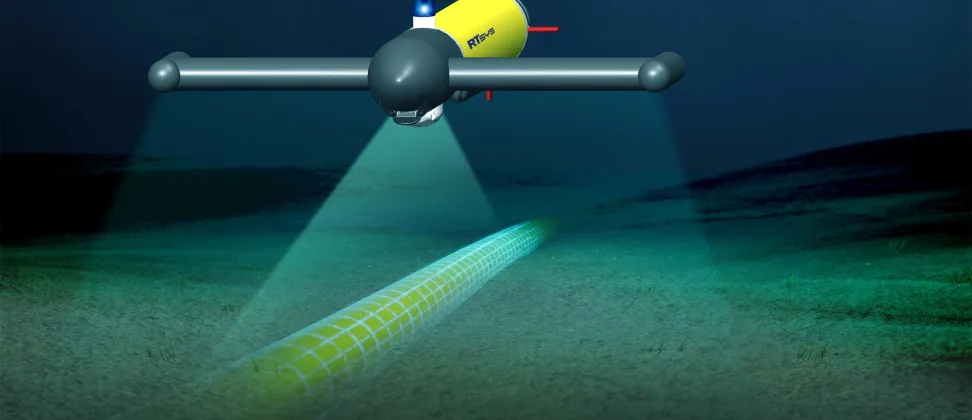
Winner of the France 2030 “Grands Fonds Marins” (“Deep Sea”) call for projects, the MARTOC project brings together RTSys (project leader), Orange Marine, Mappem Geophysics and ENSTA Bretagne with the aim of developing an autonomous solution for the detection, monitoring and control of submarine cables using an underwater drone capable of operating at a depth of 3,000 meters.

Doté d’un ensemble de capteurs complémentaires, passifs (magnétomètre flux-gate, caméra) et actifs (capteur électromagnétique, sonar frontal), « COMET-3000 » est un drone autonome sous-marin (AUV) compact. 

Développé pour intervenir en grande profondeur, il pourra être facilement déployé depuis un navire de surface dans le cadre de missions de cartographie (mesure d’enfouissement) ou de surveillance (menace de piratage).

Equipped with a range of complementary passive (fluxgate magnetometer and camera) and active (electromagnetic sensor and front-end sonar) sensors, the “COMET-3000” is a compact autonomous underwater vehicle (AUV). Designed to operate at great depths, it can be easily deployed from a surface vessel for mapping missions (measuring seafloor sediments) or threat surveillance (piracy).

The project was launched in February 2024 and will run for 3 years.For ENSTA Bretagne, it involves the recruitment of two research engineers.

The research conducted on campus will contribute to: 

  • R&D on magnetic and acoustic sensors,
  • the positioning of these sensors,
  • and the processing and analysis of their data.

A host of scientific challenges

There are many scientific hurdles to overcome when working on this type of project. Operating an autonomous vehicle at a depth of 3,000 meters is one challenge. Reliable positioning and optimal data collection is another. Finally, the cables laid at great depths are smaller and have no metal reinforcement, making them more difficult to identify with conventional sensors. The algorithms used must therefore be able to combine the data from the various sensors on board and process it efficiently.

In addition to designing the AUV and developing on-board technologies, the project also includes the development of a Launch And Recovery System (LARS). Installed on cable-laying vessels, the LARS will facilitate the launch and retrieval of the AUV.

The MARTOC project is a collaboration of 4 partners with complementary skills:

  • RTSys is a company based in Caudan (Morbihan, France) and Singapore that develops high-tech solutions in the field of underwater robotics and acoustics.
  • Orange Marine is a French company specializing in submarine cable laying. It represents more than 15% of the world’s cable-laying fleet. The company has already laid 264,000 km of fiber optic submarine cables.
  • Mappem Geophysics is an innovative SME based in Finistère, specialized in marine electromagnetics (developing electromagnetic instruments and methods, site surveys, etc.).
  • ENSTA Bretagne is a leading engineering school and research center located in Brest. Its training and research activities target the maritime, defense, transport and mobility, digital, energy and aerospace sectors.

ENSTA Bretagne is also involved in another “Grands Fonds Marins” (“Deep Sea”) project involving the creation of a deep sea distributed imager (ID-GD - Imageur Distribué Grands Fonds): a highly innovative concept involving a swarm of drones forming a vast acoustic antenna. 

Lire aussi

Our latest news

Institute | Training
IETA military engineering students training at ENSTA marched in the July 14 parade

About 40 IETA military students marched on July 14, 2026, on the Champs-Élysées on behalf of ENSTA and the DGA. For the past three weeks, they had been preparing together for this major event for the French armed forces, whose theme was “Europe’s...

IETA military engineering students training at ENSTA marched in the July 14 parade

About 40 IETA military students marched on July 14, 2026, on the Champs-Élysées on behalf of ENSTA and the DGA. For the past three weeks, they had been preparing together for this major event for the French armed forces, whose theme was “Europe’s...

Research
Chaos in Caracas : the role of sediments

During the double earthquake that struck Venezuela on June 24, 2026, damage extended as far as Caracas, the capital, more than 150 km from the epicenter. How can such extensive damage be explained at such a great distance? Jean-François Semblat, a...

Chaos in Caracas : the role of sediments

During the double earthquake that struck Venezuela on June 24, 2026, damage extended as far as Caracas, the capital, more than 150 km from the epicenter. How can such extensive damage be explained at such a great distance? Jean-François Semblat, a...

Research
APRO : Teaching Drones to Go Unnoticed

Whether used for urgent deliveries or autonomous flying taxi services, drones could help solve many of the problems plaguing our congested city centers—provided, that is, that their main nuisance is reduced: that annoying, giant-mosquito-like buzz caused...

APRO : Teaching Drones to Go Unnoticed

Whether used for urgent deliveries or autonomous flying taxi services, drones could help solve many of the problems plaguing our congested city centers—provided, that is, that their main nuisance is reduced: that annoying, giant-mosquito-like buzz caused...