Joséphine Monzac, passionate about physics

Alumni, Training, Research
Joséphine Monzac and Euler's formula

Is attending an MSc in Engineering in a French "Grande École" the best path to research? In any case, that is the path taken by Joséphine Monzac, ENSTA 2021, who has just defended her doctoral thesis, as do about one-third of each graduating class from the school's generalist program.

After completing her preparatory classes at the Lycée Pierre de Fermat in Toulouse, Joséphine Monzac chose to enroll at ENSTA because the school offers a general program that is among the most comprehensive in physics and mathematics.

Passionate about physics since her early childhood, Joséphine Monzac found at ENSTA everything she needed to quench her thirst for advanced scientific knowledge, to the point of distinguishing herself at the prestigious International Physics Tournament (IPT), where her team, coached by Professor Jérôme Perez, took first place in the French selection.

Even before graduating, Joséphine Monzac was thinking about what to do next and considering all the possibilities.

« From what I had seen during my internships and in discussions with former students, I understood that ENSTA graduates could very quickly be called upon to take on managerial responsibilities. It's great that the ENSTA degree is so highly valued in the working world, but personally, I preferred to continue studying physics. So the idea of pursuing a PhD naturally came to mind. »

After completing a third year as a substitute in the advanced physics program at École Polytechnique, Joséphine Monzac feels perfectly equipped to begin a doctoral thesis. She will be working at the Laboratoire d'optique appliquée, one of the ENSTA laboratories (CNRS-ENSTA-École Polytechnique-UMR 7639) under the supervision of Jérôme Faure

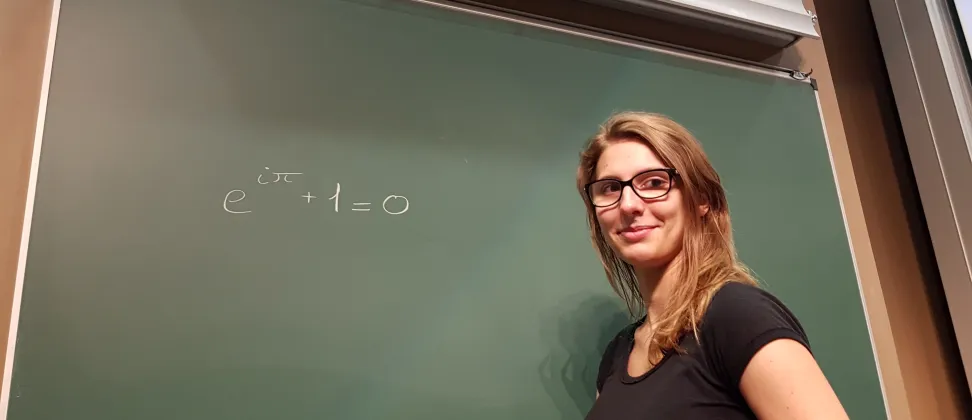
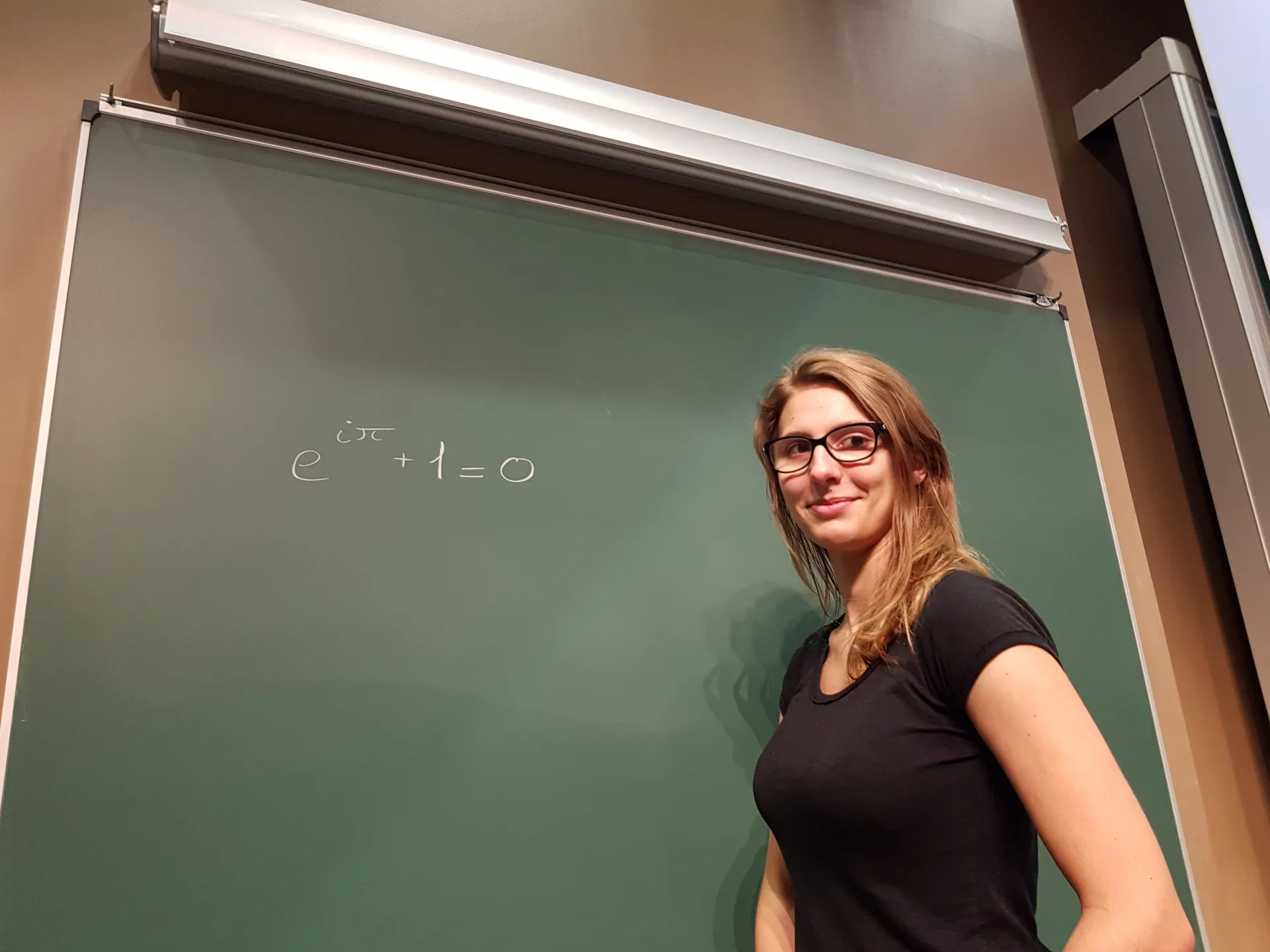
Joséphine Monzac next to Euler's identity, which Richard Feynman considered to be the most remarkable formula in mathematics

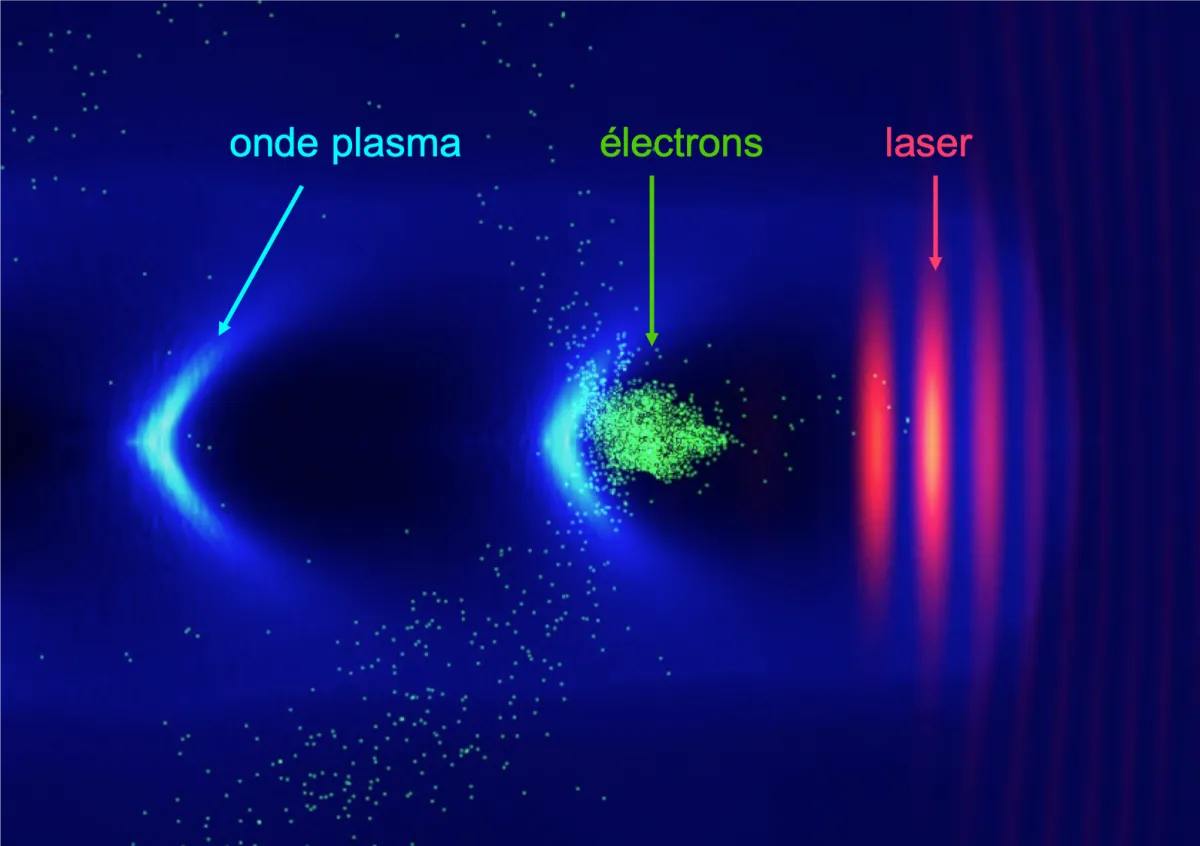
One of the LOA's research topics is laser-plasma acceleration, one of the most promising applications of lasers for the coming decades. The idea is to interact an ultra-short laser with plasma (a state of matter in which electrons are separated from atoms) to accelerate electrons to a speed close to that of light over an extremely short distance, on the order of a centimeter.

This fantastic acceleration capacity far exceeds that of conventional particle accelerators, which still require several tens of meters of acceleration to achieve the same result.

Principle of laser-plasma acceleration developed at LOA

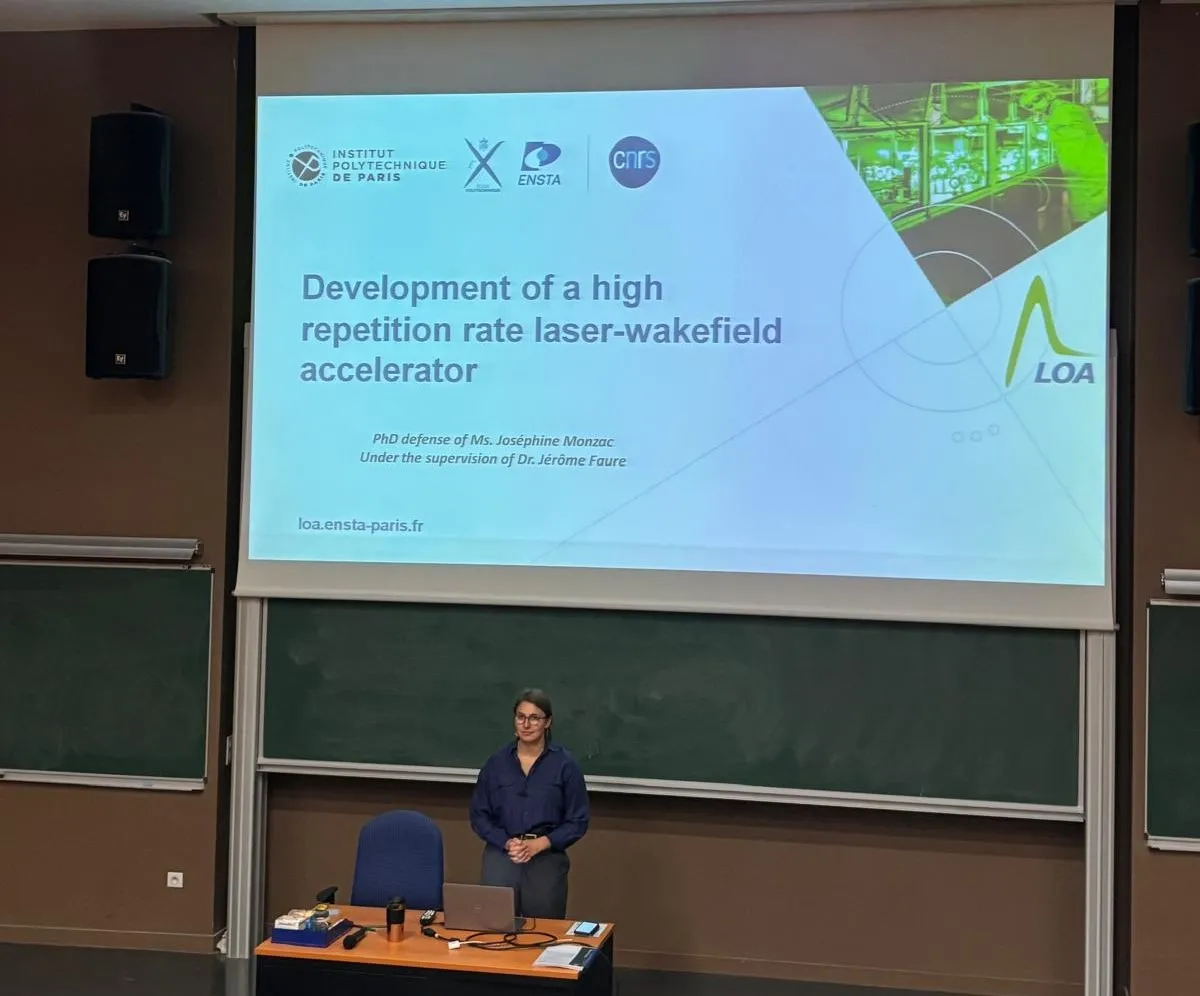
This principle, first proposed by researchers Tajima and Dawson in 1979, is now a very active area of research, with a record electron acceleration energy of 8 gigaelectronvolts achieved in 2019. The LOA is already establishing itself as one of the leading laboratories in this field, and its future Laplace center, currently under construction, aims to be the next spearhead for laser-plasma accelerators. However, one limitation of laser-plasma accelerators today is their low rate compared to traditional accelerators. This was precisely the subject of Joséphine Monzac's thesis, which focused on the possibility of accelerating an electron beam 1,000 times per second.

Joséphine Monzac's work has improved the performance of the LOA's high-frequency laser-plasma accelerator, known as the “Orange Room.” The energy of the electrons produced has increased from 3 to 7 MeV while maintaining a kHz frequency by using hydrogen plasma instead of nitrogen, with a very good explanation of the mechanism causing this gain when changing gases.


The good performance in terms of stability and energy, and the high repetition rates achieved, made it possible to produce a first electron diffraction image, paving the way for a novel method of investigating the organization and behavior of materials at the atomic scale.

Joséphine Monzac during her thesis defense

Since obtaining her doctorate, Joséphine Monzac has begun a postdoctoral contract at the Plasma and Energy Conversion Laboratory in Toulouse. There, she continues her passionate exploration of experimental physics, particularly plasmas, in the context of space propulsion using highly fuel-efficient plasma engines, which is a key factor for long-duration space missions.

Our latest news

Press release | Innovation | Research
LARIAD, laboratory of the future for defense robotics

On Wednesday, February 18, Estelle Iacona, Director General of ENSTA, and Bertrand Rondepierre, Director of AMIAD, signed the agreement to create LARIAD, the Robotics and AI Laboratory for Defense. Aimed at developing the research programs of both...

LARIAD, laboratory of the future for defense robotics

On Wednesday, February 18, Estelle Iacona, Director General of ENSTA, and Bertrand Rondepierre, Director of AMIAD, signed the agreement to create LARIAD, the Robotics and AI Laboratory for Defense. Aimed at developing the research programs of both...

Company | Innovation
What if we put wind turbines in the sky?

Generating renewable electricity at an altitude of 1,000 meters using airships—held to the ground by a cable—equipped with wind turbines: this is the bold challenge taken up by Venturix. Founded by engineer Guillaume Desrocques, the start-up, winner of...

What if we put wind turbines in the sky?

Generating renewable electricity at an altitude of 1,000 meters using airships—held to the ground by a cable—equipped with wind turbines: this is the bold challenge taken up by Venturix. Founded by engineer Guillaume Desrocques, the start-up, winner of...

Institute | Training
"DG sur écoute" : interview with Estelle Iacona

In an interview with Thotis, Estelle Iacona, Director General of ENSTA since 2025, outlines the school's main priorities one year after the merger between ENSTA Paris and ENSTA Bretagne.

"DG sur écoute" : interview with Estelle Iacona

In an interview with Thotis, Estelle Iacona, Director General of ENSTA since 2025, outlines the school's main priorities one year after the merger between ENSTA Paris and ENSTA Bretagne.