Apprenticeship program: 2nd year

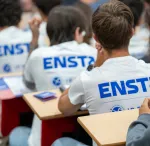
The second year of the apprenticeship program consists of 20 weeks at the School and 34 weeks in a company, alternating between four weeks at the School and four weeks in a company until mid-May, followed by full-time work in a company.

The second year of the apprenticeship program consists of 20 weeks at the School and 34 weeks in a company, alternating between four weeks at the School and four weeks in a company until mid-May, followed by full-time work in a company.
Students begin to specialize in the School's areas of excellence with a major in “Fundamentals of Complex Systems Design” and a minor in “Mechanical Design” or “Artificial Intelligence.”

The mechanical engineering minor is designed as a project-based learning program centered around a common theme proposed by a partner company (in 2023-2024, EDF: design of an offshore wind farm).

The Artificial Intelligence minor concludes with participation in a Hackathon organized by the Hi! Paris interdisciplinary center of IP Paris and HEC dedicated to artificial intelligence.

Course details

Scientific and Technical Courses

Major

  • Fundamentals of Complex Systems Design
  • Object-Oriented Programming in C++
  • Principles of Computer Networks
  • Databases
  • Differentiable Optimization Introduction to Operations Research
  • Statistical Modeling
  • Automation
  • Internet of Things and Connected Objects
  • Introduction to Machine Learning
  • Computer-Aided Design

Choice of one minor from two options:

Mechanical minor

  • Modeling of slender structures
  • Nonlinear behavior of materials
  • Dynamics of mechanical systems: waves and vibrations
  • Numerical modeling in structural mechanics
  • Numerical modeling in fluid mechanics
  • Mechanical capstone project

Artificial Intelligence minor

  • Introduction to data science
  • Statistical learning
  • Vision and learning
  • Graphs and game theory
  • Introduction to MLOps (Machine Learning Operations)
  • Hi! Paris AI Hackathon

Methods and tools for engineers

  • Introduction to systems engineering methods

Openness and personal development

  • Business sociology
  • English
  • Second language
  • Sports

Professional integration and business knowledge

  • Accounting and Financial Analysis
  • Project Management
  • Preparation for the Company Assignment
  • Preparation for Professional Integration
  • Strategic and Financial Analysis of the Company

Company Assignment

  • Assignment Evaluation
  • Analysis Sheet of your choice

This program may be modified according to changes decided by the ENSTA's governing bodies (Training Council and Board of Directors).

Schedule and pace of the work placement:

  • Until mid-May: four weeks at ENSTA, four weeks in a company
  • From mid-May to the end of August: full-time in a company
  • 20 weeks at school, 34 weeks in a company (including vacations and international stays)

The other years of the work-study program

Our latest news

Institute | Training
IETA military engineering students training at ENSTA marched in the July 14 parade

About 40 IETA military students marched on July 14, 2026, on the Champs-Élysées on behalf of ENSTA and the DGA. For the past three weeks, they had been preparing together for this major event for the French armed forces, whose theme was “Europe’s...

IETA military engineering students training at ENSTA marched in the July 14 parade

About 40 IETA military students marched on July 14, 2026, on the Champs-Élysées on behalf of ENSTA and the DGA. For the past three weeks, they had been preparing together for this major event for the French armed forces, whose theme was “Europe’s...

Research
Chaos in Caracas : the role of sediments

During the double earthquake that struck Venezuela on June 24, 2026, damage extended as far as Caracas, the capital, more than 150 km from the epicenter. How can such extensive damage be explained at such a great distance? Jean-François Semblat, a...

Chaos in Caracas : the role of sediments

During the double earthquake that struck Venezuela on June 24, 2026, damage extended as far as Caracas, the capital, more than 150 km from the epicenter. How can such extensive damage be explained at such a great distance? Jean-François Semblat, a...

Research
APRO : Teaching Drones to Go Unnoticed

Whether used for urgent deliveries or autonomous flying taxi services, drones could help solve many of the problems plaguing our congested city centers—provided, that is, that their main nuisance is reduced: that annoying, giant-mosquito-like buzz caused...

APRO : Teaching Drones to Go Unnoticed

Whether used for urgent deliveries or autonomous flying taxi services, drones could help solve many of the problems plaguing our congested city centers—provided, that is, that their main nuisance is reduced: that annoying, giant-mosquito-like buzz caused...