
At Lake Guerlédan, trainee hydrographers and robotics engineers are carrying out experiments

Institute, Training Marine Engineering

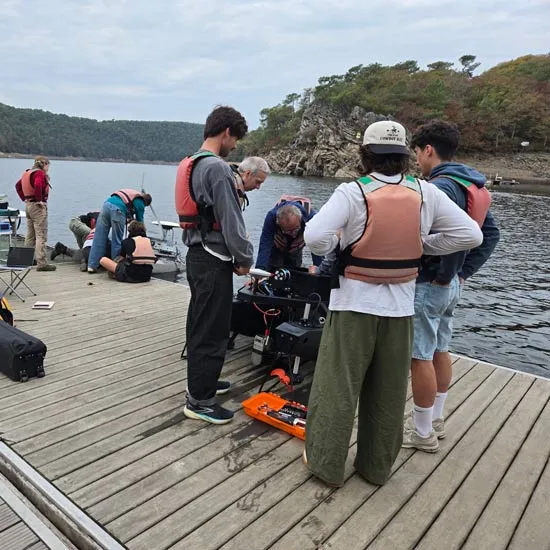
Every year, for a week in October and again in March, students on the general engineering course at ENSTA specialising in ‘Hydrography and Oceanography’ and ‘Autonomous Robotics’ gather on the shores of Lake Guerlédan. Working in small groups, they carry out innovative scientific projects.

This first week of experimentation at Lake Guerlédan is a highlight for the students, who are able to put their knowledge into practice and test it against real-world conditions, but also for the lecturers and researchers who share their research challenges.

Luc Barast Research engineer, responsible for organising the field week at Guerlédan

For the 2026 edition, 60 students made the trip, supervised by around thirty researchers and engineers, alongside industrial and academic partners. They worked in groups of three to six students on 15 projects, some of which focused specifically on robotics or Hydrography and Oceanography, whilst others combined both disciplines.

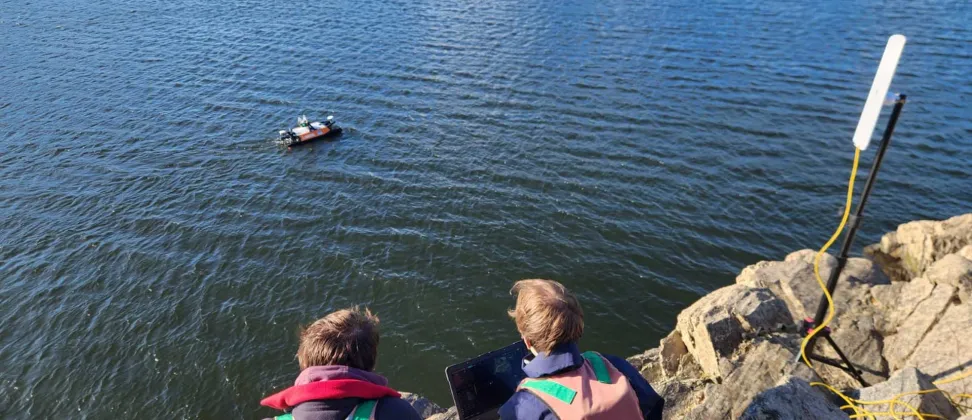
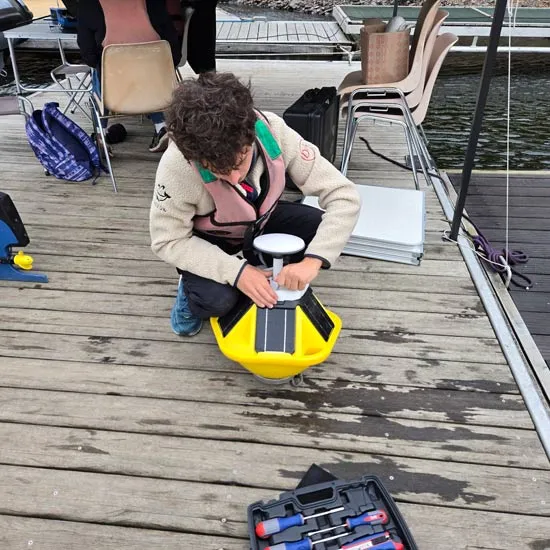
The challenges set for them were varied. These involved, for example, calibrating and testing sensors, collecting data in situ to compare it with model outputs, or operating a drone and recording navigation data to enable it to operate autonomously.

A closer look at four projects:

Monitoring lake water levels (Hydrography and Oceanography)

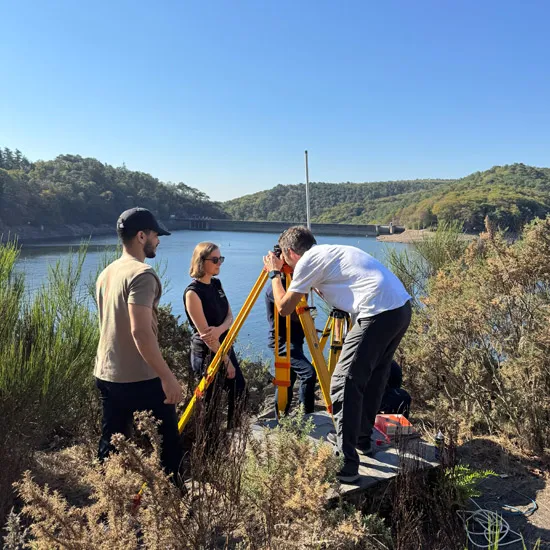
The aim of this project is to monitor variations in lake water levels: a major global issue, as lakes constitute the largest accessible reservoir of fresh water. To this end, the group had to deploy several in situ measurement systems (tide gauges, GNSS systems, etc.). The next stage of the work will involve analysing and processing the data and comparing it with data from altimetry satellites covering the area. The project is supervised by lecturers and researchers from ENSTA, alongside three partners: SHOM and the companies Vortex-Io and Noveltis.

Positioning of underwater drones (robotics)

Without GPS, various strategies can be implemented to enable the underwater drone (AUV) to orientate itself and carry out its missions safely. As part of this project, a group comprising robotics and hydrography students is experimenting with a ‘terrain-referenced navigation’ method, which involves comparing sonar measurements taken by the robot with a bathymetric map of the lake. To this end, the students are developing a particle filter to estimate the robot’s most probable positions on the lake map. The aim is to enable the robot to refine its positioning without having to return to the surface.

Monitoring hydrological variations in the lake using fibre optics (hydrography-oceanography)

Fibre-optic networks are widely deployed on land and in the seas to provide very high-speed web data transmission, but these cables can also measure information useful for environmental monitoring. The aim of this project is to combine traditional methods (moorings, sensor chains, etc.) with fibre-optic measurements to identify variations in the lake’s water temperature. It is supervised by a lecturer-researcher from ENSTA, alongside two partners: Ifremer and the CNRS.

Underwater drone navigation using visual familiarity (robotics)

Certain desert ants navigate using their low-resolution panoramic visual memory. This bio-inspired project aims to adapt this strategy to the field of underwater robotics, enabling the robot to retrace its route through visual familiarity. The aim is to propose a simple, robust and energy-efficient model for autonomous underwater navigation.

From water-level monitoring to bio-inspired navigation, these projects enable students to learn through experimentation, to deal with unforeseen challenges in the field, and to manage constraints… all essential skills for their future careers as engineers.

Our latest news

Alumni | Institute | Company | Training | International | Student Life
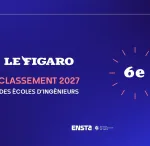
ENSTA has moved up to 6th place in the ranking of engineering schools by Le Figaro

ENSTA has climbed further up the rankings and is now tied for sixth place in *Le Figaro*’s engineering school rankings, moving up one place from last year’s ranking.


ENSTA has moved up to 6th place in the ranking of engineering schools by Le Figaro

ENSTA has climbed further up the rankings and is now tied for sixth place in *Le Figaro*’s engineering school rankings, moving up one place from last year’s ranking.

Alumni
Agence 402 : AI in the service of sovereignty

Enabling major French groups to utilise artificial intelligence in their confidential operations whilst ensuring the security of their sensitive data: this is the mission set by Agence 402, co-founded by Bertrand Paturel, ENSTA 2021.

Agence 402 : AI in the service of sovereignty

Enabling major French groups to utilise artificial intelligence in their confidential operations whilst ensuring the security of their sensitive data: this is the mission set by Agence 402, co-founded by Bertrand Paturel, ENSTA 2021.

Alumni | Institute | Training | Research | Student Life
Fathi Trigui : solidarity at the heart of the ENSTA Foundation’s missions

From research engineering within a major industrial group to consultancy, the career path of Fathi Trigui, now an associate director at BearingPoint, illustrates the diversity of opportunities opened up by an ENSTA education. He now wishes to put this...