
APRO : Teaching Drones to Go Unnoticed

Research Defense and Security, Digital Science & Engineering, Transport and mobility
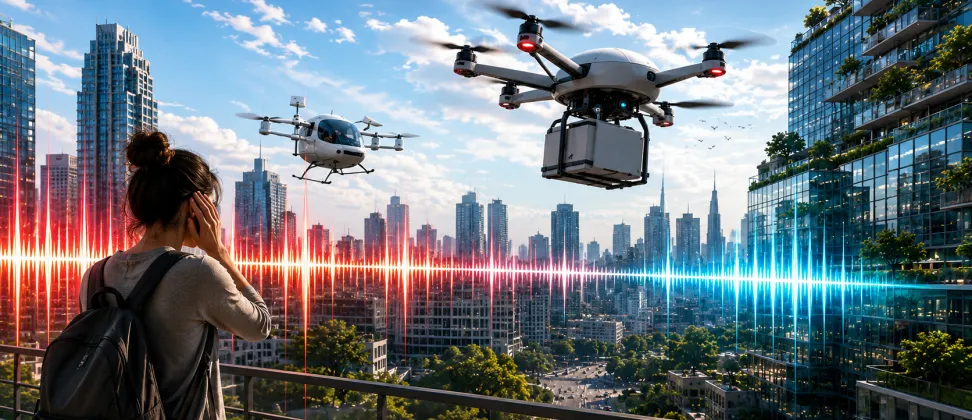
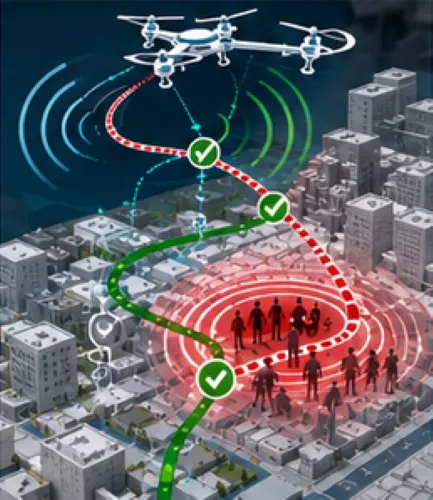
Assessing and reducing the noise impact of drones on nearby residents is one of the main objectives of the APRO project. Illustration created using generative AI (OpenAI)

Whether used for urgent deliveries or autonomous flying taxi services, drones could help solve many of the problems plaguing our congested city centers—provided, that is, that their main nuisance is reduced: that annoying, giant-mosquito-like buzz caused by their propellers. Several ENSTA laboratories are collaborating to address this issue.

In a 2017 study, NASA researchers asked 38 participants to subjectively rate about 100 transportation-related sounds on a scale from “not at all annoying” to “very annoying.” Surprisingly, the results showed that humans are far less tolerant of the sounds produced by aerial drones than those generated by cars—and even trucks. One hypothesis put forward to explain this finding was the shrill and piercing nature of drone noise, linked to their relatively slow speed and their position overhead relative to the listener.

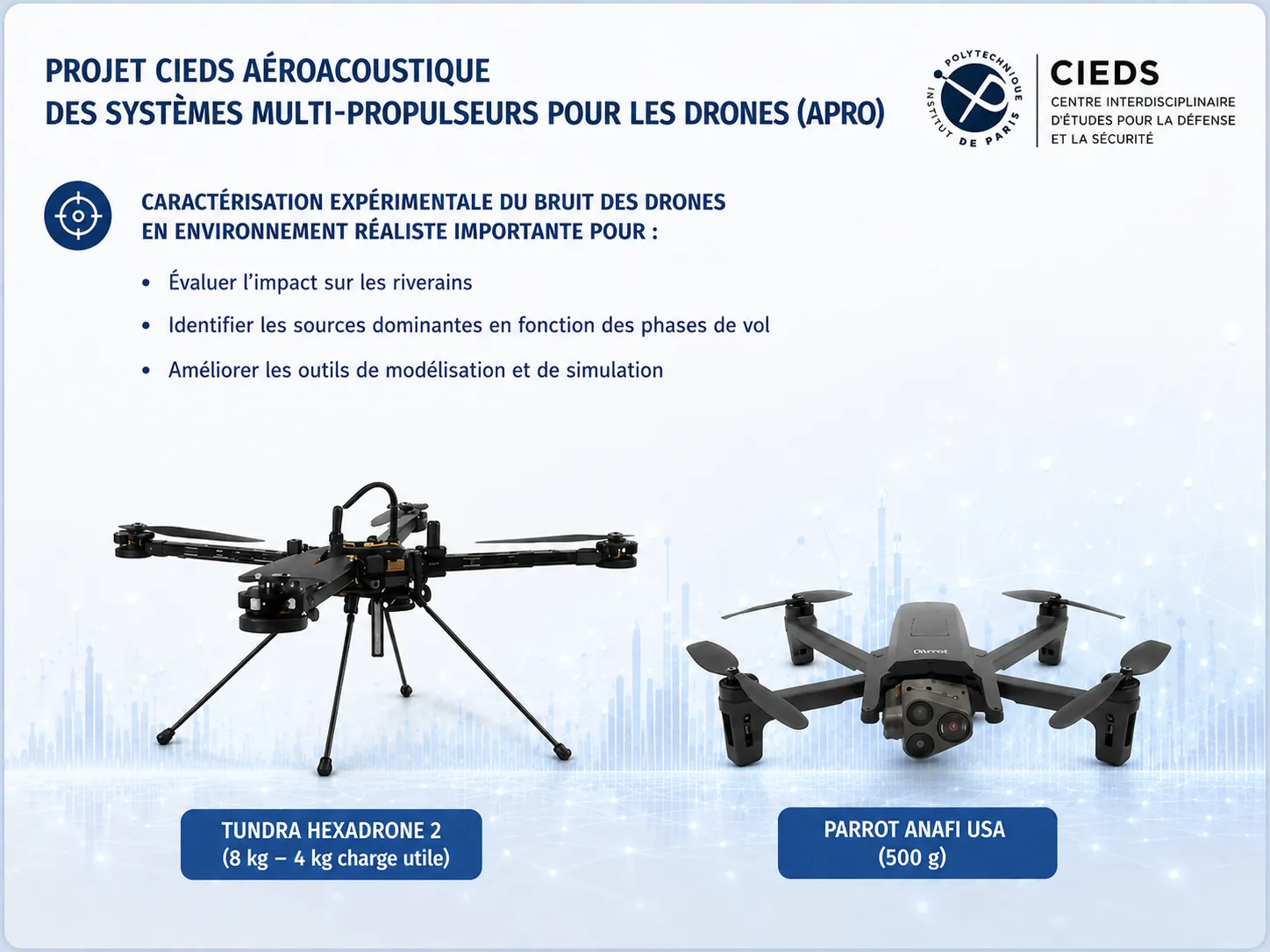
One of the specialties of Benjamin Cotté, a faculty researcher at IMSIA—one of ENSTA’s 13 laboratories—is precisely aeroacoustics. In other words, he seeks to understand how airflow around a solid object produces sound. This is precisely the kind of challenge posed by drones, which is why he serves as the scientific lead for the APRO project (an acronym for “Aeroacoustics of Multi-PROpulsion Systems”), conducted under the auspices of the Defense Innovation Agency (AID) as part of the Interdisciplinary Center for Defense and Security Studies (CIEDS).

Benjamin Cotté, lecturer and researcher at ENSTA

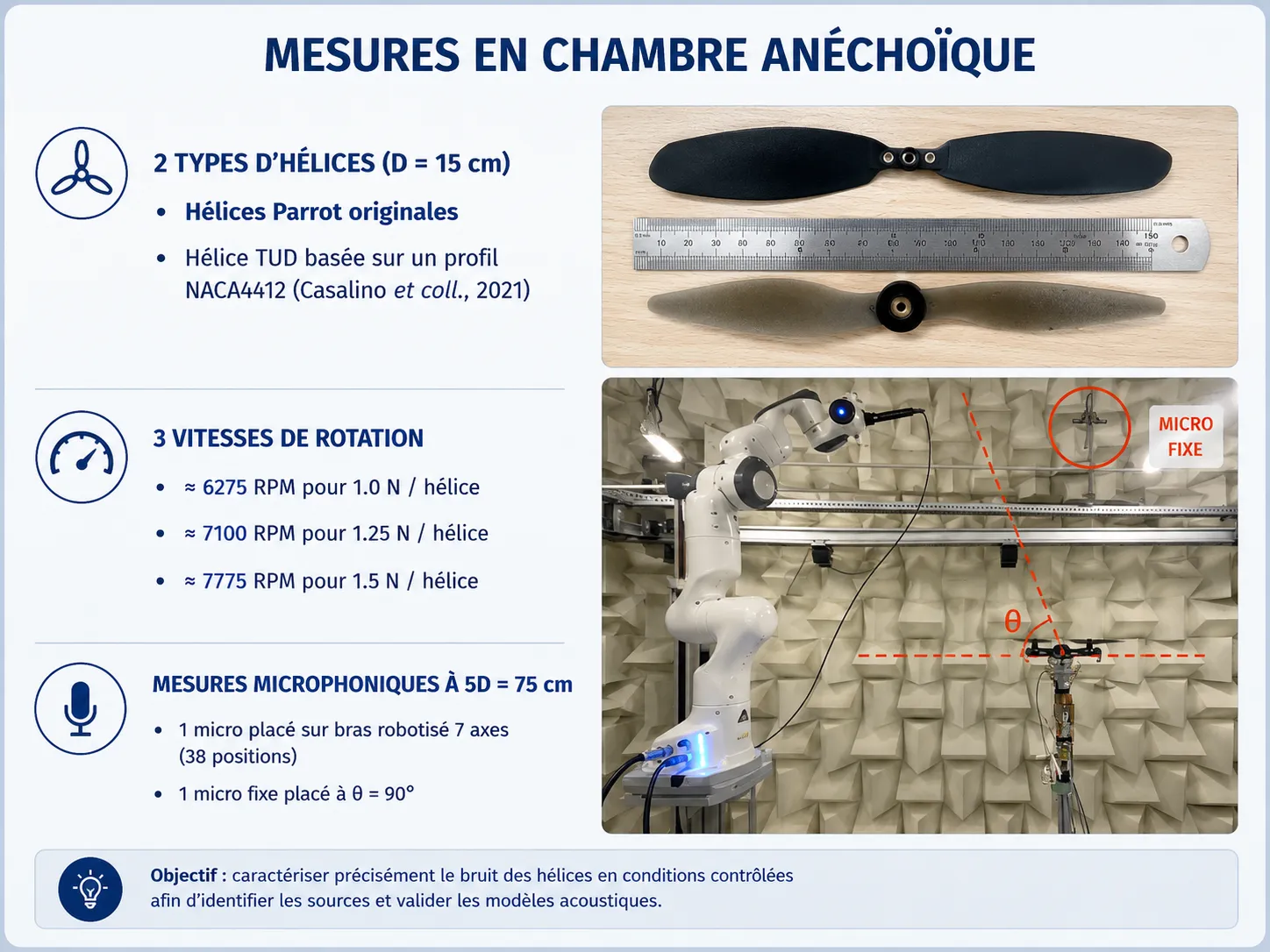
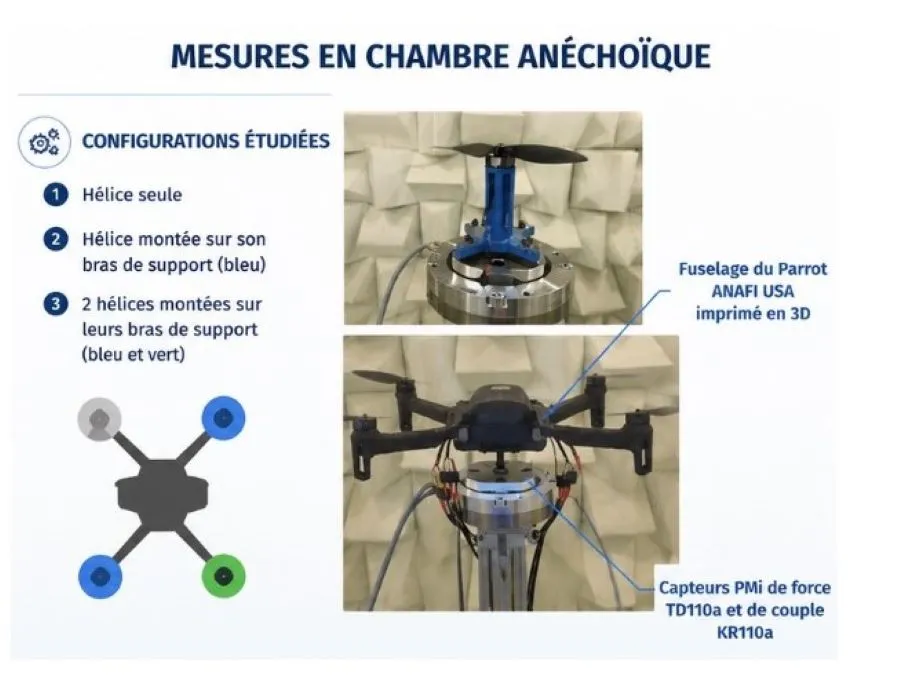
To precisely measure the sounds produced and eliminate any subjectivity in their perception, Benjamin Cotté and his team began by characterizing the noise emitted by drone propellers in their anechoic chamber. They tested the propellers individually, then in combination, at different rotational speeds.

Based on this, the researchers developed analytical models enabling a numerical simulation of these noises, which use aerodynamic calculations—taking into account the evolution of boundary layers (the interface zones between the blades and the air)—as input data to predict the radiated noise.

It was only after completing these first two steps that it became possible to consider concrete ways to reduce this noise.

“As for the propellers, we explored the possibility of modifying the surface roughness of the blades. Using 3D printing, we created blades with a very fine band of roughness—between 50 and 300 microns—at the point where the propeller’s profile is thickest. This effectively modifies the boundary layers. We demonstrated that this could be beneficial at certain rotational speeds, reducing noise by about 3 to 4 decibels. 

Another avenue of research is aeroelasticity, which takes into account the propeller’s stiffness depending on the material used. Thus, the quest for quieter drones could lead to a resurgence in the use of wooden propellers, which are less rigid than composite ones and filter vibrations more effectively.

But drones never have just a single propeller. We must therefore account for possible interference between them, as well as interactions between the support arms and the propellers.

“We’re seeking to optimize the entire structure by taking into account as many geometric parameters as possible, such as the placement of the propellers relative to one another, rotor/stator interactions, and so on,” the researcher continues.

“Another interesting effect—if we take the case of a quadcopter—is that the rotational speeds of the four propellers are constantly changing to ensure the drone’s stability. We’ve therefore observed destructive or constructive interference effects between the propellers, which don’t always intersect at the same point. ”

However, the best way for an aerial drone to go unnoticed is still to stay away from people it might disturb. That’s the focus of researchers at U2IS, the lab on the Paris-Saclay campus of ENSTA’s Department of Information Sciences and Computer Science.

“For us, the challenge is to propose flight paths that reach the desired point but via a route that minimizes noise pollution,” summarizes Rémi Marsal, a postdoctoral researcher at U2IS.

An initial phase, led by Damien Hoareau, also a postdoctoral researcher at U2IS, involved classic flight path optimization.

Rémi Marsal then stepped in to propose using neural networks rather than a traditional optimization algorithm to simulate sound propagation. The network, trained on data from sound emitted by the drone, estimates sound propagation relative to a number of reference points.
 

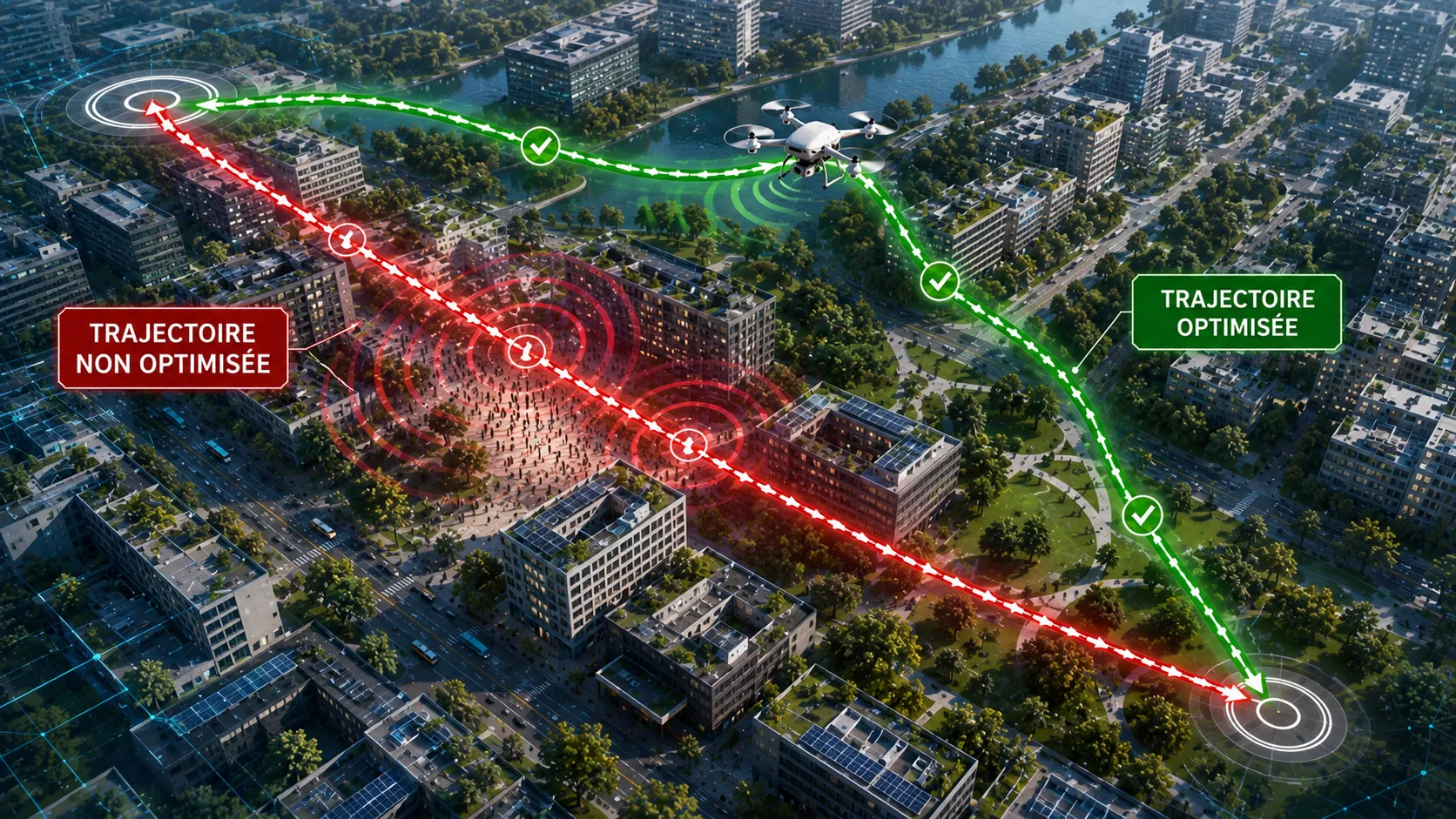
Trajectory optimization based on radiated noise and the most densely populated areas. Illustration created using generative AI (OpenAI)

“We’re able to be 100 times faster than with a solver, but we’re slightly less accurate. It’s a trade-off we have to find,” explains Rémi Marsal.

In fact, in the cities of tomorrow, the future of drones may hinge less on their raw performance than on their ability to go unnoticed. Making a drone truly discreet without compromising its aerodynamic performance remains a challenge today. But the research conducted at ENSTA shows that there is room for improvement.

Spanning fluid mechanics, acoustics, materials science, and artificial intelligence, the quest for the silent drone draws on a wide range of expertise. This is a concrete example of the multidisciplinary approach developed at ENSTA to address the technological challenges of tomorrow.

In the city of tomorrow, optimizing a drone’s flight path will no longer mean finding the shortest route, but rather the one that causes the least noise pollution for nearby residents. Illustration created using generative AI (OpenAI)

Our latest news

Institute | Training
IETA military engineering students training at ENSTA marched in the July 14 parade

About 40 IETA military students marched on July 14, 2026, on the Champs-Élysées on behalf of ENSTA and the DGA. For the past three weeks, they had been preparing together for this major event for the French armed forces, whose theme was “Europe’s...

IETA military engineering students training at ENSTA marched in the July 14 parade

About 40 IETA military students marched on July 14, 2026, on the Champs-Élysées on behalf of ENSTA and the DGA. For the past three weeks, they had been preparing together for this major event for the French armed forces, whose theme was “Europe’s...

Research
Chaos in Caracas : the role of sediments

During the double earthquake that struck Venezuela on June 24, 2026, damage extended as far as Caracas, the capital, more than 150 km from the epicenter. How can such extensive damage be explained at such a great distance? Jean-François Semblat, a...

Chaos in Caracas : the role of sediments

During the double earthquake that struck Venezuela on June 24, 2026, damage extended as far as Caracas, the capital, more than 150 km from the epicenter. How can such extensive damage be explained at such a great distance? Jean-François Semblat, a...

Institute | Training | Student Life
Gaspard, a top-level windsurfer and engineering student

Having always been passionate about sailing and the maritime world, Gaspard Carfantan has built his professional and personal life around this passion. At 23, he divides his time between competitive sailing and his engineering studies at ENSTA.

Gaspard, a top-level windsurfer and engineering student

Having always been passionate about sailing and the maritime world, Gaspard Carfantan has built his professional and personal life around this passion. At 23, he divides his time between competitive sailing and his engineering studies at ENSTA.