
Applied Mathematics

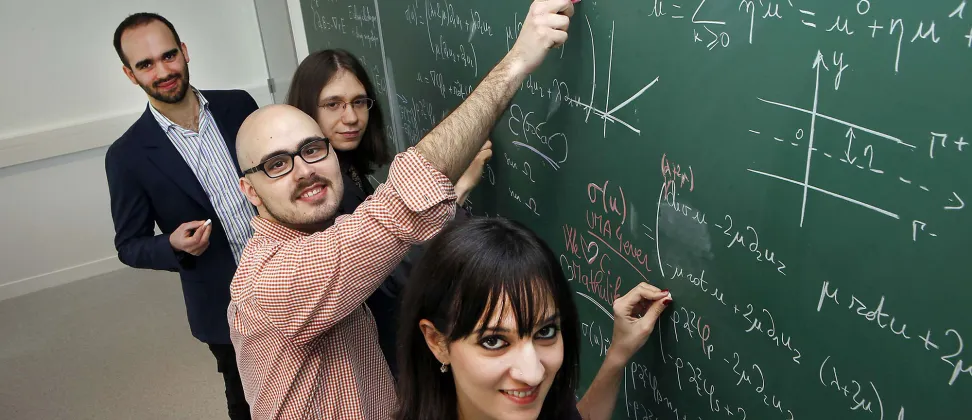
The "Unité de mathématiques appliquées (UMA)" conducts education and research in numerical modeling and simulation, control and optimization, scientific computing, operations research and data science, partial differential equations, and probability.

The unit consists of three teams:

  • IDEFIX: design, analysis, and implementation of efficient numerical methods for solving inverse problems related to partial differential equations.
  • Optimization and Control: decision mathematics and systems analysis in three major research areas: optimization, dynamic systems, and probability.
  • POEMS: development of mathematical and numerical studies concerning wave propagation in all areas of mechanics and physics.

     
Areas of application
  • Energy
  • Defense
  • Non-destructive testing

Research topics

MODELING OF WAVE PROPAGATION PHENOMENA, NUMERICAL METHODS FOR APPROXIMATING PARTIAL DIFFERENTIAL EQUATIONS, INVERSE PROBLEMS, NON-DESTRUCTIVE TESTING AND IMAGING, OPTIMIZATION, OPERATIONS RESEARCH AND DATA SCIENCE, CONTROL AND ANALYSIS OF DYNAMIC SYSTEMS, STOCHASTIC ANALYSIS AND PROBABILISTIC MODELS

Examples of Research Projects

updated on 08/28/26

Mettre les oreilles d'or à l'abri des fausses notes

The ability of submarines to successfully carry out their missions depends directly on the noise emitted by their various components. In a doctoral dissertation defended in April 2025, Louise Pacaut opened up new avenues for predicting the noise radiated by various key parts of submarines (diving planes, fins, propellers).

This noise effectively interferes with sonar measurements, which can mislead operators and cause them to miss a critical detection. This dissertation, conducted within the POEMS team, proposes a method that—starting from turbulent flow over a given structure—enables the prediction of radiated noise while streamlining the process by eliminating numerous steps through new computational methods.

Our latest news

Institute | Training | Innovation | Research
The education and the research at ENSTA at the core of the development of IP Paris

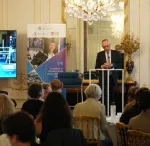
The Institut Polytechnique de Paris’s back-to-term press conference took place on Tuesday 29 September. In particular, it provided an opportunity to highlight ENSTA’s specific contributions and new developments in education that benefit the Institute.
The education and the research at ENSTA at the core of the development of IP Paris

The Institut Polytechnique de Paris’s back-to-term press conference took place on Tuesday 29 September. In particular, it provided an opportunity to highlight ENSTA’s specific contributions and new developments in education that benefit the Institute.

Innovation | Research
SEARENITY, the magnetic hull-cleaning robot designed to decarbonise maritime transport

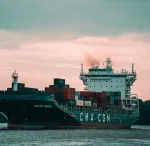
ENSTA is one of the partners in the SEARENITY project, which was selected under the ‘CORIMER Low-Carbon Ships’ call for proposals (funded by Ademe, France 2030). The project aims to develop an autonomous robot capable of continuously cleaning ship hulls...

SEARENITY, the magnetic hull-cleaning robot designed to decarbonise maritime transport

ENSTA is one of the partners in the SEARENITY project, which was selected under the ‘CORIMER Low-Carbon Ships’ call for proposals (funded by Ademe, France 2030). The project aims to develop an autonomous robot capable of continuously cleaning ship hulls...

Institute | Training
Training a generation of committed engineers

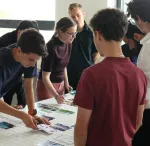
One afternoon in September, in the lecture theatres at ENSTA, groups of around ten students are discussing ideas whilst gathered around large sheets of white paper. Together, with the help of a facilitator, they are placing cards relating to climate...

Training a generation of committed engineers

One afternoon in September, in the lecture theatres at ENSTA, groups of around ten students are discussing ideas whilst gathered around large sheets of white paper. Together, with the help of a facilitator, they are placing cards relating to climate...