
Protection against unexploded ordnances: ENSTA’s expertise called upon in Japan

International, Research Defense and Security, Marine Engineering

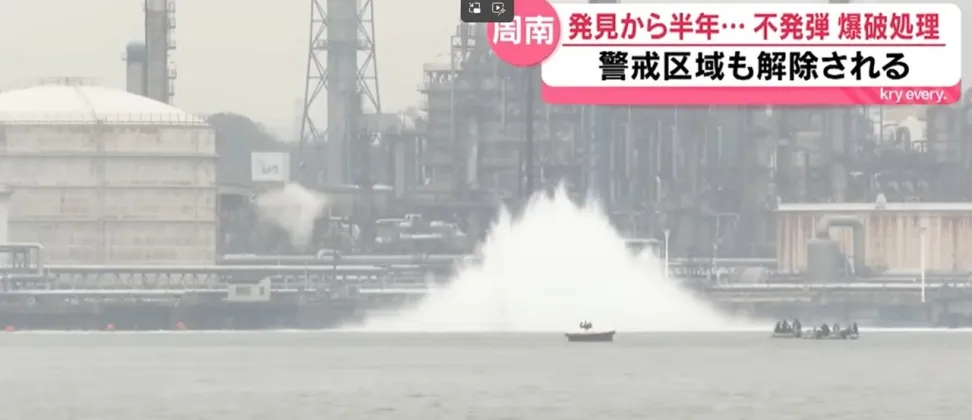
On 5 September 2025, an unexploded ordnance (UXO) was discovered on the seabed approximately 9 metres below the surface at Tokuyama-Kudamatsu Port in Shunan City, Yamaguchi Prefecture, Japan—specifically in the waters about 48 metres west of Berth No. 3 of the East Jetty of the IDEMITSU KOSAN Tokuyama Plant.

Following the discovery, the “Yamaguchi Prefecture Coastal Port and Disaster Prevention Liaison Council (Liaison Conference for UXO Disposal at Tokuyama-Kudamatsu Port)” was established, with its secretariat hosted by the Ube Port and Airport Engineering Office of the Chugoku Regional Development Bureau, Ministry of Land, Infrastructure, Transport and Tourism (MLIT). National and local government agencies, the Japan Maritime Self-Defense Force (JMSDF), and other relevant organisations coordinated closely to plan the disposal operation.

To protect the pile-supported jetty facility of the IDEMITSU KOSAN Tokuyama Plant from the underwater shockwave generated by the UXO detonation, Yamaguchi Prefecture installed bubble curtains as a prefectural initiative. This marked the first application of the bubble curtain technique for UXO disposal in Japan.
 

To support its protection strategy, IDEMITSU KOSAN requested technical assistance from ENSTA to review the bubble curtain design and assess whether the configuration was reasonable and optimal for mitigating shockwave effects. Based on previous publications, ENSTA’s researchers were identified as having the skills and expertise necessary to meet IDEMITSU KOSAN’s expectations.

Calculations performed jointly by ENSTA and IDEMITSU KOSAN in February 2026 indicated that the bubble curtain would need to attenuate the shockwave by 60–90%, which was considered sufficient to prevent damage to the jetty structure.

On 25 March 2026 at 11:08 (Japan Standard Time), the UXO was detonated by the JMSDF while bubble curtains were in operation along the jetty. Strain measurements recorded during the operation confirmed that the pier structure sustained no damage and remained firmly in place.

This case study stands as a successful example of international collaboration between academic research and industry, and it is hoped that this experience will open new opportunities for scientific cooperation between France and Japan.
 

Report by the local Japanese television station KRY

Our latest news

Institute | Training | Innovation | Research
The education and the research at ENSTA at the core of the development of IP Paris

The Institut Polytechnique de Paris’s back-to-term press conference took place on Tuesday 29 September. In particular, it provided an opportunity to highlight ENSTA’s specific contributions and new developments in education that benefit the Institute.
The education and the research at ENSTA at the core of the development of IP Paris

The Institut Polytechnique de Paris’s back-to-term press conference took place on Tuesday 29 September. In particular, it provided an opportunity to highlight ENSTA’s specific contributions and new developments in education that benefit the Institute.

Innovation | Research
SEARENITY, the magnetic hull-cleaning robot designed to decarbonise maritime transport

ENSTA is one of the partners in the SEARENITY project, which was selected under the ‘CORIMER Low-Carbon Ships’ call for proposals (funded by Ademe, France 2030). The project aims to develop an autonomous robot capable of continuously cleaning ship hulls...

SEARENITY, the magnetic hull-cleaning robot designed to decarbonise maritime transport

ENSTA is one of the partners in the SEARENITY project, which was selected under the ‘CORIMER Low-Carbon Ships’ call for proposals (funded by Ademe, France 2030). The project aims to develop an autonomous robot capable of continuously cleaning ship hulls...

Institute | Training
Training a generation of committed engineers

One afternoon in September, in the lecture theatres at ENSTA, groups of around ten students are discussing ideas whilst gathered around large sheets of white paper. Together, with the help of a facilitator, they are placing cards relating to climate...

Training a generation of committed engineers

One afternoon in September, in the lecture theatres at ENSTA, groups of around ten students are discussing ideas whilst gathered around large sheets of white paper. Together, with the help of a facilitator, they are placing cards relating to climate...