MSc in Engineering program

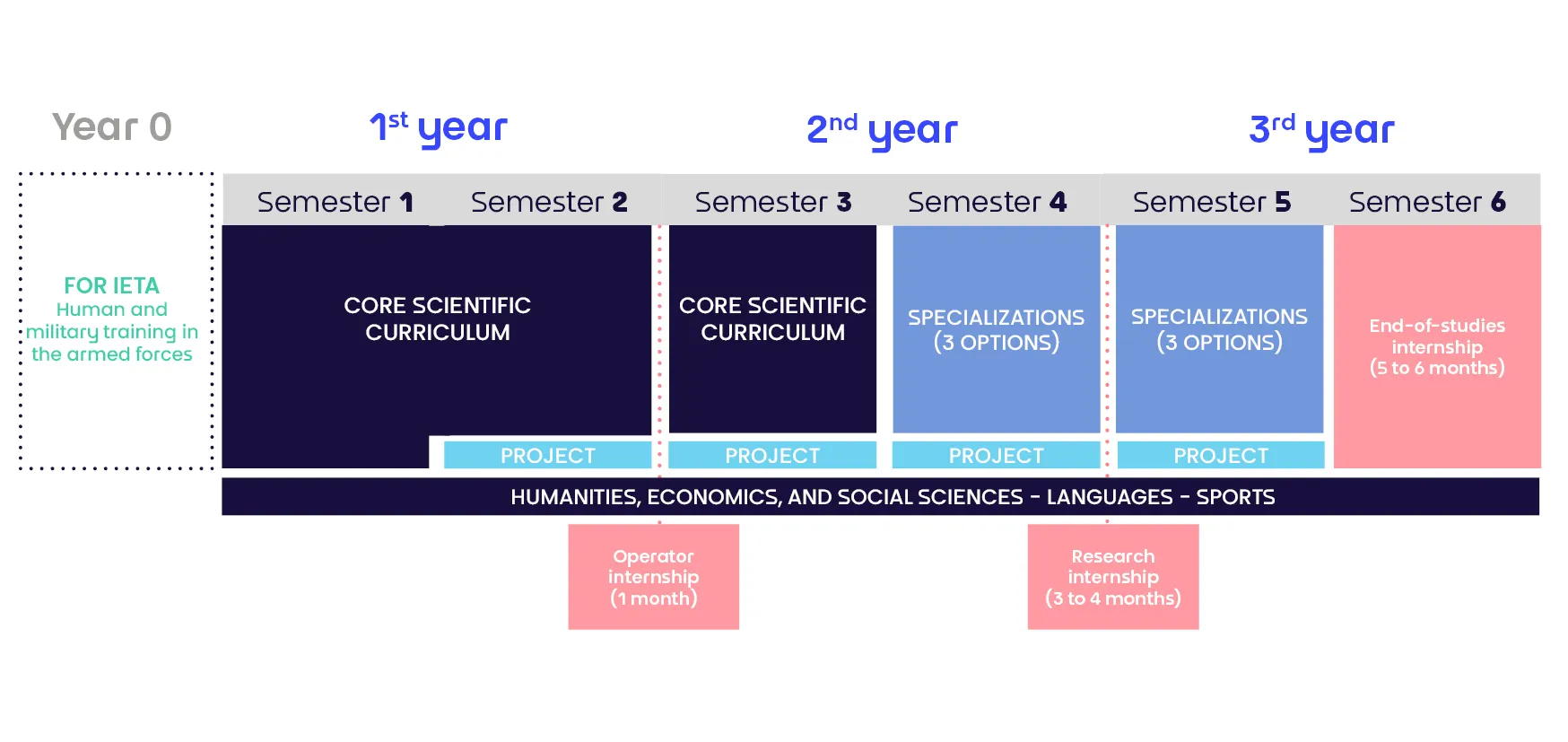
The three-year ENSTA MSc in Engineering program combines scientific rigor, a wide range of choices, and progressive learning.
The curriculum covers a broad spectrum of sciences, technologies, and humanities that define ENSTA's general engineering program. Professionalization is progressive, with numerous elective courses that open up the world of engineering and allow students to personalize their academic path, using a variety of immersive teaching methods.

1st year

Scientific and generalist

It consists of

  • a core curriculum covering mechanics, energy, and digital technology. It also includes humanities, economics, and social sciences to develop skills in communication, project management, environmental and societal transition, innovation, and interculturality. In addition, there are modern languages (two compulsory, with the option of a third) and sports.
  • elective courses (1 choice from 35 options)
  • a one-month internship that can be completed in any type of professional environment.

2nd year

Scientific major and openness

The goal is to achieve a high level of scientific and technical expertise in the field of your choice, enabling you to tackle complex problems in different professional contexts.

A choice of three major disciplinary fields:

Applied Mathematics

Objectives: Master mathematical concepts and acquire digital tools and methods for modeling, simulation, and decision-making. The emphasis is on underlying mathematical models and structures as well as digital methods of resolution.

Mechanics

Objectives: Acquire a common foundation of knowledge in mechanics and numerical modeling. Experimental teaching is also offered on a topic of your choice. The emphasis is on the modeling of nonlinear materials and structural dynamics, as well as heat and turbulent transfer.

Digital Sciences

Objective: To develop knowledge in information science and technology (information theory, networks, OOP, databases, processor architecture, operating systems) and the associated mathematical models.

3rd year

Specialization and professionalization

This is the year when students personalize their course of study. It includes:

  • Choosing a specialization offered on both campuses.
  • Choosing a “career” profile to acquire tools and methods and prepare you for work in research and development, innovation management and entrepreneurship, project management, and complex systems.
  • A supervised team project
  • The final project. It lasts one semester and concludes the program.

Third-year specializations

Applied Mathematics

  • Optimization and Data Science
  • Quantitative Finance
  • Modeling and Simulation
  • Engineering and Mathematics for Health

Seas & Oceans

  • Naval Engineering
  • Energy and Seas
  • Hydrography and Oceanography

Digital Systems, Robotics, AI

  • Smart Sensing and Intelligent Processing System
  • Artificial intelligence
  • Robotics and autonomous systems
  • Cybersecurity

Energy, transport, and space

  • Nuclear
  • Pyrotechnic systems and rocket propulsion
  • Sustainable energy
  • Sustainable mobility

Multiphysics Mechanical Modeling

  • Advanced Modeling of Materials and Structures
  • Computational Fluid Dynamics
Learn more about the third-year specializations

Please note: A minimum stay of 16 weeks must be completed abroad (during semester 4 or the research internship, or in semester 6: end-of-study internship).

Our latest news

Alumni | Training | Research
A thesis on characterizing the strength of a submerged textile structure

Noise pollution generated during the installation of offshore wind turbines is attracting increasing attention. An engineer trained at ENSTA in the specialty of “mechanical modeling of materials and structures,” Jeanne Cavoit wrote her thesis on the...

A thesis on characterizing the strength of a submerged textile structure

Noise pollution generated during the installation of offshore wind turbines is attracting increasing attention. An engineer trained at ENSTA in the specialty of “mechanical modeling of materials and structures,” Jeanne Cavoit wrote her thesis on the...

Alumni | Innovation
DeepFoil: Two ENSTA Graduates Are Reinventing Underwater Exploration

Graduates in architecture and naval hydrodynamics, Emillia Perdigon and Paul François have designed the DeepFoil, a flying underwater wing that allows for effortless movement underwater. Fueled by public enthusiasm and investor support, their project is...

DeepFoil: Two ENSTA Graduates Are Reinventing Underwater Exploration

Graduates in architecture and naval hydrodynamics, Emillia Perdigon and Paul François have designed the DeepFoil, a flying underwater wing that allows for effortless movement underwater. Fueled by public enthusiasm and investor support, their project is...

Innovation | Research
Gabriel Betton: Exploring the karst networks

Beneath our feet, in the darkness of the underground, a natural network spanning more than a third of France’s territory supplies drinking water to nearly 30 million people. But the quality of this vast freshwater reservoir is threatened by climate change...

Gabriel Betton: Exploring the karst networks

Beneath our feet, in the darkness of the underground, a natural network spanning more than a third of France’s territory supplies drinking water to nearly 30 million people. But the quality of this vast freshwater reservoir is threatened by climate change...