Rozali Badaoui honored at IEEE ETECOM 2025

Training, Innovation, Research Digital
Rozali Badaoui honored at IEEE ETECOM 2025

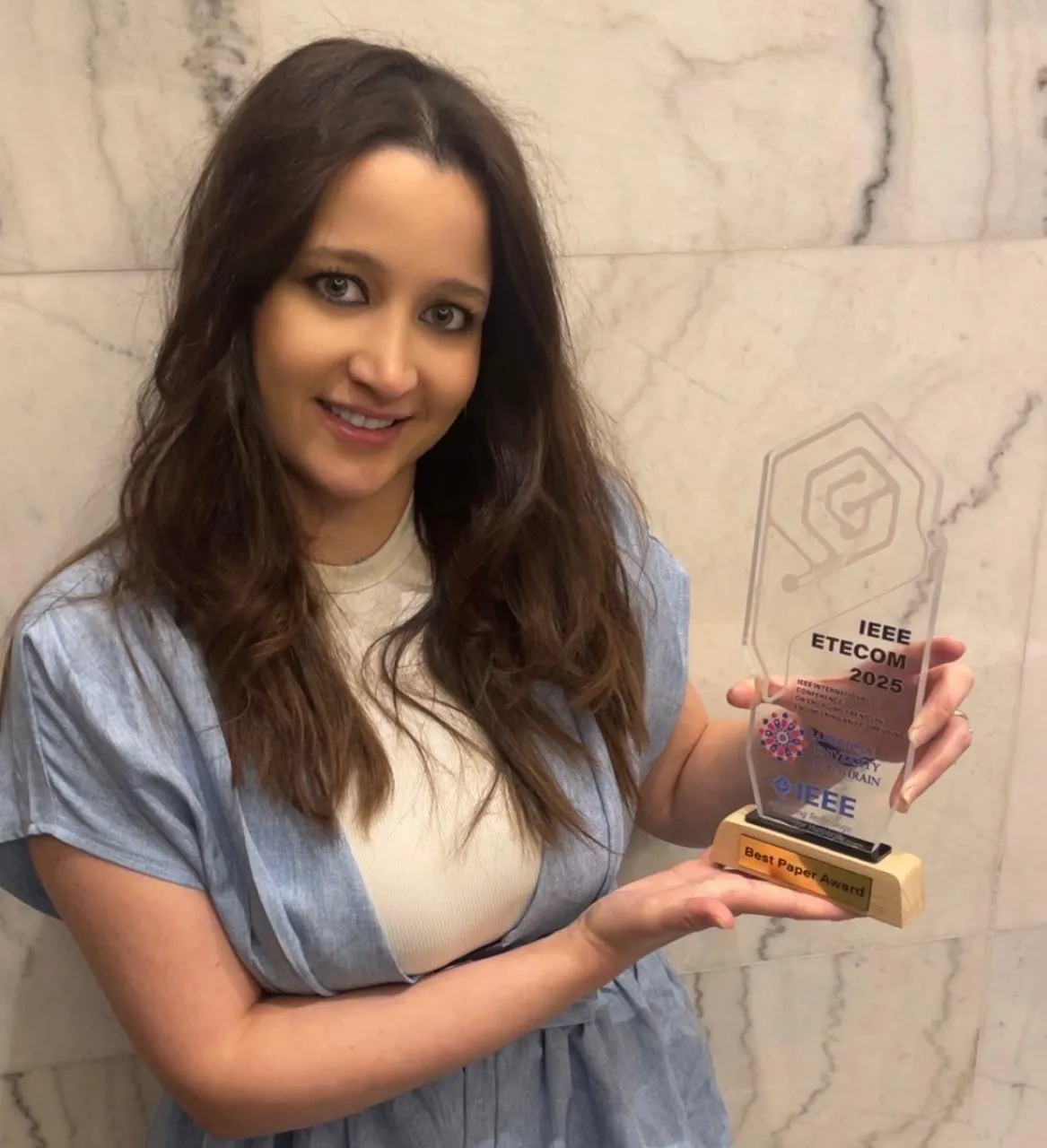
Rozali Badaoui's early thesis work has just been recognized with the Best Paper Award in the “Engineering Education” category at the IEEE ETECOM 2025 conference on emerging trends in engineering and computing, held in Bahrain last October.

Already holding a master's degree in management, it was her passion for teaching that motivated Rozali Badaoui to undertake an interdisciplinary doctoral thesis in education and management sciences.

What are the most effective technologies to implement in higher education for optimal classroom management? This is the question that Rozali Badaoui has chosen to tackle in her thesis, co-supervised by Nicolas Jullien from IMT Atlantique and Klara Kövesi from ENSTA, within the SPIN doctoral school. To answer this question, Rozali Badaoui examines the impact of new technologies on engineering education in her doctoral research.

Long fascinated by new technologies, Rozali Badaoui published her research at the end of her master's studies, notably at the SEFI 2023 conference, where her article was among the three nominated for the Best Research Paper Award. She was particularly impressed by the ability of cutting-edge technologies to adapt to a variety of teaching contexts, thereby helping to improve learning efficiency. This interest naturally led her research work to focus on the integration of new technologies in education, particularly in engineering training.

Her doctoral research is part of the study of the challenges and opportunities associated with the integration of new technologies in higher education.

Rozali Badaoui and her award

Her doctoral research focuses on the challenges and opportunities associated with the integration of new technologies in higher education. She analyzes how non-technological, low-tech, and high-tech solutions can be combined in a complementary way to improve classroom management. Classroom management is a key issue, as it encompasses all the strategies and practices implemented by teachers and institutions to create an effective learning environment that encourages student engagement (time management, communication, student interactions, etc.).

Her research aims to provide teachers with practical guidelines enabling them to make informed pedagogical decisions regarding the choice and use of technological solutions. Based on the results obtained, she aims to propose operational recommendations for the effective integration of these tools, while taking into account issues of confidentiality, security, and ethics.

In the article she presented at the IEEE ETECOM 2025 conference, she focused on the issue of protecting students' personal data, a subject that raises questions about the technological choices made by academic institutions, but also about the behavior of the students themselves.

“Students are the primary actors in the protection of their personal data, and they have as much responsibility in this matter as the institutions in which they pursue their studies,” confirms Rozali Badaoui.

But academic institutions obviously play a structural role in this issue through their choice of technologies and the amount of data collected. In the age of big data, learning method analysis has very effective tools for measuring learner and teacher engagement, detecting difficulties and identifying areas for improvement, but at the risk of infringing on everyone's privacy.

“The challenge is to find a balance between cognitive and emotional engagement and respect for privacy,” continues Rozali Badaoui.

Currently in her second year of her PhD, buoyed by this initial recognition, Rozali is fully committed to continuing her research on the integration of advanced technologies in engineering education.

Our latest news

Training | Innovation | Research
Success for the first edition of the Seas and Ocean Forum

On Tuesday, January 13, ENSTA's Paris-Saclay campus hosted the first edition of the Institut Polytechnique de Paris's Seas and Ocean Forum, which is part of the activities of the Interdisciplinary Seas and Ocean Center (CIMO). This unifying event brought...

Success for the first edition of the Seas and Ocean Forum

On Tuesday, January 13, ENSTA's Paris-Saclay campus hosted the first edition of the Institut Polytechnique de Paris's Seas and Ocean Forum, which is part of the activities of the Interdisciplinary Seas and Ocean Center (CIMO). This unifying event brought...

Innovation | Research
Adnan Saood: a touch of feeling in robotics

Robots can already see, hear, and even smell, but their sense of touch remains very rudimentary and is more akin to obstacle detection than any kind of dexterity. How can this be improved? This is the focus of the thesis work of Adnan Saood, a doctoral...

Adnan Saood: a touch of feeling in robotics

Robots can already see, hear, and even smell, but their sense of touch remains very rudimentary and is more akin to obstacle detection than any kind of dexterity. How can this be improved? This is the focus of the thesis work of Adnan Saood, a doctoral...

Research
Franck Ruffier, a researcher in bio-inspired robotics

Recently appointed to the ENSTA campus in Brest, Franck Ruffier is a CNRS research director in robotics in the ROBEX team at Lab-STICC. His research projects are inspired by living organisms. At the crossroads of biology and robotics, he explores animal...

Franck Ruffier, a researcher in bio-inspired robotics

Recently appointed to the ENSTA campus in Brest, Franck Ruffier is a CNRS research director in robotics in the ROBEX team at Lab-STICC. His research projects are inspired by living organisms. At the crossroads of biology and robotics, he explores animal...