ENSTA's history began with the strategic needs of the French Navy in the 18th century, and has been enriched over the centuries by major developments in engineering and research. Building on a legacy of exceptional expertise, ENSTA, under the supervision of the French Ministry of Armed Forces, is now a major player in higher education and research, both in France and internationally.
18th and 19th centuries – The roots of a prestigious Graduate School of Science and Engineering
1741 – Creation of the School of Royal Shipbuilding Engineers
The origins of ENSTA date back to 1741, when Henri-Louis Duhamel du Monceau, Inspector General of the French Navy, identified the need to provide master shipwrights with theoretical knowledge in mathematics and physics. After initially being established in Toulon, the school was transferred to Paris and set up in the Louvre Palace.
In 1765, after a seven-year hiatus due to budgetary reasons, Duhamel du Monceau secured the reopening of the school and ran it until the end of his life. It gradually became the École Nationale Supérieure du Génie Maritime (National Graduate School of Marine Engineering).
1819 – Birth of "écoles de maistrance"
On April 17, 1819, Baron Portal, Louis XVIII's Minister of the French Navy, created special petty officer schools in Brest, Rochefort, and Toulon. These schools trained highly skilled workers in the practical methods of the arts related to naval architecture.
In 1868, these schools were reorganized into two levels: preparatory schools and normal schools for ship's officers. In 1877, the Brest school became the École Supérieure de Maistrance (Higher School for Ship's Officers).
20th century – Mergers and expansions
1934–1936: Towards the "diplôme d'ingénieur" (Master of Science degree)
The Commission des Titres d'Ingénieur (CTI), created in 1934, accredited the "École Nationale Supérieure du Génie Maritime" and the "École Supérieure de Maistrance" to award engineering degrees equivalent to an MSc in Engineering.
1940: Merger of the École du Génie Maritime with the École d’Application de l’Artillerie Navale
In 1940, the École Nationale Supérieure du Génie Maritime merged with the École d’Application de l’Artillerie Navale, expanding its areas of expertise.
1961–1990: Birth of the ENSTA brand
In 1961, the French Ministerial Delegation for Armament initiated a series of mergers that led to the creation of ENSIETA (National School of Armament Engineering and Technology) in 1971, which later became ENSTA Bretagne. Initially, training was spread between Brest and Arcueil, then fully centralized in Brest in 1987.
At the same time, in 1970, the General Delegation for Armament (DGA) merged the École Nationale Supérieure du Génie Maritime (National Graduate School of Marine Engineering) with several other schools to create the École Nationale Supérieure de Techniques Avancées (ENSTA):
- École Nationale Supérieure des Poudres (National School of Powders) (1900)
- École Nationale Supérieure de l'Armement (1936)
- École des Ingénieurs Hydrographes de la Marine.
ENSTA then took on a broader mission to train generalist engineers capable of supporting major transformations in strategic sectors (transport, energy, defense, etc.).
1990–2010: Diversification and growth
In 1990, ENSIETA opened its entrance exams to civilian students. By 1996, civilians made up the majority of the student body. The school expanded its research activities, inaugurating a research center in 2005 equipped with cutting-edge experimental facilities.
2010–2018: ENSTA Group and integration into the Institut Polytechnique de Paris
In December 2010, ENSIETA became ENSTA Bretagne when it joined the ENSTA group alongside ENSTA, which was renamed ENSTA Paris for the occasion.
In 2012, ENSTA Paris moved to the Saclay plateau, to premises certified as High Environmental Quality (HQE), near the École Polytechnique.
At the end of 2018, ENSTA Paris joined École Polytechnique, ENSAE Paris, Télécom Paris, and Télécom SudParis to create the Institut Polytechnique de Paris, a world-class teaching and research institution.
Today: One Institute, two campuses
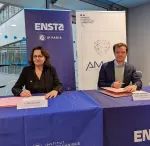
On January 1, 2025, ENSTA Paris and ENSTA Bretagne merged to form a single institution, ENSTA. It brings together 2,200 students, 670 staff, including nearly 200 teachers and teacher-researchers, 300 doctoral students, 11 research laboratories, and some 30 joint chairs and laboratories spread across its two campuses in Paris-Saclay in Palaiseau (Île-de-France) and Brest (Brittany).
ENSTA provides training and conducts research in the areas of defense and security, sustainable energy, transports and mobility, enginnering for health, naval enginnering, and digital technology. Its alumni community now forms a vast network of nearly 20,000 former students.
Key figures
 22%
22%
female students
 36%
36%
scholarship recipients
18%
of students on paid contracts (military and work-study programs)
+ 25%
international students
32
nationalities represented
~ 100
academic partnerships
€80
million budget in 2025, including €55 million from the Ministry of the Armed Forces