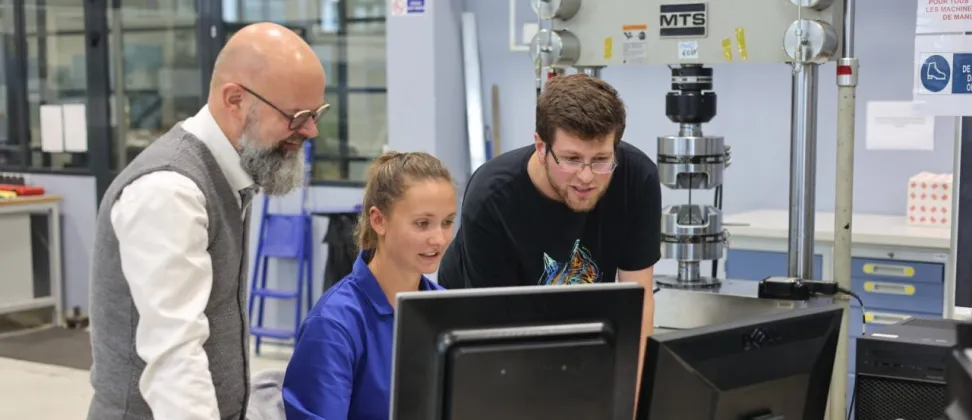
L'ENSTA accueille chaque année sur ses 2 campus plusieurs centaines de doctorants et leur permet d'évoluer au meilleur niveau scientifique dans des domaines d'innovation variés et stimulants.

Pourquoi faire sa thèse à l'ENSTA ?

Reconnu à l’international, diplôme d’excellence et marqueur d’un très haut niveau d’expertise, le doctorat ouvre à des emplois hautement qualifiés dans le secteur public comme privé. Outre l’accès au monde académique, il ouvre des opportunités de carrière majeures sur le long terme, reposant sur les compétences particulières atteintes lors du doctorat et largement reconnues dans le monde socio-économique pour des emplois hautement qualifiés.

Au sein des laboratoires de l'ENSTA, les doctorants et doctorantes évoluent dans un écosystème de recherche et d’innovation de pointe. En liens étroits avec l'industrie (de nombreuses thèses CIFRE), ils et elles intègrent une grande communauté de recherche, reconnue à l'international.

Key figures

300
doctorants
11
laboratoires de recherche
27
chaires et laboratoires communs
+ 200
enseignants et enseignants-chercheurs

Qu'est ce qu'une thèse ?

Accessible après un diplômé d'ingénieur, de master ou de grade équivalent, le doctorat est un diplôme national, délivré par un établissement d’enseignement supérieur habilité, sanctionnant les travaux de recherche menés par un doctorant dans le cadre d’une thèse. 

Celle-ci se déroule généralement dans un laboratoire de recherche de l’établissement (ou bien partiellement en entreprise dans le cadre des conventions CIFRE), est encadrée par un ou plusieurs directeurs de thèse et dure généralement 3 ans. Les doctorants s’inscrivent dans des écoles doctorales qui les accompagnent dans leur parcours de formation par la recherche. Le doctorat est un diplôme internationalement reconnu.

Les écoles doctorales

Les écoles doctorales rattachées à l’ENSTA sont : 

Dans le domaine des Sciences humaines et sociales, les doctorants ENSTA, associés au laboratoire FoAP sont rattachés à l'école doctorale Abbé Grégoire du CNAM Paris.

Lire aussi

Our latest news

Training | Innovation | Research
Rozali Badaoui honored at IEEE ETECOM 2025

Rozali Badaoui's early thesis work has just been recognized with the Best Paper Award in the “Engineering Education” category at the IEEE ETECOM 2025 conference on emerging trends in engineering and computing, held in Bahrain last October.

Rozali Badaoui honored at IEEE ETECOM 2025

Rozali Badaoui's early thesis work has just been recognized with the Best Paper Award in the “Engineering Education” category at the IEEE ETECOM 2025 conference on emerging trends in engineering and computing, held in Bahrain last October.

Training | Innovation | Research
Success for the first edition of the Seas and Ocean Forum

On Tuesday, January 13, ENSTA's Paris-Saclay campus hosted the first edition of the Institut Polytechnique de Paris's Seas and Ocean Forum, which is part of the activities of the Interdisciplinary Seas and Ocean Center (CIMO). This unifying event brought...

Success for the first edition of the Seas and Ocean Forum

On Tuesday, January 13, ENSTA's Paris-Saclay campus hosted the first edition of the Institut Polytechnique de Paris's Seas and Ocean Forum, which is part of the activities of the Interdisciplinary Seas and Ocean Center (CIMO). This unifying event brought...

Innovation | Research
Adnan Saood: a touch of feeling in robotics

Robots can already see, hear, and even smell, but their sense of touch remains very rudimentary and is more akin to obstacle detection than any kind of dexterity. How can this be improved? This is the focus of the thesis work of Adnan Saood, a doctoral...

Adnan Saood: a touch of feeling in robotics

Robots can already see, hear, and even smell, but their sense of touch remains very rudimentary and is more akin to obstacle detection than any kind of dexterity. How can this be improved? This is the focus of the thesis work of Adnan Saood, a doctoral...