Innovation: beam-steering antenna module for low-orbit space applications

Innovation, Research Digital Science & Engineering

Low Earth Orbit (LEO) satellites are playing an increasingly important role in space communications, Earth observation, and scientific missions. Their proximity to the Earth's surface offers many advantages, but also imposes severe constraints on onboard systems, particularly antennas, which must combine high performance, efficient radio signal transmission, low power consumption, and controlled costs.

In this context, a team of researchers from ENSTA Brest, the University of Western Brittany (UBO), and members of the Lab-STICC laboratory have developed and patented, in collaboration with the French Ministry of the Armed Forces, an innovative antenna module that allows 2D beam deflection while offering reduced complexity and significant energy efficiency.

Major challenges for communications in low Earth orbit

LEO satellites move quickly relative to the Earth's surface. This constant movement makes it more difficult to maintain an effective radio link with a ground station, particularly when the onboard antenna has a fixed beam. In this context, the ability to orient the antenna's main lobe becomes a key challenge in ensuring reliable communications during the satellite's passage, in order to make the best use of the available communication windows.

The antenna solutions currently in use are often based on complex architectures, requiring numerous active and passive electronic components to orient the beam. While these approaches offer great flexibility of use, they also involve highly complex design, delicate integration, and losses that must be compensated for by active devices, resulting in high power consumption.

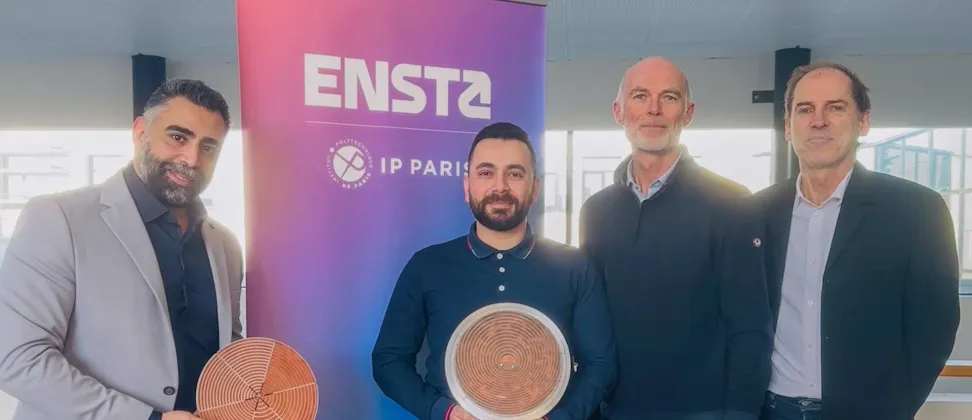
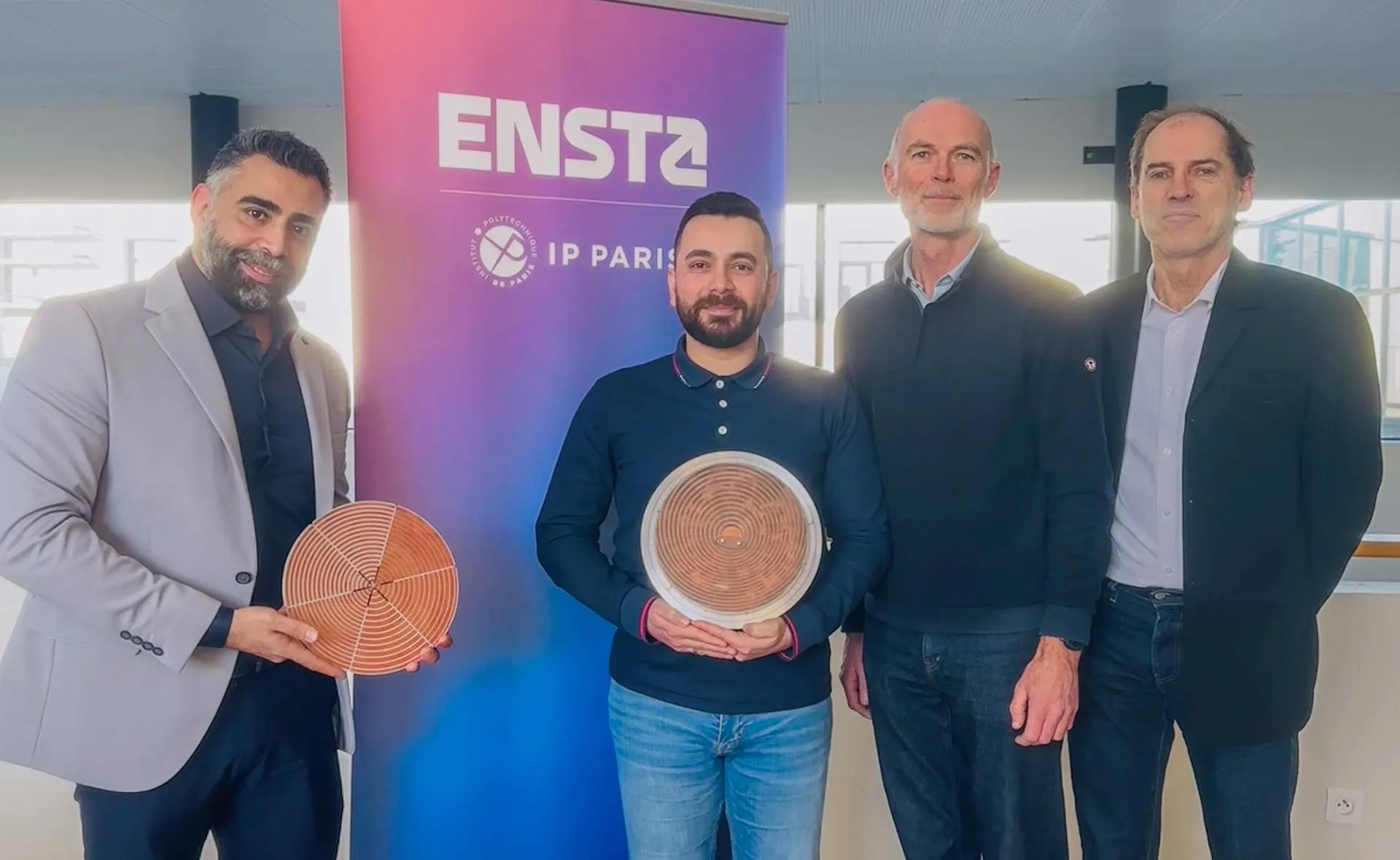
De gauche à droite, les inventeurs du système : Raafat Lababidi, Hadi Hijazi, Marc Le Roy, André Perennec (absent : Denis Le Jeune).

Une innovation technologique pour améliorer les performances : dépointage de faisceau agile, complexité minimisée et efficacité énergétique optimisée

L’innovation brevetée repose sur une antenne à ondes de fuite dont la géométrie a été entièrement repensée. Elle se présente sous la forme d’un module antennaire autonome, conçu pour en faciliter l’intégration à bord d’un satellite.

Il en découle une architecture allégée, dont deux versions ont été brevetées, permettant un dépointage continu du faisceau radio en azimut et soit continu, soit discret en élévation, grâce à un simple mécanisme de rotation, sans recours à des réseaux d’antennes complexes ni à une électronique de commande lourde. Ces versions offrent une adaptabilité optimale aux exigences spécifiques de chaque mission. Cette approche permet d’atteindre une haute efficacité énergétique de l’antenne, en limitant les pertes radio, tout en conservant d’excellentes performances.

The objective was to propose an antenna solution that is both effective and controlled, capable of meeting the constraints of modern space platforms without resorting to excessively complex and costly architectures. This approach is based on a modular antenna topology, whose characteristics can be adapted to different uses.

explain Raafat Lababidi, Lecturer-Researcher, and Hadi Hijazi, Research Engineer, at ENSTA.

Towards technological maturity

In order to continue this work and bring this innovation closer to real-world conditions, the team is now considering a maturation project. The aim is to consolidate the studies and validate the technology in order to prepare for its integration into operational systems.

Our latest news

Company | Training | Student Life
ENSTA Junior Enterprise: going further together

The Junior Enterprises of ENSTA's two historic campuses, IMPACT and TAEP, were the first student associations to merge, giving rise to a structure of excellence that reflects the quality of the education provided at Paris-Saclay and Brest. This successful...

ENSTA Junior Enterprise: going further together

The Junior Enterprises of ENSTA's two historic campuses, IMPACT and TAEP, were the first student associations to merge, giving rise to a structure of excellence that reflects the quality of the education provided at Paris-Saclay and Brest. This successful...

Training | Innovation | Research
Rozali Badaoui honored at IEEE ETECOM 2025

Rozali Badaoui's early thesis work has just been recognized with the Best Paper Award in the “Engineering Education” category at the IEEE ETECOM 2025 conference on emerging trends in engineering and computing, held in Bahrain last October.

Rozali Badaoui honored at IEEE ETECOM 2025

Rozali Badaoui's early thesis work has just been recognized with the Best Paper Award in the “Engineering Education” category at the IEEE ETECOM 2025 conference on emerging trends in engineering and computing, held in Bahrain last October.

Training | Innovation | Research
Success for the first edition of the Seas and Ocean Forum

On Tuesday, January 13, ENSTA's Paris-Saclay campus hosted the first edition of the Institut Polytechnique de Paris's Seas and Ocean Forum, which is part of the activities of the Interdisciplinary Seas and Ocean Center (CIMO). This unifying event brought...

Success for the first edition of the Seas and Ocean Forum

On Tuesday, January 13, ENSTA's Paris-Saclay campus hosted the first edition of the Institut Polytechnique de Paris's Seas and Ocean Forum, which is part of the activities of the Interdisciplinary Seas and Ocean Center (CIMO). This unifying event brought...