
Venir étudier à l'ENSTA

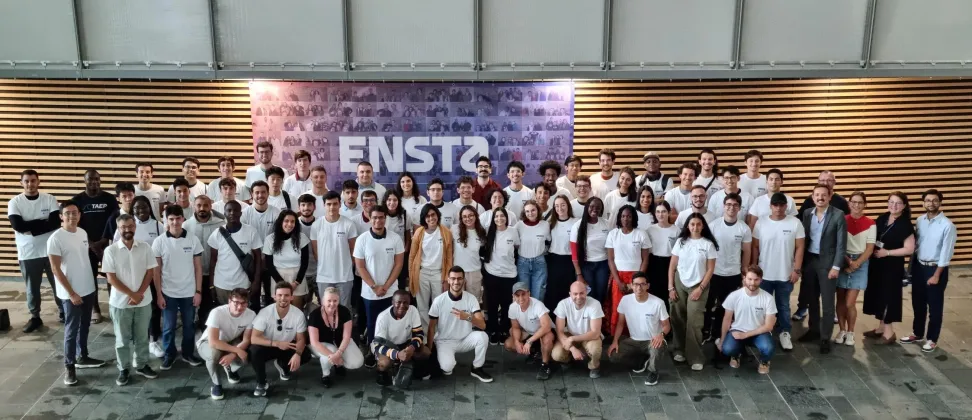
L'ENSTA, en tant que grande École d’ingénieurs, a à cœur de transmettre sa formation d’excellence aux meilleurs étudiants internationaux.
C’est pourquoi nous accueillons chaque année de nombreux étudiants venus du monde entier qui suivent les mêmes cursus que les étudiants français : formation d’ingénieurs, masters et mastères spécialisés.

En tant qu’étudiant ou étudiante titulaire d’un diplôme étranger, vous pouvez effectuer :

  • Un séjour académique diplômant
  • Un séjour en tant qu’auditeur libre à l'ENSTA (étudiant en échange)
  • Un doctorat ou un stage de recherche
    • Doctorat : Les six UFR (Unités de formation et de recherche) réparties sur nos deux campus accueillent régulièrement des élèves internationaux dans le cadre de thèses de doctorat. L'étudiant intéressé doit contacter directement le laboratoire de l’École en fonction du sujet de thèse envisagé.
    • Stages de recherche : Les étudiants et étudiantes d'universités partenaires souhaitant effectuer un stage de recherche dans un des laboratoires de l'ENSTA doivent prendre contact avec le laboratoire concerné en fonction de leur thème de recherche et remplir le formulaire de candidature des stagiaires.   

Auditeurs

Les étudiants inscrits dans une formation dans une institution partenaire avec l’ENSTA peuvent candidater pour suivre un semestre ou une année de substitution en tant qu’auditeur libre à l’ENSTA (campus de Brest ou Paris-Saclay).

Admission hors partenariat (free movers)

Les étudiants souhaitant intégrer la formation ENSTA après avoir commencé leurs études supérieures dans un établissement qui n’a pas de partenariat avec l’ENSTA peuvent postuler pour intégrer la première ou la deuxième année (selon son profil) sur dossier. Ces étudiants "admis sur titre" intégreront le cycle ingénieur de l’ENSTA et recevront leur diplôme d’ingénieur ENSTA à la fin de leur scolarité d’une durée de 2 ou 3 ans.

Admission en double diplôme

Les étudiants inscrits dans une formation dans une institution partenaire avec l’ENSTA peuvent suivre deux ans à l'ENSTA (campus de Brest ou Paris-Saclay) suite à 3 années d’études supérieures au sein de leur université d’origine.  Grâce à une prolongation de sa scolarité d’un an, l’étudiant recevra les diplômes des deux institutions à la fin du programme : ENSTA et le diplôme de son établissement d’origine.

Découvrez en détail :

Our latest news

Training | Innovation | Research
Rozali Badaoui honored at IEEE ETECOM 2025

Rozali Badaoui's early thesis work has just been recognized with the Best Paper Award in the “Engineering Education” category at the IEEE ETECOM 2025 conference on emerging trends in engineering and computing, held in Bahrain last October.
Rozali Badaoui honored at IEEE ETECOM 2025

Rozali Badaoui's early thesis work has just been recognized with the Best Paper Award in the “Engineering Education” category at the IEEE ETECOM 2025 conference on emerging trends in engineering and computing, held in Bahrain last October.

Training | Innovation | Research
Success for the first edition of the Seas and Ocean Forum

On Tuesday, January 13, ENSTA's Paris-Saclay campus hosted the first edition of the Institut Polytechnique de Paris's Seas and Ocean Forum, which is part of the activities of the Interdisciplinary Seas and Ocean Center (CIMO). This unifying event brought...

Success for the first edition of the Seas and Ocean Forum

On Tuesday, January 13, ENSTA's Paris-Saclay campus hosted the first edition of the Institut Polytechnique de Paris's Seas and Ocean Forum, which is part of the activities of the Interdisciplinary Seas and Ocean Center (CIMO). This unifying event brought...

Innovation | Research
Adnan Saood: a touch of feeling in robotics

Robots can already see, hear, and even smell, but their sense of touch remains very rudimentary and is more akin to obstacle detection than any kind of dexterity. How can this be improved? This is the focus of the thesis work of Adnan Saood, a doctoral...

Adnan Saood: a touch of feeling in robotics

Robots can already see, hear, and even smell, but their sense of touch remains very rudimentary and is more akin to obstacle detection than any kind of dexterity. How can this be improved? This is the focus of the thesis work of Adnan Saood, a doctoral...