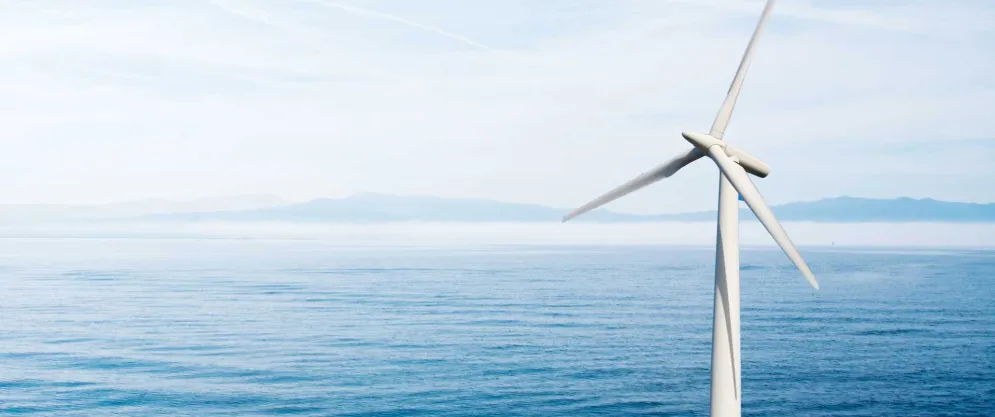
A unique, high-level program dedicated to offshore wind energy
For this program, ENSTA has partnered with the École Nationale des Ponts et Chaussées to offer a comprehensive four-semester program.
The content of the program prepares Master's graduates to meet the challenge of energy transition. To meet this challenge, France and Europe are committed to ramping up offshore wind power, which requires the training of highly qualified executives in R&D and the design of high-performance floating systems.
Objective of the program
To train operational engineers, research and development engineers, and project managers for the floating and fixed offshore wind power sector.
Year 1 (Master 1)
Semester 1:
- Mechanics for Wind Energy
- Power Electrical Engineering for renewable energy
- Waves, vibrations & Fluid-structure interactions
- Structural mechanics
- Numerical Methods for Fluids & Solids Mechanics
- Soil mechanics
Semester 2
- Reinforced and prestressed concrete
- Steel construction
- Composite materials
- Fatigue, Plasticity & FractureOffshore structures - 3 ECTS / Anglais
- Design of geotechnical structures - 3 ECTS / Anglais
- Project Demonstrators & Labs
The second semester is completed with an application project and a 12-week internship.
Year 2 (Master 2)
Semester 1:
- Waves, winds, currents, coastal circulation
- Coastal weather, bathymetry, and seabed studies
- Wake effects and loads on offshore structures
- Seaworthiness, aerodynamic and hydrodynamic loads, and instabilities
- Behavior and modeling of fixed and floating wind turbines
- Fatigue loads and tower fatigue
- Behavior, creep, and fatigue of electrical cables and anchor ropes
- Behavior and fatigue of anchors and foundations
- Aging of materials in a marine environment
- Turbine control and hydro-aerodynamic-servo-elastic coupling
- Mechanical power transmission: direct or indirect?
- In-service monitoring and diagnosis of wind turbines, AI
- Connection of the wind farm to the grid, substation, AC/DC
- Environmental and societal impacts
Semester 2
End-of-studies internship (18 semesters to 6 months)
Successful professional integration
Teaching methods combining technical skills and project management (theoretical courses, practical work, and projects) will enable you to be immediately operational upon graduation in:
- vehicle and system design,
- automotive system performance qualification,
- mechanical engineering in the broadest sense.
Graduates of this Master's program hold positions in design engineering, production engineering, business engineering, R&D, etc. This program also offers students the opportunity to pursue a PhD if they wish.
Admission requirements
To enroll in M1, you must have completed the first year of a Bachelor of Science (or equivalent) in physics or mathematics at the Institut Polytechnique de Paris or equivalent in France or abroad. Transfer pathways are possible from other more technical programs.
To enroll in M2, you must:
- Have completed the first year of a Master's degree in energy at the Institut Polytechnique de Paris or equivalent in France or abroad. Transfer pathways are possible from other more technical programs.
- Have completed the first year of a Master's or Master of Science or Master of Science and Technology in one of the following specializations: energy engineering, mechanical engineering, materials mechanics, electrical engineering, materials science.
- Transfer pathways are possible from other more technical programs.
Language requirements
A B1 level in English is required for this program.
Application procedure
Applications must be submitted online only. You will need to provide the following documents:
- Diplomas and transcripts
- Two academic references (please note that it is your responsibility to ensure that the people you designate provide their references online)
- CV
- Cover letter
- ...